A systems architect is designing a real-time, AI-driven traffic monitoring and video analytics platform for a smart city initiative. The solution must process feeds from hundreds of high-definition cameras with minimal latency, but the budget restricts the deployment of high-end, dedicated servers at every location. Which two architecture strategies will best optimize this deployment under these constraints? (Select two)
Select all correct answers, then click Submit.
Short Explanation and Infographic
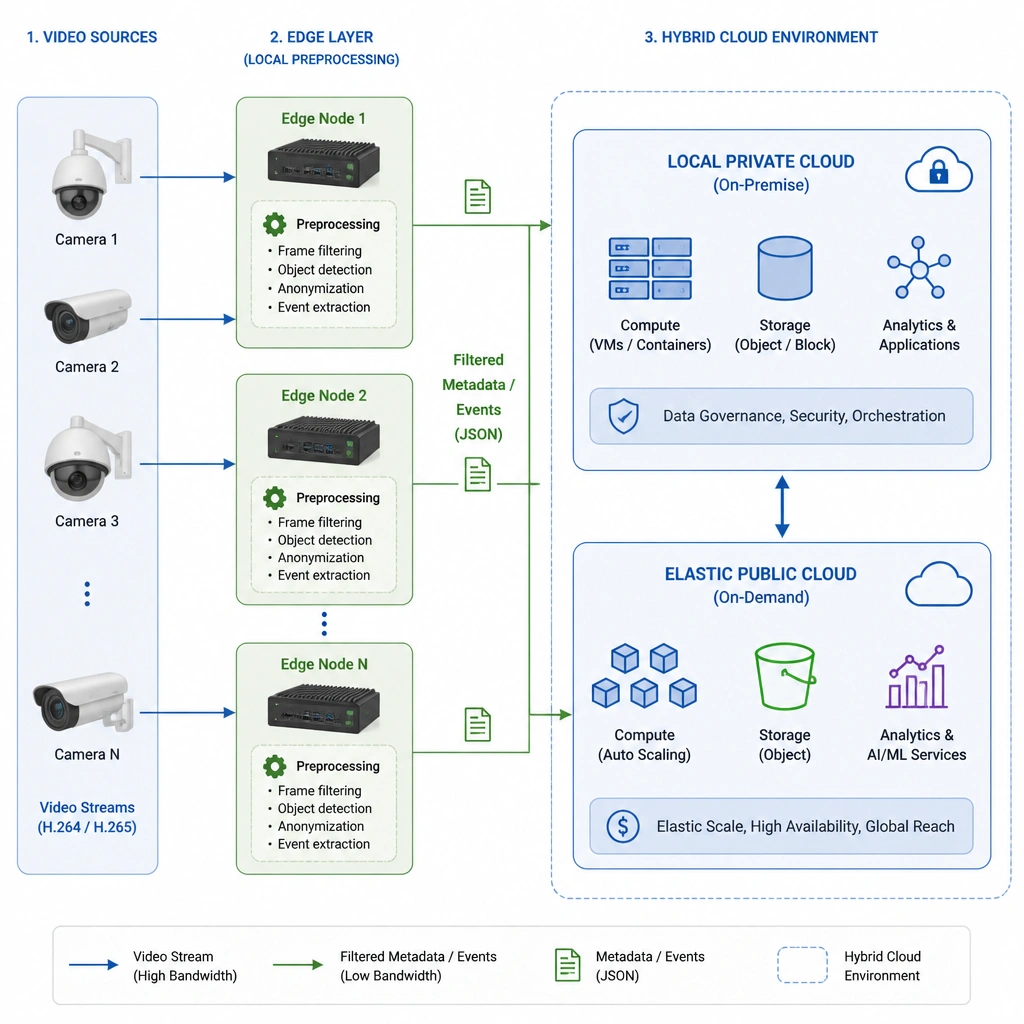
Okay, let's dive in. Picture this: your boss walks in and says you need to build a smart-city traffic monitoring system with hundreds of HD cameras, but your budget is paper-thin. You can't just throw high-end servers at every single street corner — that would break the bank! And sending all that raw video back to a central office will clog your network pipes fast. So, what do we do? First, we use edge computing. By processing the video right there near the cameras, we can filter out the noise and only send the important data down the line. Second, we roll out a hybrid cloud architecture. Use your local servers for the steady, baseline processing, and then spin up public cloud resources when traffic peaks and you need that extra muscle. This is how you build a fast, scalable system without blowing your budget!
Full explanation below image
Full Explanation
Deploying real-time AI video analytics across a wide geographical area like a smart city presents significant challenges in latency, bandwidth, and cost. - Edge computing optimizes resource usage by running initial inference and filtering (e.g., object detection, motion filtering) at the edge of the network, closer to the cameras. This dramatically reduces the volume of data that needs to be transmitted over the network and minimizes latency. - Hybrid cloud architecture provides the flexibility to handle baseline processing loads locally while leveraging the public cloud's elastic compute capacity to scale during peak demand times or for offline, intensive training and deep analytics. Together, these two strategies maximize efficiency and reduce the need for massive upfront capital expenditure on local servers. - Centralizing raw video on legacy hardware fails because legacy hardware will lack the parallel processing capacity required for real-time video analytics, and sending raw feeds centralizes a massive network bandwidth bottleneck. - Replacing AI models with CPU-bound heuristics is incorrect because simple heuristics cannot achieve the high-accuracy analytics (like license plate recognition or vehicle classification) required by smart city systems. - Disabling encryption is a major security risk and does not address the fundamental compute or bandwidth constraints of the system.