When retrofitting an existing enterprise data center or building a new facility specifically to support high-performance AI training clusters, which infrastructure challenge requires the most significant design shift compared to hosting traditional enterprise web workloads?
Select an answer to reveal the explanation.
Short Explanation and Infographic
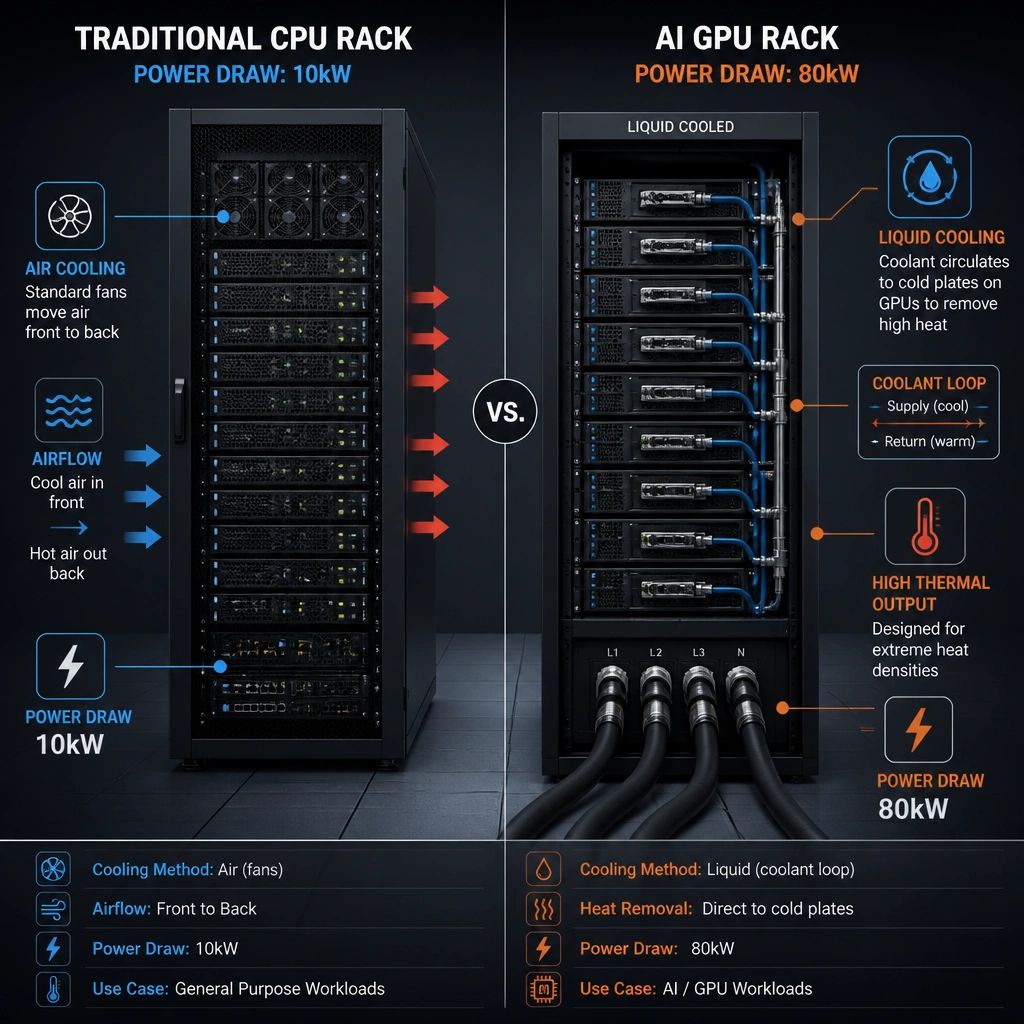
Imagine your boss walks in and says, 'Hey, we just bought ten racks of NVIDIA H100 servers, let's stack them in Server Room B.' You'd better stop him right there! Traditional data centers are built for standard CPU servers that draw maybe 5 to 10 kilowatts per rack. An AI server rack packed with high-end GPUs can easily pull 40 to 100 kilowatts! If you don't have the heavy-duty power lines to feed those power-hungry GPUs, and the advanced cooling systems (like liquid cooling) to extract that massive heat, your hardware will thermal throttle or, worse, shut down the entire room. Trust me on this: power and cooling are the absolute make-or-break factors for AI data centers.
Full explanation below image
Full Explanation
AI training workloads demand massive computational density, which translates directly to extraordinary thermal and electrical requirements. When designing or upgrading data centers for AI, architects must pivot away from legacy designs optimized for low-density CPU compute. 1. Power Density: A standard enterprise server rack typically consumes between 5 kW and 15 kW. In contrast, modern AI servers (such as NVIDIA DGX systems) packed with multiple high-power GPUs can easily push rack power requirements to 40 kW, 80 kW, or even over 100 kW per rack. The facility must be designed with robust electrical substations, uninterruptible power supplies (UPS), and power distribution units (PDUs) capable of handling this extreme density. 2. Cooling Infrastructure: Because almost all electrical energy consumed by a server is converted into heat, AI racks generate extreme thermal loads. Traditional air-cooling methods (like hot/cold aisle containment) are often insufficient for heat densities above 30-35 kW per rack. AI-optimized data centers must integrate advanced cooling solutions, such as Rear Door Heat Exchangers (RDHx) or direct-to-chip liquid cooling systems, to prevent thermal throttling and maintain hardware reliability.
Why Distractors are Incorrect: A) Maximizing the floor area dedicated to physical tape storage libraries: While high-performance storage is necessary for AI datasets, physical tape storage is a cold archive medium and does not represent the primary infrastructure challenge or design shift associated with active AI training. C) Optimizing the office spaces for on-site database administrators: Data center facilities focus on physical server infrastructure, power, and environmental controls. On-site staff office space is a minor administrative layout issue, not a technical data center design constraint for compute-heavy workloads. * D) Standardizing rack layouts on low-power, single-core CPU web servers: Standardizing on low-power, single-core CPUs is the exact opposite of what AI workloads require. AI infrastructure demands high-performance GPU accelerators and multi-core host CPUs to feed data to the GPUs.