To build a complete end-to-end AI workflow, you need to accelerate both the heavy training phase and the subsequent production serving phase. Which two components of the NVIDIA software ecosystem should you integrate to speed up deep neural network training calculations and optimize the final model for low-latency inference? (Choose two)
Select all correct answers, then click Submit.
Short Explanation and Infographic
Here's the deal: don't let all these similar-sounding NVIDIA tools trip you up. The key to answering this one correctly is matching the tool to the specific phase of your AI workflow. During the training phase, your model is doing a massive amount of matrix multiplication, convolution, and pooling. Instead of writing that low-level math yourself, you use cuDNN (Option B). It provides highly tuned GPU implementations of those neural network primitives, saving your framework tons of time during training. Once you're done training and need to deploy (or serve) the model to users, you pass it through TensorRT (Option D). TensorRT strips out unnecessary layers, optimizes memory layout, and speeds up inference so users get answers in milliseconds. Now, DeepStream (Option A) is for video analytics pipelines, DGX-1 (Option C) is actual physical server hardware, and Nsight (Option E) is for profiling. Keep cuDNN for training acceleration and TensorRT for deployment optimization, and you'll ace this topic! Let's keep rolling.
Full explanation below image
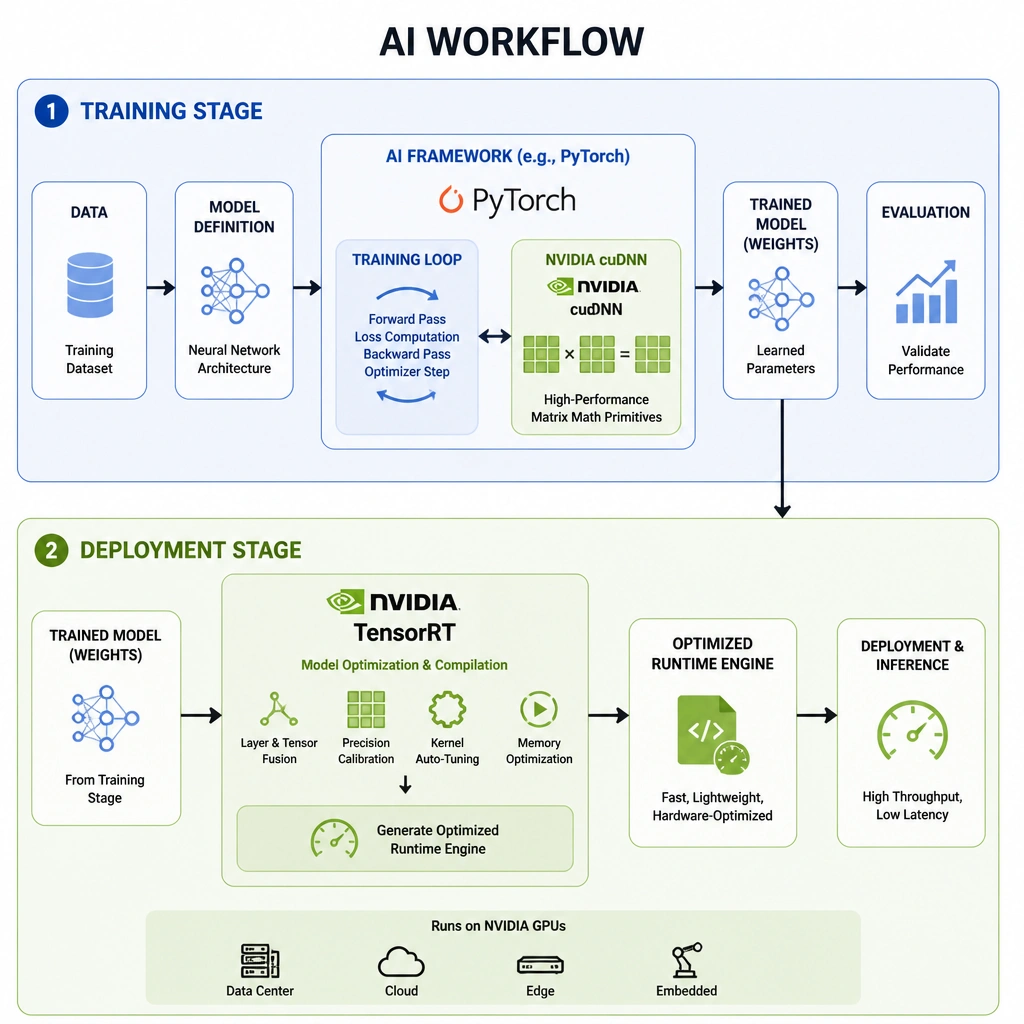
Full Explanation
Optimizing an end-to-end AI workflow requires different software acceleration libraries at different stages of the lifecycle: model training (backpropagation and forward passes) and model deployment (inference serving).
1. NVIDIA cuDNN (Option B): The CUDA Deep Neural Network library (cuDNN) is a GPU-accelerated library of primitives for deep neural networks. It provides highly tuned implementations for standard routines such as forward and backward passes for convolution, pooling, normalization, and activation layers. Deep learning frameworks like PyTorch and TensorFlow integrate cuDNN under the hood to offload these computationally heavy operations to GPU Tensor Cores, dramatically accelerating model training times. 2. NVIDIA TensorRT (Option D): Once a model is fully trained, TensorRT is used to optimize the model for inference deployment. It acts as an optimizer and runtime engine, converting the trained model into a highly efficient execution format. TensorRT achieves this through precision calibration (reducing precision to FP16 or INT8), layer and tensor fusion (combining operations to reduce memory transfers), and kernel auto-tuning. This ensures the deployed model achieves the lowest possible latency and maximum throughput.
Analyzing the incorrect options: - Option A (NVIDIA DeepStream SDK) is a streaming analytics toolkit built for multi-sensor processing, video, and audio understanding. It is a high-level application framework rather than a core library for general model training or optimization. - Option C (NVIDIA DGX-1) is a physical, turnkey AI supercomputer hardware platform, not a software library or component of the software stack. - Option E (NVIDIA Nsight) is a developer suite of profiling and debugging tools used to analyze application performance, not to directly execute or accelerate training or inference runtimes.
Consequently, cuDNN accelerates the mathematical calculations during the training phase, while TensorRT optimizes the model for the deployment phase.