When designing an enterprise AI development and deployment environment, you must build on top of NVIDIA's core software stack. Which two software components are essential for compiling GPU-accelerated code and optimizing deep learning models for high-performance inference? (Select two)
Select all correct answers, then click Submit.
Short Explanation and Infographic
Check this out: the NVIDIA software stack can look like an alphabet soup of different SDKs and tools, but you need to focus on the absolute essentials for AI operations. First, you've got to have the CUDA Toolkit (Option B). That's the bedrock. Without CUDA, your development frameworks like PyTorch or TensorFlow can't talk to the GPU hardware to compile and run your code. Second, once you've trained your model, you need it to run as fast as possible in production. That's where TensorRT (Option D) comes into play. It optimizes the model by fusing layers and quantizing math, making inference run at blazing speeds. Now, look at the others: GameWorks (Option A) is for video game developers, JetPack (Option C) is for edge hardware like Jetson, and Nsight Systems (Option E) is a profiling tool to find bottlenecks. They are nice to have for their specific jobs, but CUDA and TensorRT are the core essentials for your AI pipeline. Got it? Let's keep rolling.
Full explanation below image
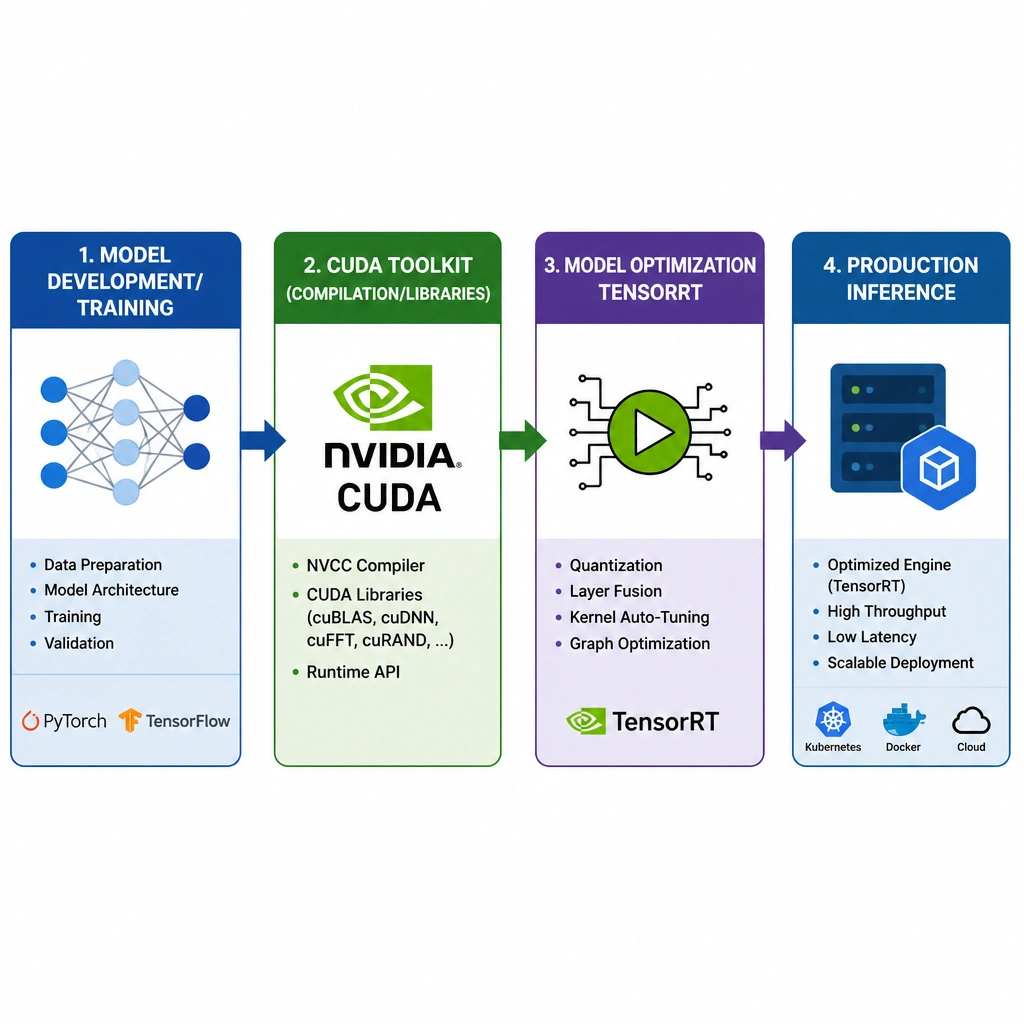
Full Explanation
The NVIDIA software stack contains layers ranging from drivers and low-level programming models to developer tools and high-level libraries. In an AI development and deployment pipeline, two components are fundamental:
1. NVIDIA CUDA Toolkit (Option B): This is the foundational parallel computing platform and programming model for NVIDIA GPUs. It includes compilers (nvcc), libraries (such as cuBLAS and cuDNN), debugging tools, and the runtime environment. The CUDA Toolkit enables deep learning frameworks to execute complex mathematical operations in parallel across thousands of GPU cores, making it essential for the development and training phases of the AI lifecycle. 2. NVIDIA TensorRT (Option D): This is an SDK for high-performance deep learning inference. It includes a deep learning inference optimizer and runtime that delivers low latency and high throughput. TensorRT optimizes trained models by performing layer and tensor fusion, kernel tuning, and precision calibration (e.g., converting FP32 models to FP16 or INT8). This is critical for maximizing performance during the deployment (inference) phase on enterprise GPU hardware.
Evaluating the other options: - Option A (NVIDIA GameWorks) is a suite of graphics and simulation technologies designed for game developers to build visual effects in gaming applications, not for enterprise AI workloads. - Option C (NVIDIA JetPack SDK) is a specialized software bundle designed specifically for NVIDIA Jetson embedded edge modules, rather than general data center AI pipelines. - Option E (NVIDIA Nsight Systems) is a system-wide performance profiling tool. While extremely useful for identifying CPU/GPU bottlenecks, it is an analytical utility rather than a core functional component for compiling and executing AI workloads.
Thus, the CUDA Toolkit and TensorRT represent the core functional pillars of the NVIDIA AI software stack.