
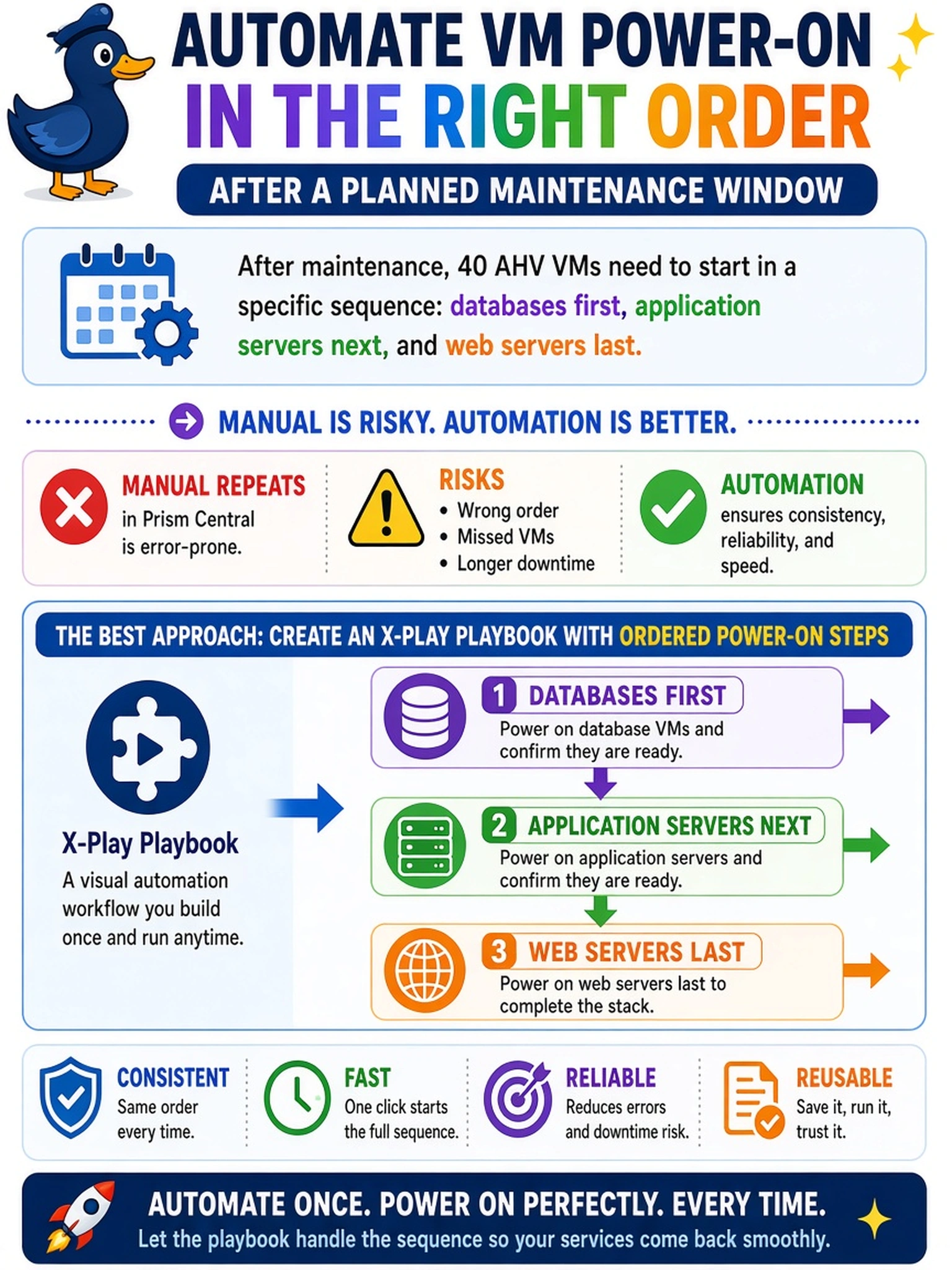
After a planned maintenance window, you must power on 40 AHV VMs so databases start first, application servers next, and web servers last. Repeating the action manually in Prism Central is error-prone. Which approach best automates the sequence?
Select an answer to reveal the explanation.
Short Explanation
Think of X-Play like a checklist robot: you set the order once, then it walks the rows for you. If you fire all 40 VMs at once, your web tier can wake up before its database is ready. That's the trap — bulk action is fast, but it isn't sequencing.
Full Explanation
X-Play is the right choice because it turns a repeatable operational task into an ordered, reusable playbook. You define the VM tasks, add sequencing such as start databases first, wait for a power state, then start application and web tiers. This removes manual clicks and makes the same runbook usable after every maintenance window. A bulk power-on action is wrong because it treats all VMs as independent and does not enforce dependency order, so services may boot before their prerequisites. A simple API loop is also wrong for this requirement: although the REST API can power on VMs, a loop by itself does not provide the built-in sequencing and wait workflow needed for a controlled startup unless you write and maintain custom orchestration logic. Alert-based notification is wrong because it still asks people to perform repeated manual actions and cannot guarantee that each tier waits for the previous tier. Exam caveat: choose the feature that provides the workflow, not just the transport mechanism; APIs are useful when no packaged automation exists. Operational check: create the playbook in a non-production VM group, add a power-state check or delay between tiers, and execute it once before scheduling it for production maintenance.