
An administrator is forecasting runway for a growing Nutanix AHV cluster. Raw data is increasing slowly, but the number of managed disks and VMs is climbing. Which factor should be included in the capacity model?
Select an answer to reveal the explanation.
Short Explanation
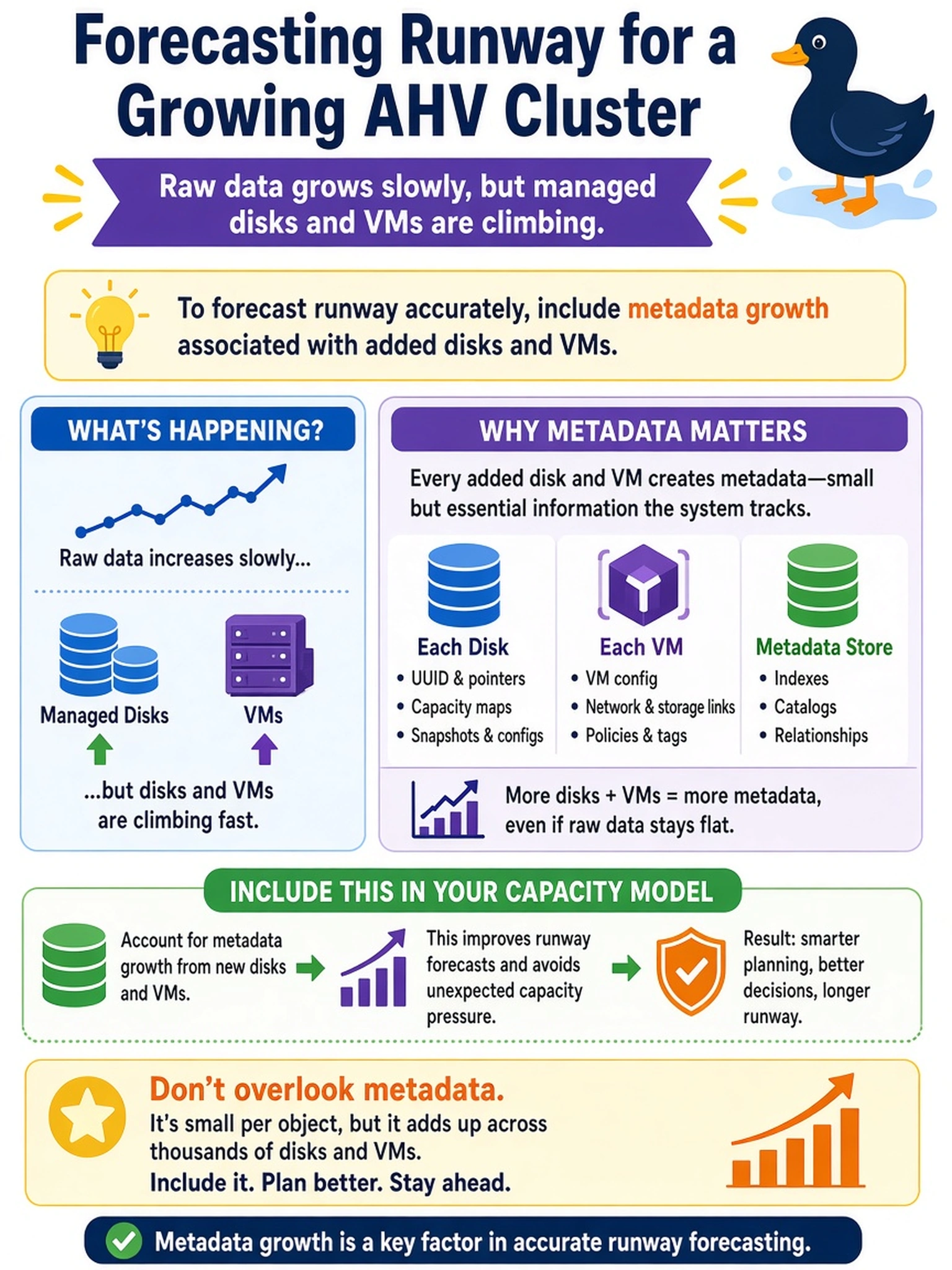
Think of metadata like the index at the back of a growing book: as you add more chapters, the index gets thicker even if the story barely changes. So when you forecast runway, don't just track raw data—count the disks and VMs that create more metadata. If you ignore that growth, your usable capacity will disappear before your raw data does.
Full Explanation
Metadata capacity planning tracks the space consumed by cluster and workload bookkeeping, not just the bytes written to VM disks. As the estate grows, more managed disks and VMs create more objects whose descriptors, placement records, and related bookkeeping must be stored, so runway forecasts should project that overhead from the expected increase in disks and VMs rather than treating it as static. A forecast that models metadata as fixed per-node overhead independent of disk and VM count misses the driver of growth: object count changes with expansion, even when node count is unchanged. A forecast that ties metadata consumption only to snapshots or replication is also wrong because protection features add metadata, but baseline metadata can rise from ordinary workload and disk inventory growth. A forecast that uses average VM disk usage while ignoring changes in object count treats metadata as proportional to data volume, which fails when VMs are numerous, thin, or changing in disk count. Exam caveat: capacity runway must separate raw data growth from overhead growth, including metadata, because usable capacity can exhaust before raw capacity. Operational check: review current metadata or object-count trends in Prism, then extrapolate them against projected disk and VM additions before approving new workloads.