
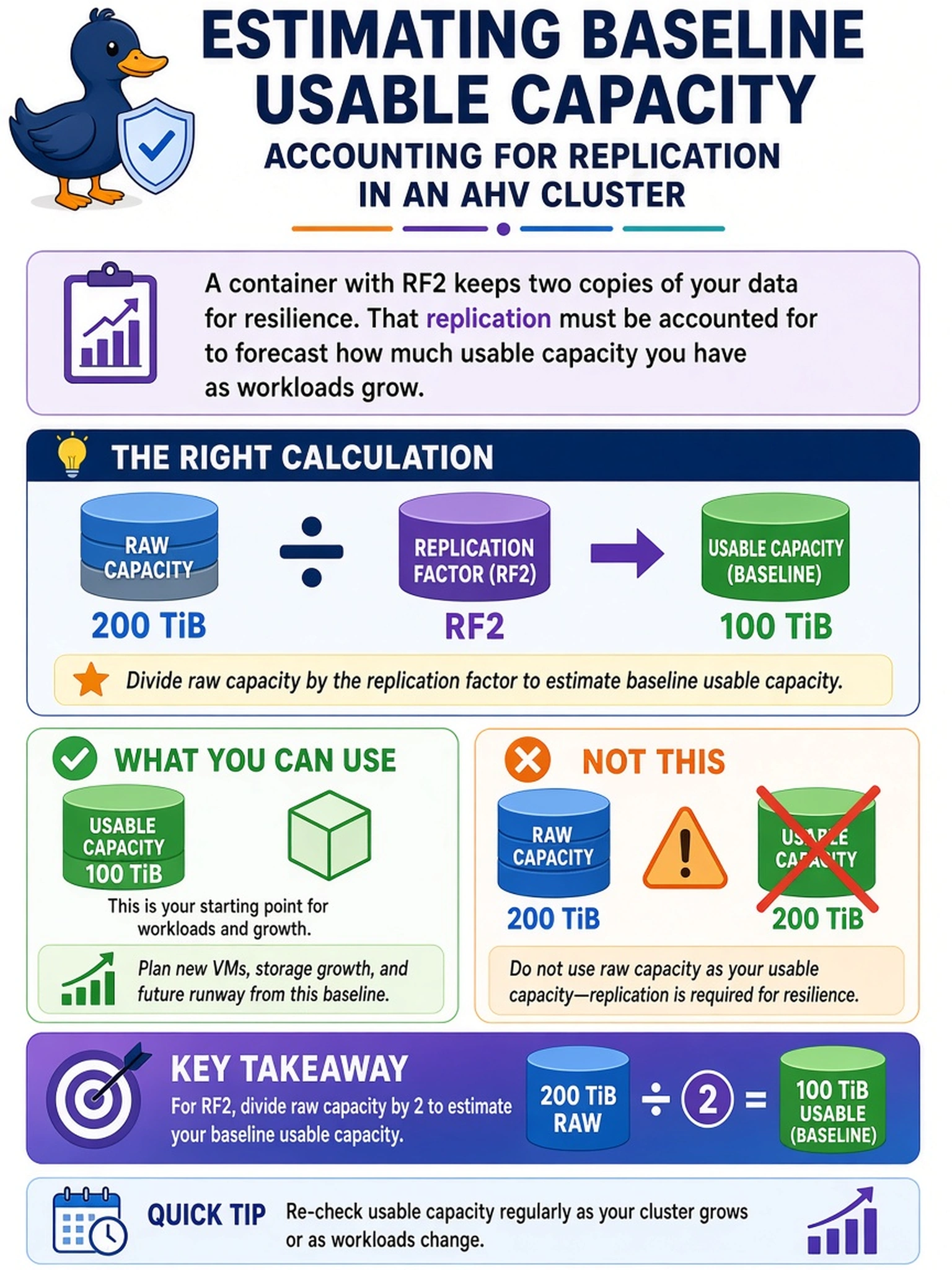
A Nutanix AHV cluster stores production VMs in a container configured with RF2. The container reports 200 TiB raw capacity, and workloads are growing. An admin forecasts runway and must account for replication. Which calculation should the admin use to estimate baseline usable capacity?
Select an answer to reveal the explanation.
Short Explanation
Think of RF2 like making two copies of every block: your raw capacity is the library shelf, but usable space is half that shelf. If you forecast runway without dividing by RF, you’ll look healthy today and run out tomorrow. Always plan on the usable number, not the raw number.
Full Explanation
Baseline usable capacity on a Nutanix cluster is derived from raw capacity adjusted for data protection overhead. With replication factor 2, each written block is stored twice, so the first-order calculation divides raw capacity by two before comparing consumed capacity to growth forecasts. This gives the capacity that can actually hold application data under the current protection policy, while still leaving room to consider metadata, snapshots, and compression separately. Snapshot retention is a consumption factor, not the definition of usable capacity, because retention can change and consumes space after data is written. Node count does not determine usable capacity directly; raw capacity already reflects disks, while RF and efficiency determine how much of that raw pool is available. Compression savings are opportunistic and workload dependent, so adding them to raw capacity overstates runway unless a verified efficiency ratio is deliberately modeled. Exam caveat: distinguish raw, usable, and effective capacity, and do not treat efficiency ratios as guaranteed. Operational check: compare the container's raw capacity, configured RF, and used capacity, then confirm the forecasted free space is based on raw divided by RF rather than raw alone.