
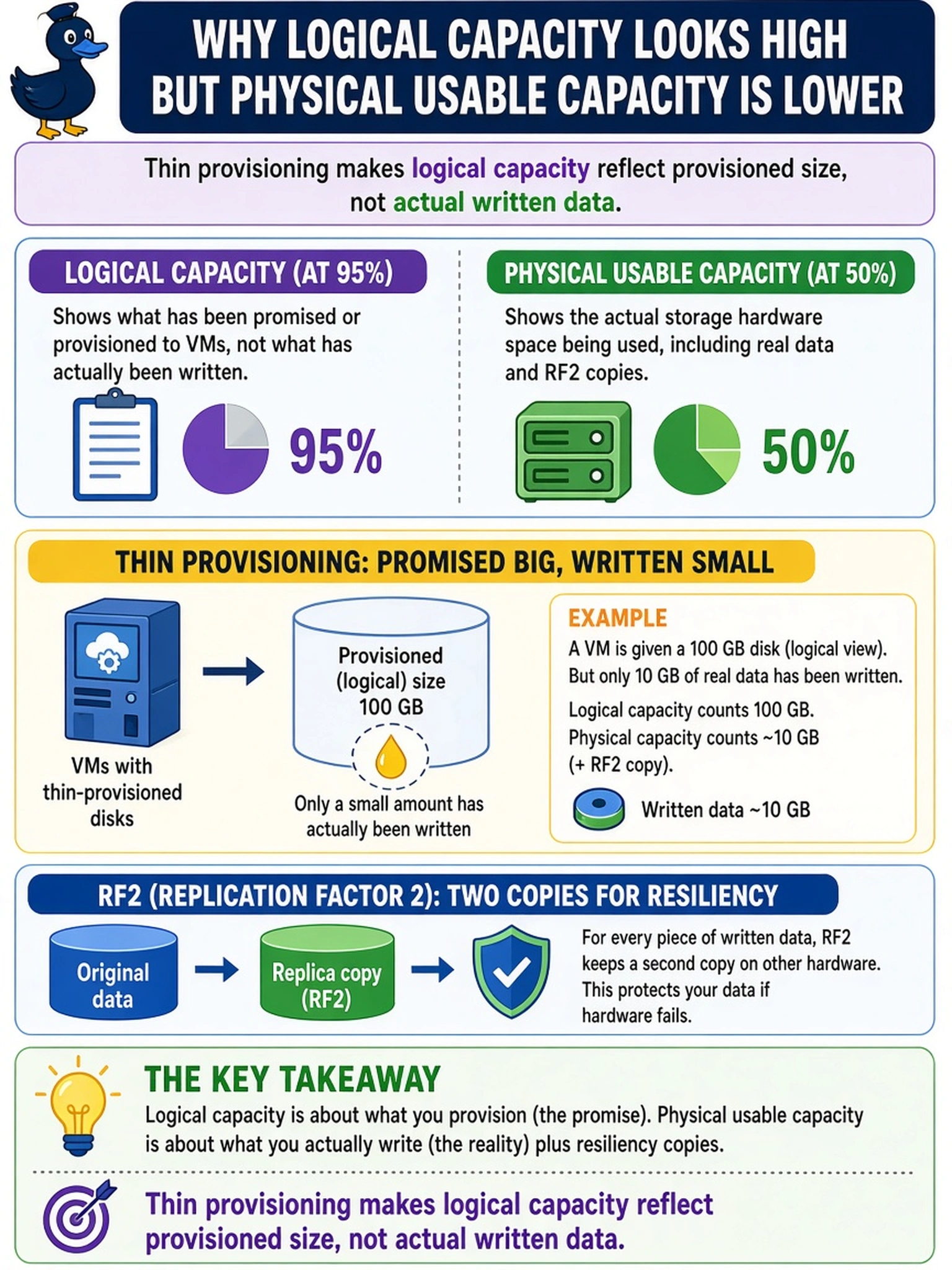
A Prism Central capacity view shows logical capacity consumption at 95% while physical usable capacity consumption is only 50%. The VMs use thin-provisioned disks and RF2. Which statement explains the difference?
Select an answer to reveal the explanation.
Short Explanation
Think of logical capacity like the total square footage you promised tenants, while physical usable capacity is the actual floor space you can build. You can overbook the promise, but the building still has only so many real square feet. That thin-provisioning gap is what you are seeing.
Full Explanation
Thin provisioning lets the virtual disk size presented to a workload differ from the physical space the workload consumes. Nutanix logical capacity is based on provisioned disk sizes, so a cluster can look logically full while the underlying physical usable capacity remains lower because only written data has been committed. Physical usable capacity also reflects cluster overhead and data protection, such as replication factor, so it is the practical measure for expansion decisions. The claim that RF2 and thin provisioning duplicate every provisioned byte is wrong because replication operates on written data blocks, not on the entire provisioned virtual disk. The claim that snapshots and metadata make logical capacity always exceed physical usable capacity is wrong because capacity relationships depend on provisioning, data reduction, snapshots, and RF, not on snapshots alone. The claim that logical capacity is calculated after compression and deduplication is wrong because logical capacity is the provisioned footprint, while data reduction affects physical capacity consumption. Exam caveat: distinguish provisioned or logical capacity from physical usable capacity before declaring a cluster out of space. Operational check: compare provisioned disk sizes with actual written data, snapshots, RF, and available physical capacity in Prism Central capacity trends.