
During business hours, Prism shows AHV hosts with high CPU oversubscription while storage and network metrics remain normal. Users report slow VM response. What should you expect?
Select an answer to reveal the explanation.
Short Explanation
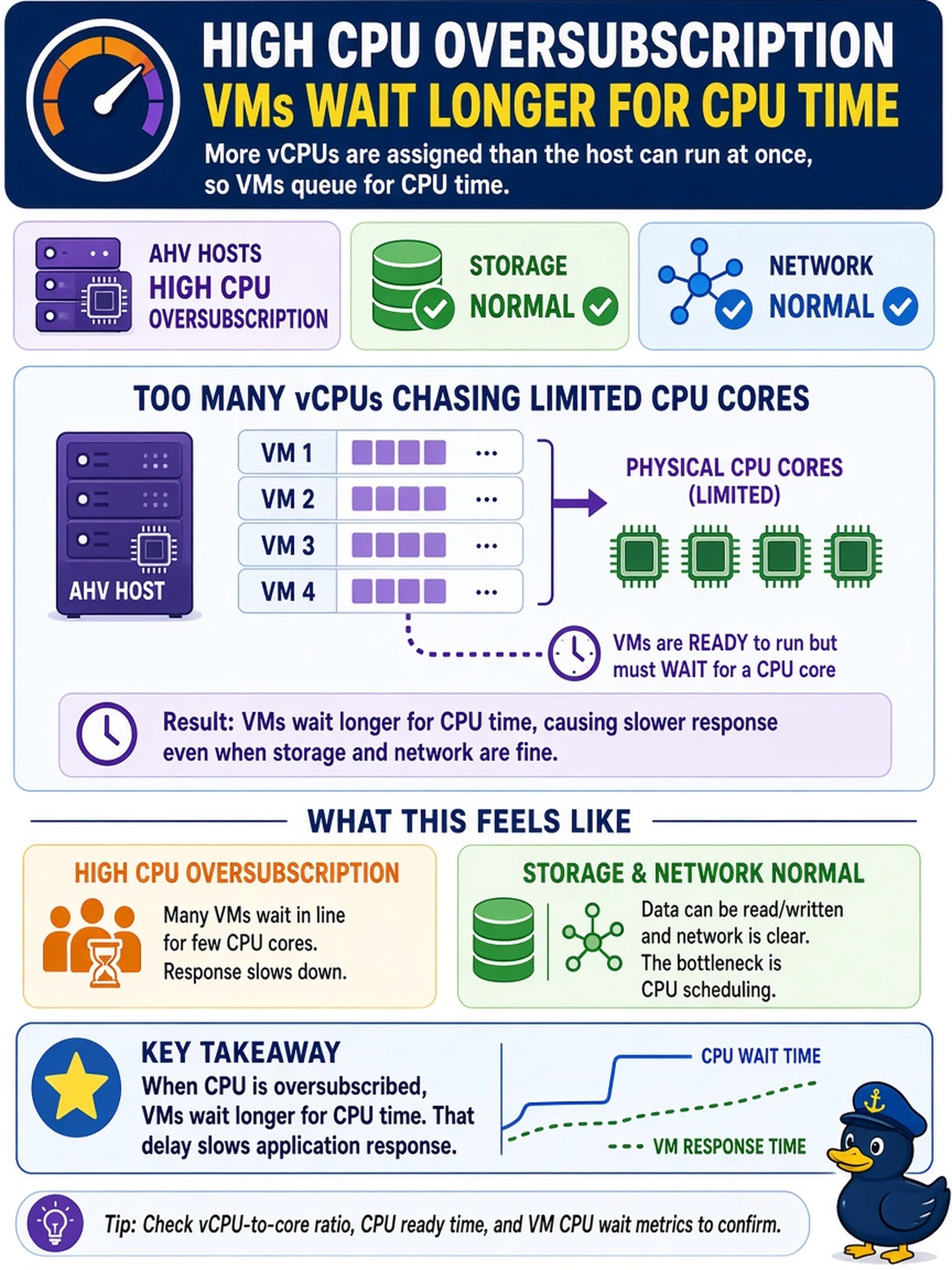
Think of CPU oversubscription like too many drivers on one highway: the road isn't broken, cars are just queued. When your AHV hosts are oversubscribed, you'll see VMs wait longer for CPU time, so response slows even if storage and network look fine. Don't chase CVM or OVS symptoms when the scheduler is the real traffic jam.
Full Explanation
CPU oversubscription occurs when aggregate vCPU demand across AHV VMs exceeds the physical CPU cycles available to a host. The hypervisor then time-slices CPUs, so VMs spend more time waiting to be scheduled rather than executing instructions. That scheduler wait shows up as higher guest latency and slower application response, even when storage, network, and memory subsystems are healthy. A storage queue explanation is wrong because normal storage metrics and no reported I/O latency do not indicate CVM queues filling; storage saturation would show high latency, queue depth, or IOPS pressure. A network explanation is wrong because OVS flow table overflow would produce packet drops, throughput loss, or connectivity errors, not CPU scheduling wait. A memory ballooning explanation is wrong because ballooning is triggered by guest memory pressure and appears as balloon driver activity, not by CPU oversubscription alone. Exam caveat: treat CPU oversubscription as a capacity and scheduling signal, not a blanket explanation for every performance symptom. Operational check: compare aggregate vCPU demand to physical cores on affected AHV hosts during peak and review CPU ready or CPU contention metrics for slow VMs.