
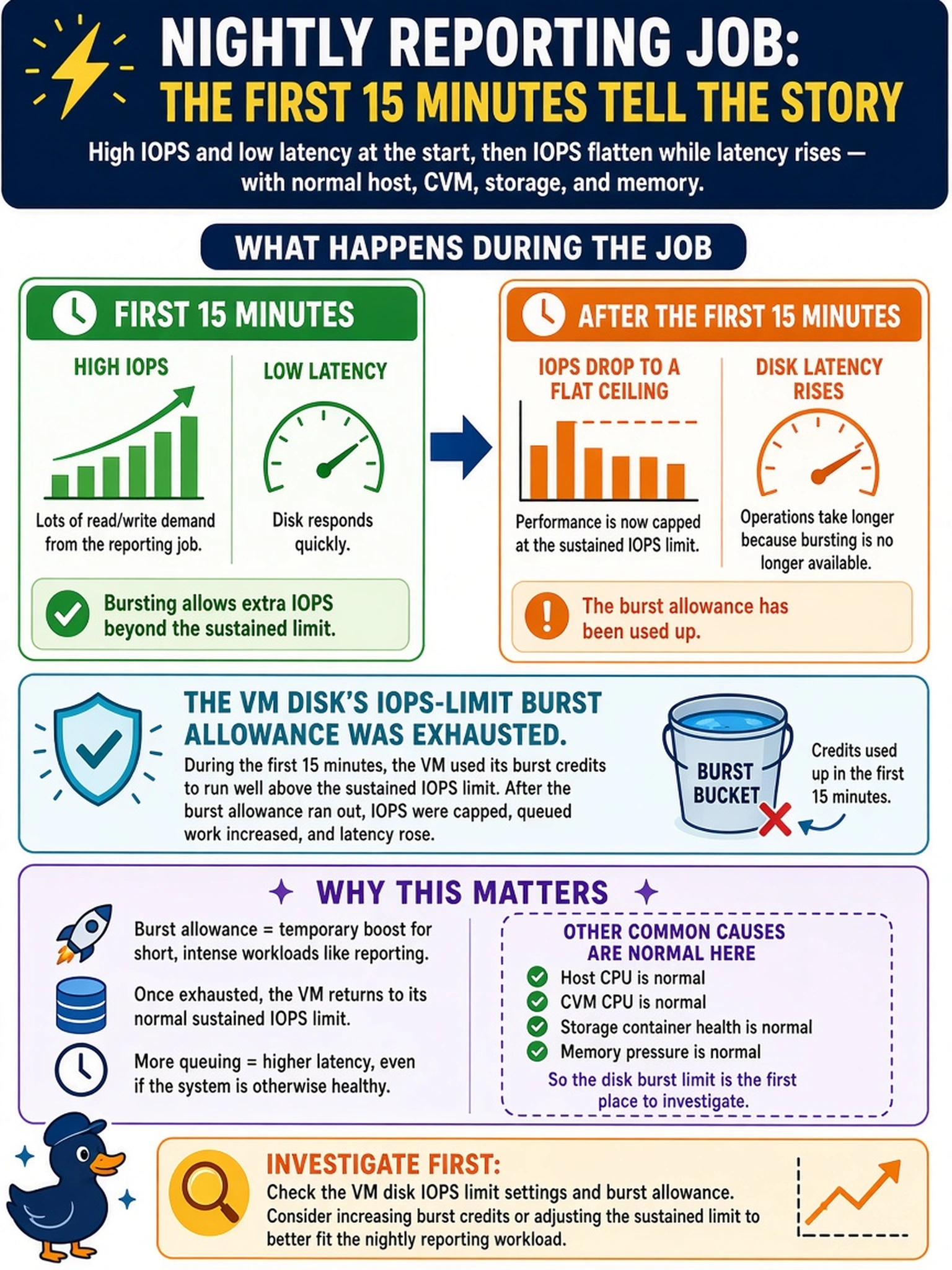
During the first 15 minutes of a nightly reporting job, an AHV VM shows high IOPS and low latency. After that window, IOPS drop to a flat ceiling and disk latency rises, while host CPU, CVM CPU, storage container health, and memory pressure remain normal. Which cause should you investigate first?
Select an answer to reveal the explanation.
Short Explanation
Think of a burst allowance like a credit card: you can spend fast, then the limit kicks in. If your VM was cruising and then flattens out, ask whether it burned through its IOPS-limit burst and got throttled. Don't chase host CPU or storage health when the performance curve looks like a hard ceiling.
Full Explanation
In Nutanix disk IOPS limits, a configured limit can include a burst allowance: a VM may exceed the sustained limit for a short period, then the platform throttles it back to the configured ceiling. That pattern explains strong early performance followed by a flat IOPS line and rising latency while host and storage remain healthy. A CVM CPU bottleneck would usually show broader CVM CPU contention and often affect other VMs or I/O paths, not just one VM after a fixed burst window. A higher replication factor changes redundancy and write amplification, so it would affect capacity, write latency, or space usage more broadly rather than creating a temporary burst ceiling. A working set that outgrows memory increases cache misses and disk reads, but that degradation is tied to data set size and cache hit ratios, not a sudden transition after an initial burst. Exam caveat: burst behavior appears as throttling to a limit, so distinguish a configured QoS ceiling from genuine resource contention. Operational check: inspect the VM disk performance metrics for IOPS limit or burst settings and compare the IOPS ceiling against the configured limit during the degraded period.