
An NCC health check on a four-node AHV cluster reports a Zookeeper quorum issue. While troubleshooting, you need to explain why this matters. Which Nutanix capability is most directly affected by the failed quorum?
Select an answer to reveal the explanation.
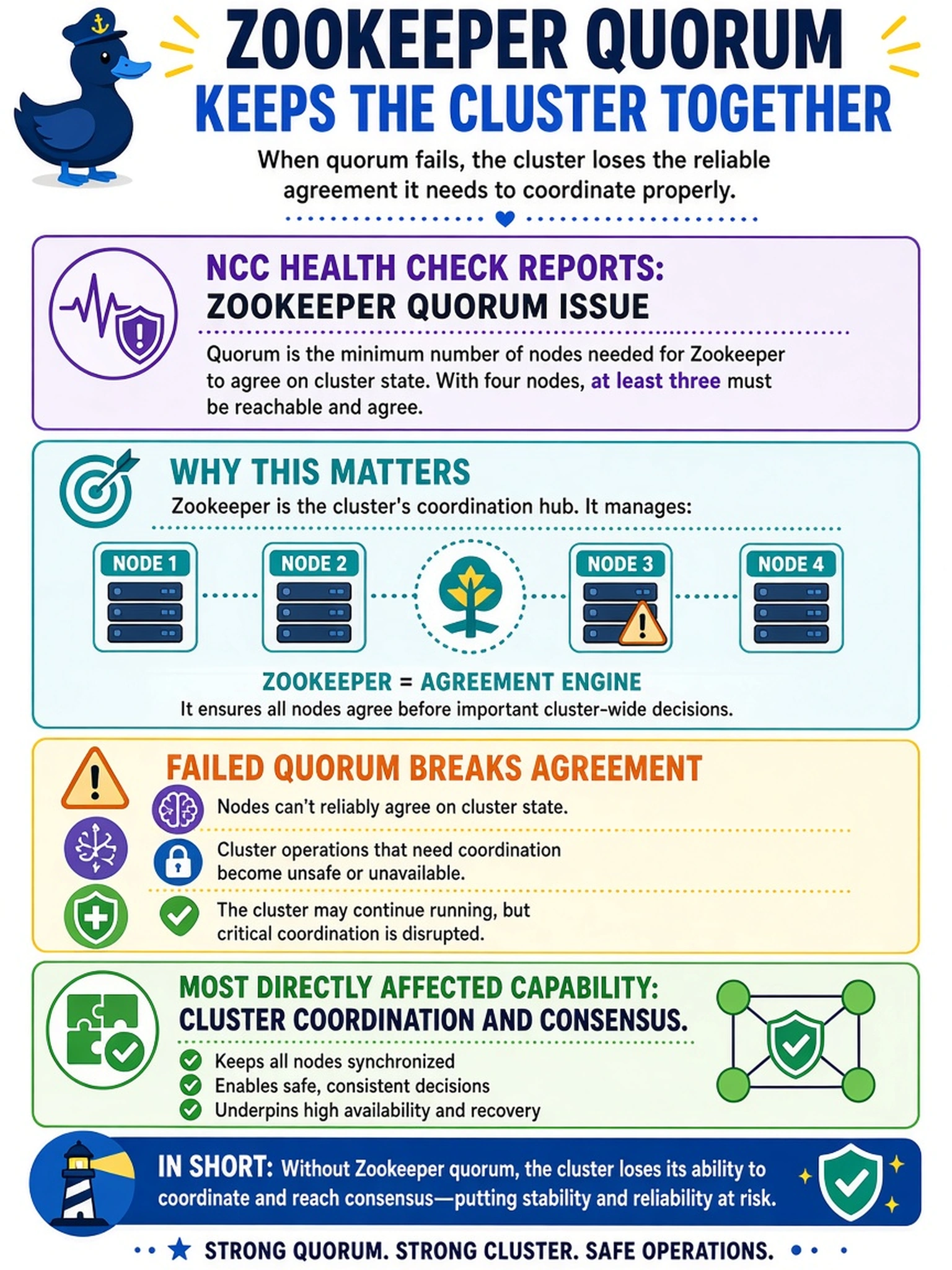
Short Explanation
Think of ZooKeeper like the meeting minutes and gavel for a distributed team: everyone agrees who leads and who's still in the room. If quorum breaks, that coordination and consensus stop working, not your compression or snapshots. So when NCC flags a Zookeeper quorum issue, you chase the cluster's agreement service, not the data path.
Full Explanation
ZooKeeper is the distributed coordination service that Nutanix uses for consensus, leader election, membership, and configuration synchronization among cluster components. A quorum failure means a majority of ZooKeeper ensemble members cannot agree, so services that rely on coordinated state may stall or become unavailable. When NCC reports this, the investigation focuses on CVM/ZooKeeper process health, node reachability, and ensemble membership rather than data protection or storage reduction features. Distributed storage compression and deduplication are Curator and storage data-reduction functions, not ZooKeeper consensus. Network packet filtering and microsegmentation policy enforcement belong to Flow networking and security policy processing, not distributed coordination. Snapshot retention and recovery plan orchestration are data-protection and Prism control-plane features, not the consensus layer used to coordinate cluster state. Exam caveat: do not confuse a ZooKeeper quorum alert with a Cassandra or Stargate outage; each service has a different role in cluster operation. Operational check: verify ZooKeeper process status, quorum membership, and inter-node connectivity on the cluster before escalating to Nutanix Support.