
During a planned hardware replacement, several AHV nodes will reboot and temporarily report node-down events. You must avoid paging the operations team while still preserving normal alerting after the window closes. What should you do?
Select an answer to reveal the explanation.
Short Explanation
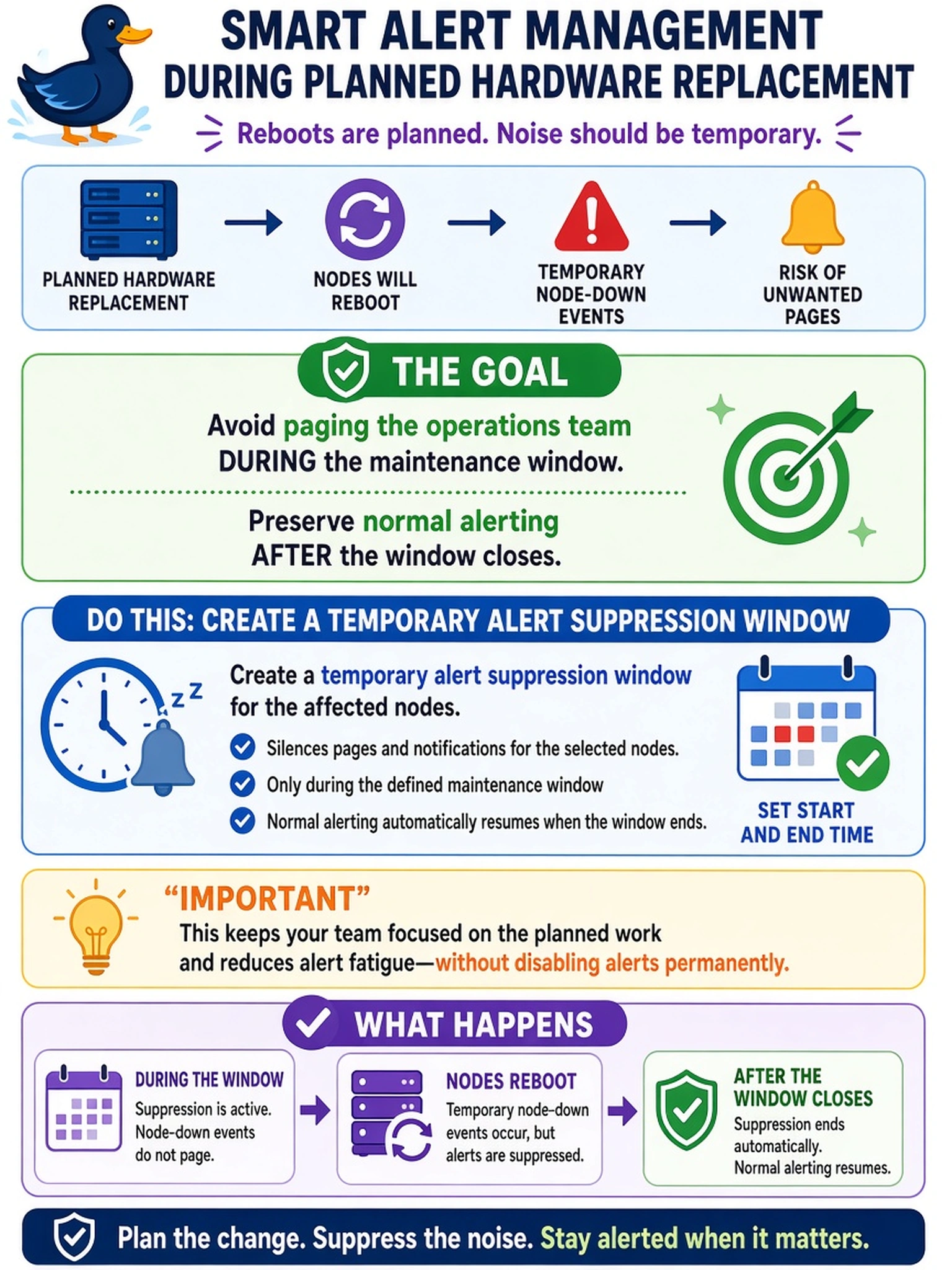
Think of maintenance alerts like a doorbell during a planned power outage: you don't unplug the whole security system, you just silence the chime for a while. You would suppress the known node-down alerts for that window, then let normal detection resume. If you disable health checks, you blind yourself to real trouble while the crew is still working.
Full Explanation
Temporary alert suppression is the intended control for a known maintenance event. It applies a bounded exception to alerting for selected nodes or alerts while the underlying monitoring and health-check engine continues to collect state. When the window expires, normal alert generation resumes, so operators still receive unexpected failures and the maintenance exception is auditable as a deliberate, time-limited action. Disabling NCC health checks removes the diagnostic baseline during the exact period when failures may be introduced, so a genuine CVM, storage, or network fault could be missed and the cluster may later need revalidation. Raising alert severity thresholds is a blunt tuning change that can suppress unrelated high-severity symptoms and does not target a known maintenance condition. Deleting and recreating an alert policy creates an unmanaged gap, may discard policy history or subscriptions, and leaves recovery dependent on manual restoration. Exam caveat: if the exam uses vendor wording such as maintenance mode or suppression, choose the bounded, reversible option over any permanent or cluster-wide monitoring change. Operational check: confirm the suppression scope, start and end time, and post-window alert state before approving the maintenance plan.