
A Nutanix cluster raises an alert stating that a disk has failed and data resiliency is at risk. How should an administrator classify this alert, and why?
Select an answer to reveal the explanation.
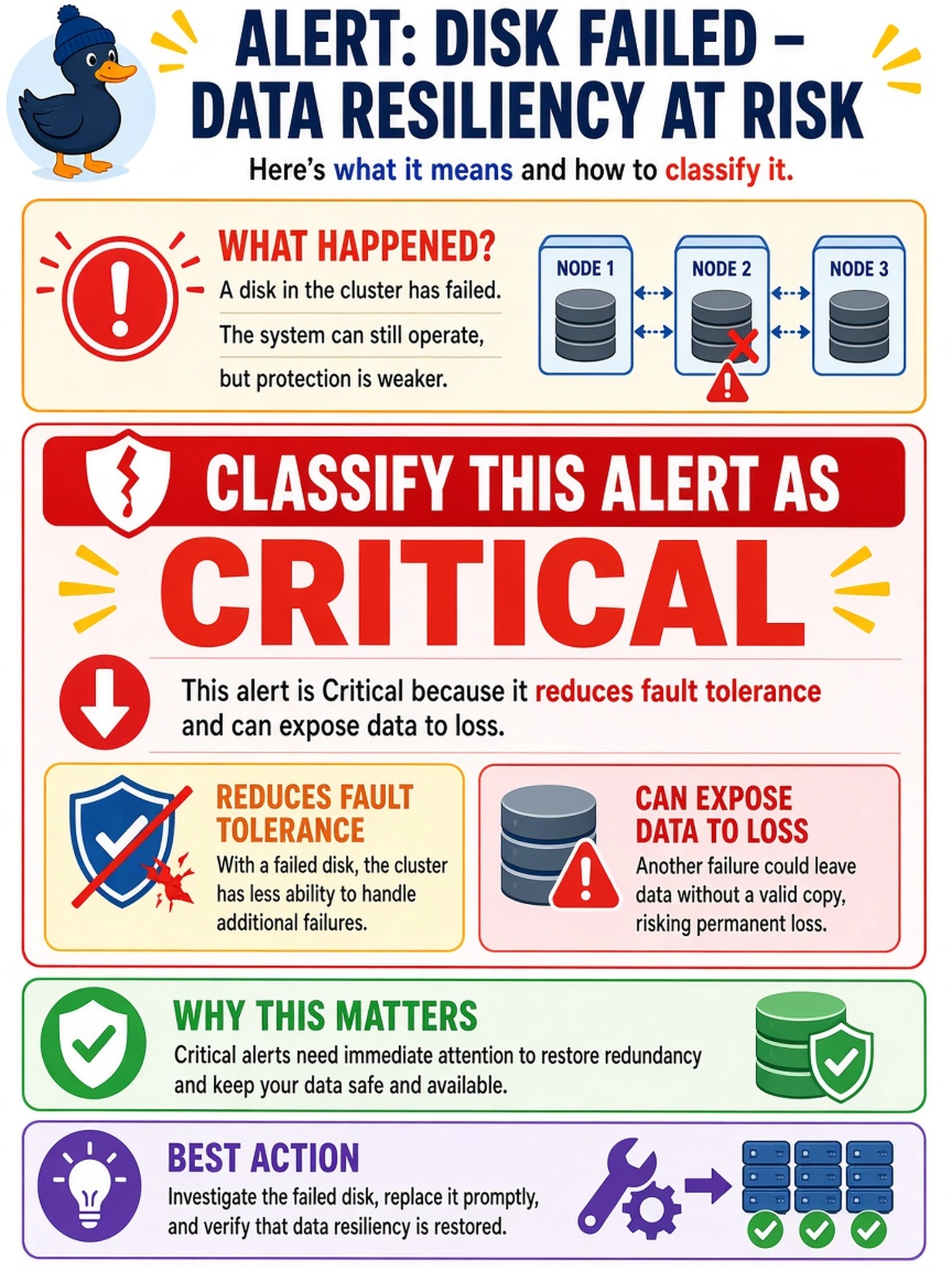
Short Explanation
Think of a disk down alert like losing one tire on a truck that is already carrying a load: you can still move, but you have no margin left. That is why you treat it as critical, because another failure can turn a degraded cluster into a data-loss event. Do not wait for a second component to fail before escalating.
Full Explanation
Disk down alerts are classified as critical because a failed disk removes a replica or erasure-coded shard from the protection domain and reduces the cluster's fault tolerance. While AHV and CVM services may continue serving I/O from remaining replicas, the cluster no longer has the same tolerance for a second failure, so the risk is data availability and durability rather than merely performance or capacity. Warning-level alerts generally describe conditions that require attention but do not immediately endanger data, such as capacity approaching a threshold or a non-redundant service degradation that has not yet affected protected data. Informational alerts are status notices that do not require urgent remediation, and they are inappropriate for a failed disk because administrator action is needed to restore resiliency. A warning based on continued I/O is also incorrect because availability can persist only while the remaining fault domain is intact, and Curator rebuilds data in the background without eliminating the elevated risk during the rebuild window. Exam caveat: classify by the impact on data protection and fault tolerance, not by whether the cluster is still responsive. Operational check: confirm the failed disk event in Prism alerts, identify the affected node and disk, and validate that the protection domain or container is rebuilding before closing the incident.