
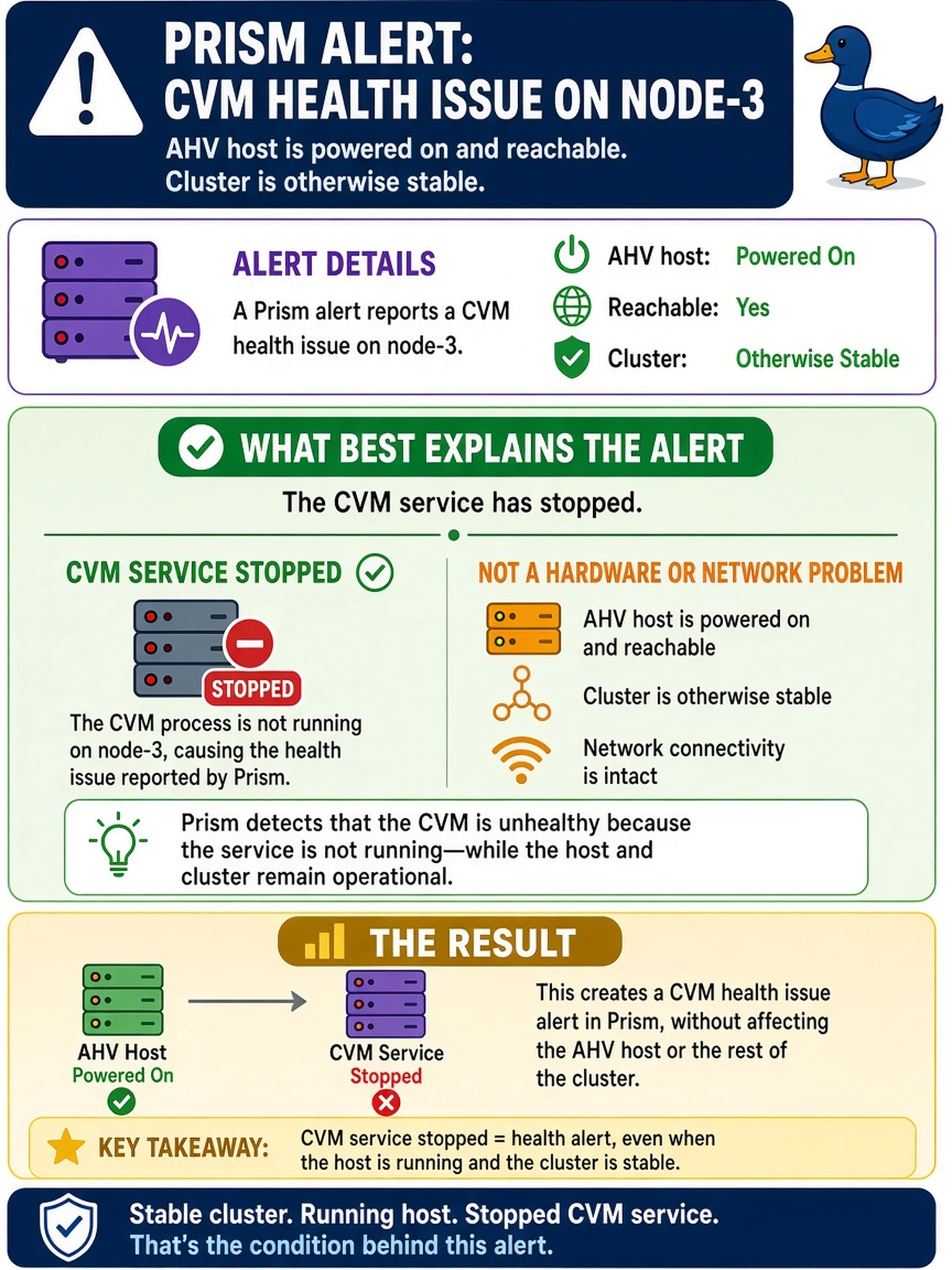
A Prism alert reports a CVM health issue on node-3, while the AHV host remains powered on and reachable. The cluster is otherwise stable, and the CVM process is not running on that node. Which condition best explains the alert?
Select an answer to reveal the explanation.
Short Explanation
Think of it like a house where the power is on but the furnace has quit; the host is alive, but the CVM service is not. You don't blame CPU pressure when the process itself is absent. Check the CVM health first, then look around it.
Full Explanation
In Nutanix AHV, the Controller VM provides cluster services such as storage and management, so an alert tied to CVM health points to the CVM itself when the host remains powered on and reachable. A stopped CVM process can trigger health and monitoring events even though hypervisor connectivity is intact. Sustained CPU pressure from VM contention may degrade performance and generate resource alerts, but it does not by itself indicate that the CVM process has stopped. A management VLAN routing problem can make a CVM unreachable from Prism or prevent normal management traffic, yet the alert condition described is the absence of the running CVM process, not a path failure. Curator-driven rebuilds occur after storage failures or data imbalance and can create capacity or I/O events, but they are not the primary explanation when the CVM service is not running. Exam caveat: NCP-MCI questions expect you to separate hypervisor liveness from Nutanix service health, because a powered host can still have a failed CVM. Operational check: confirm the CVM status on the affected node and review CVM health events before investigating CPU, network, or storage rebuild activity.