
A Nutanix administrator must protect a Prism Central-managed cluster against loss of the entire production site while preserving 30 days of application-consistent restore points. Local snapshots already exist on the cluster. Which action best satisfies the site-disaster and retention goal?
Select an answer to reveal the explanation.
Short Explanation
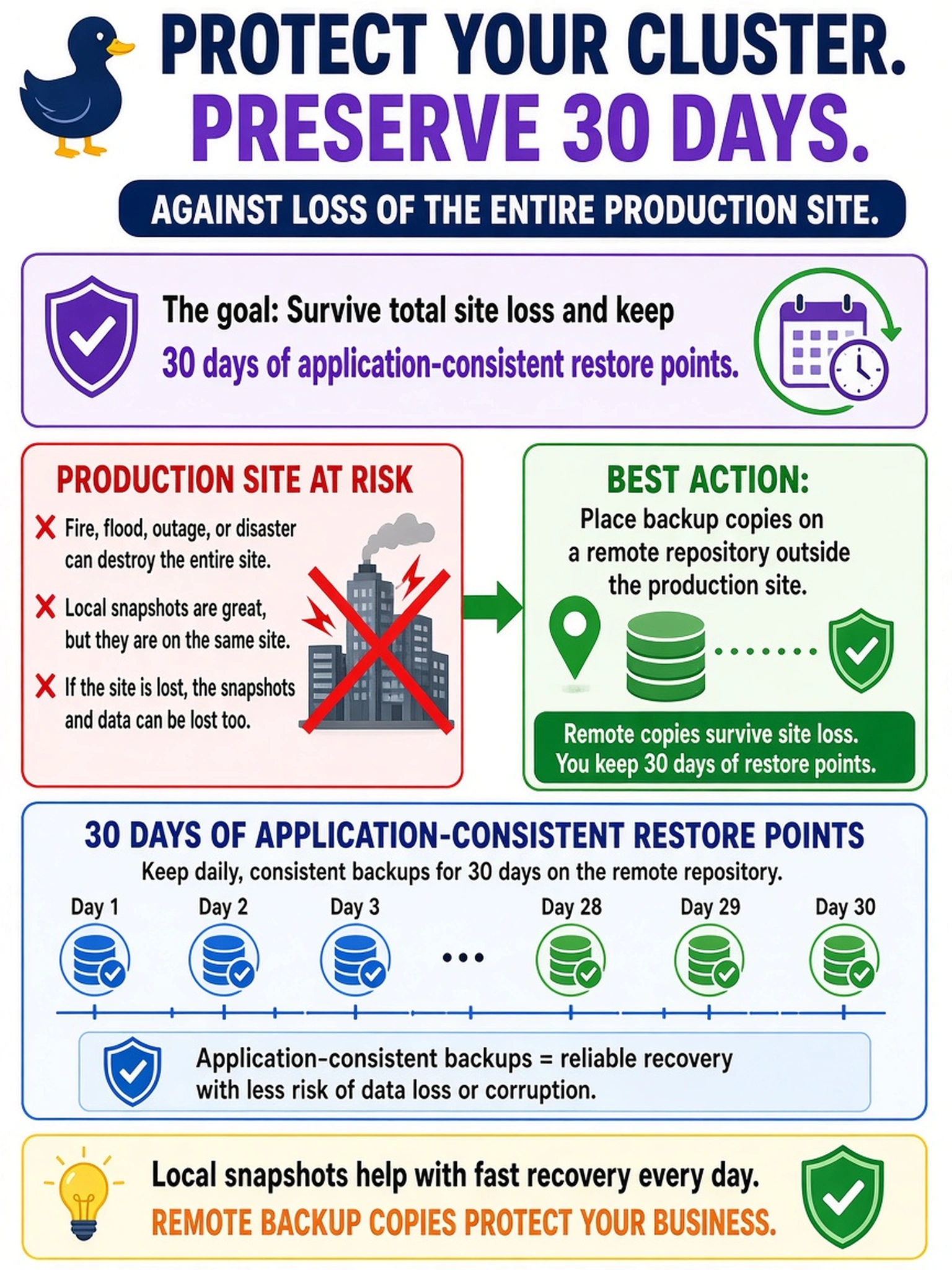
Think of site disaster protection like keeping a copy of the house key with a neighbor, not in your fireproof safe. You can have perfect local snapshots, but if the whole site burns, those copies burn too. Put backup copies offsite so your retention plan survives the building, not just the hardware.
Full Explanation
Backup integration for site disaster protection means the retained restore points must survive failure of the production facility, so copies must be placed on a target outside that site, such as a remote repository or external backup platform. Local snapshots and replicas remain inside the failure domain unless the remote target is truly separate. A wrong approach that relies on NearSync recovery points treats low-latency replication as long-term backup; NearSync is designed for tight RPO availability, not retention governance or immutable archive. Relying on local snapshots with RF2 is also wrong because redundancy protects against node or disk loss, not loss of the entire site or accidental retention deletion. Adding another CVM per node is wrong because CVM placement affects data path and node-level resiliency, not the location of retained backup copies. Exam caveat: distinguish replication availability from backup retention when the requirement names site disaster and retention period. Operational check: confirm the backup target is reachable from the cluster but located in a different physical site and that a restore test can select a copy outside the production site.