
An administrator backs up a three-tier application whose web, app, and database VMs must be recovered as one consistent set. Which backup approach should be used?
Select an answer to reveal the explanation.
Short Explanation
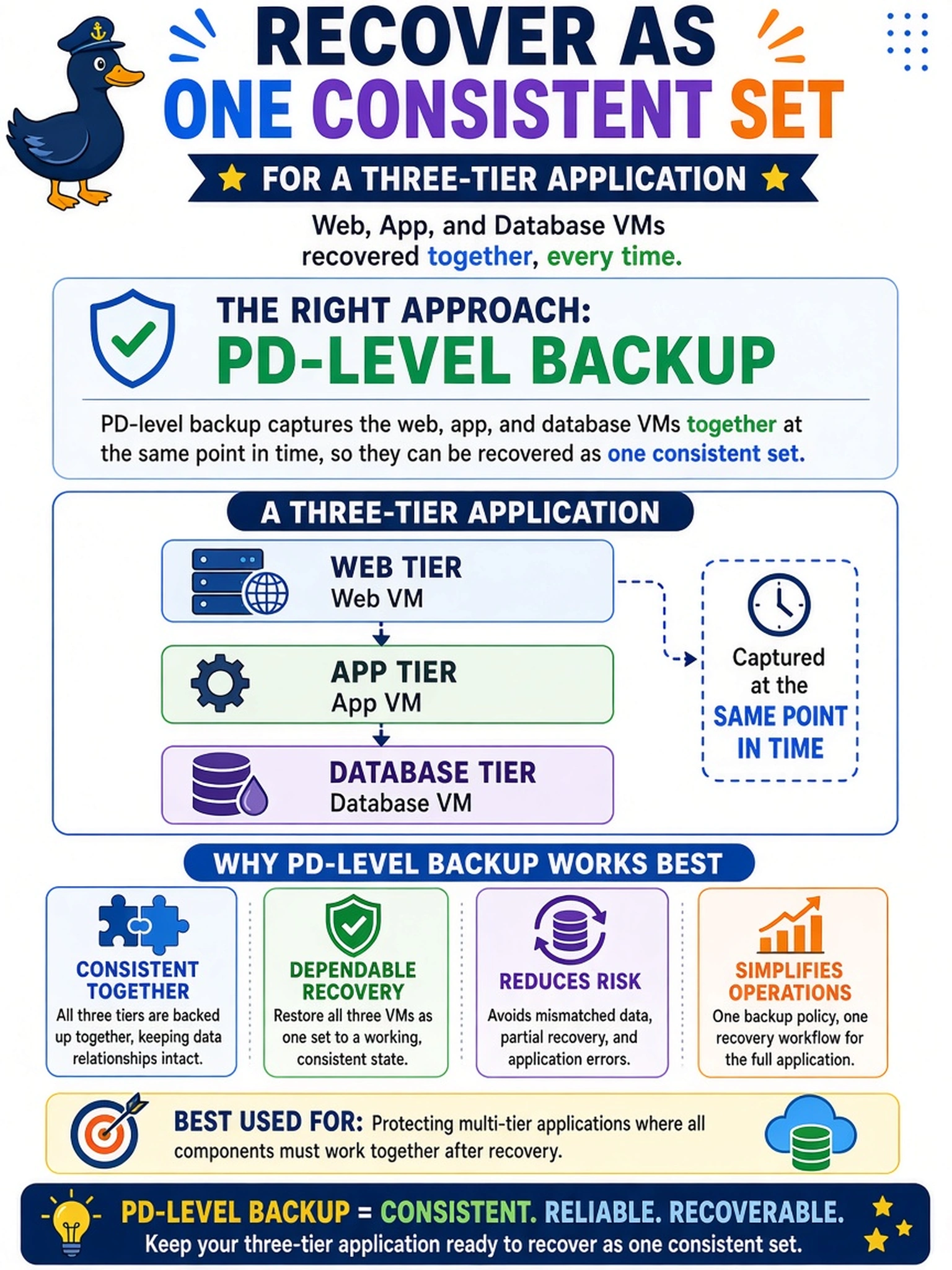
Think of a protection domain like a family photo: you want every member in the same frame, not three separate snapshots taken at different times. If your app spans multiple VMs, back up the PD so recovery returns them as one consistent set. Choosing individual VM backups is the trap, because each one can land on a different clock.
Full Explanation
Protection domains are the Nutanix construct for treating a group of related VMs as one management and protection unit. When a snapshot or backup policy is applied to the PD, the operation is coordinated across the member VMs so recovery can return the application to a single aggregate point in time. This is the right choice when tiers such as web, application, and database must be restored together rather than independently. Backups created per virtual machine can be useful for isolated workloads, but staggered schedules produce different recovery timestamps and can leave the application inconsistent. Snapshot policies attached to individual VM disks suffer the same problem because they protect each disk or VM without a shared group boundary, so cross-VM state may not line up. Volume group snapshots address block storage objects rather than the application's VM membership, so they do not guarantee that all related virtual machines are captured as one coordinated set. Exam caveat: the exact Prism Central or backup target wording may vary by release, but the concept tested is group-level protection through a protection domain. Operational check: confirm every VM in the application is a member of the same protection domain and that the PD snapshot or backup schedule is enabled before relying on coordinated recovery.