
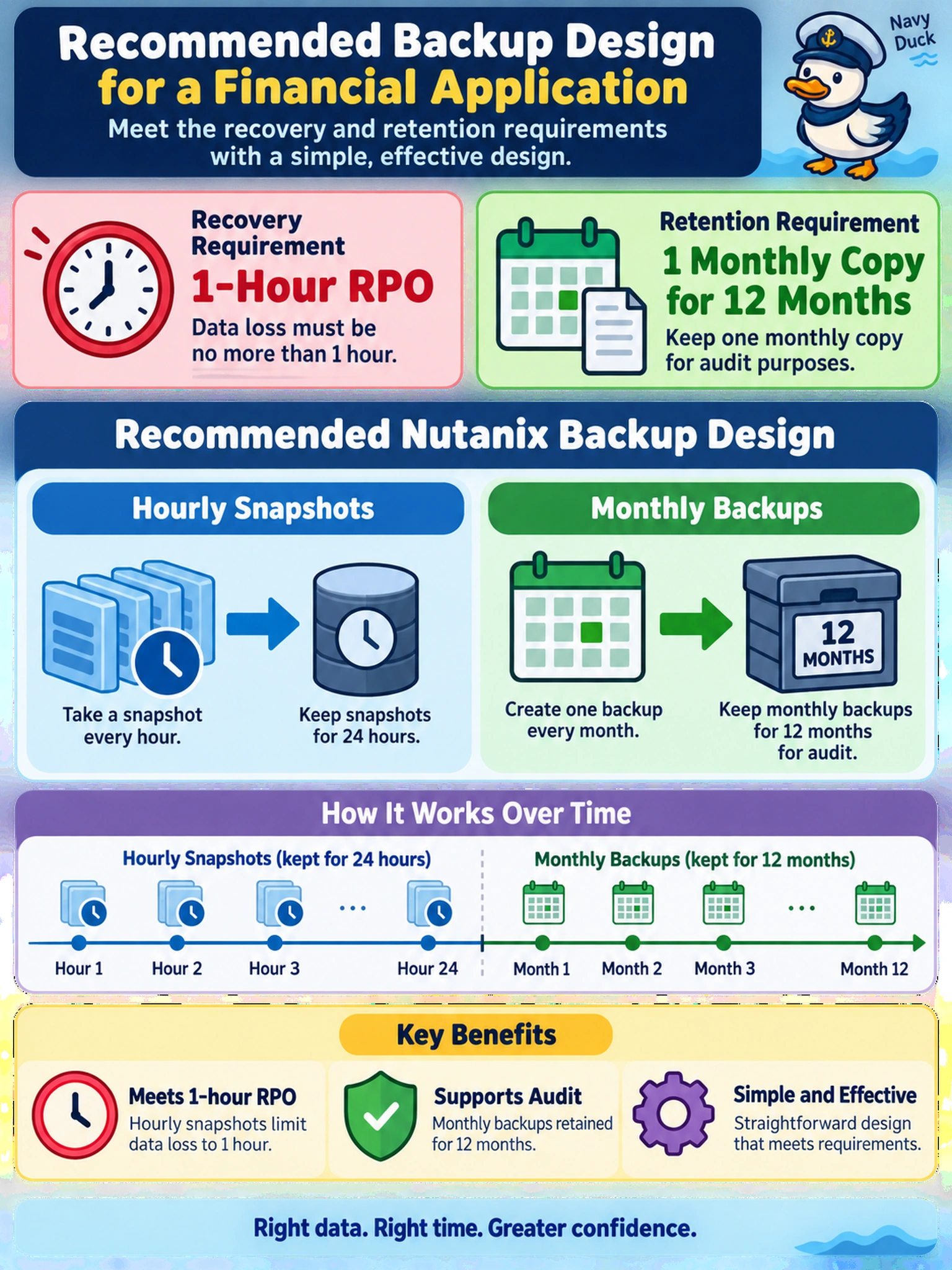
A financial application requires a 1-hour RPO and must retain one monthly copy for 12 months for audit. Which Nutanix backup design should you recommend?
Select an answer to reveal the explanation.
Short Explanation
Think of retention like two clocks: RPO needs frequent points, compliance needs monthly keeps. If you only snap daily, your last safe copy doesn't meet a one-hour RPO. Set hourly snapshots for the short window and monthly backups for the long audit window.
Full Explanation
A recovery point objective is met only when the most recent recoverable point is no older than the allowed loss. An hourly snapshot schedule creates recovery points every hour, so a failure shortly after the last snapshot leaves an RPO near one hour. A separate monthly retention requirement is a retention design problem: the backup or snapshot set must keep one copy per month for twelve months. Correct design combines short-window high-frequency protection with long-window compliance copies. Daily snapshots with weekly backups cannot satisfy a one-hour recovery point because the newest daily snapshot may be up to twenty-four hours old. Hourly snapshots retained for twelve months plus daily backups for thirty days provides many points but does not guarantee monthly compliance copies, and it wastes space. Hourly snapshots for twenty-four hours plus daily backups for thirty days also lacks the required monthly retention. Exam caveat: RPO and retention are related but distinct; frequent snapshots do not equal regulatory retention. Operational check: validate the snapshot schedule, retention counts, and external backup policy to confirm hourly points and twelve monthly copies exist.