
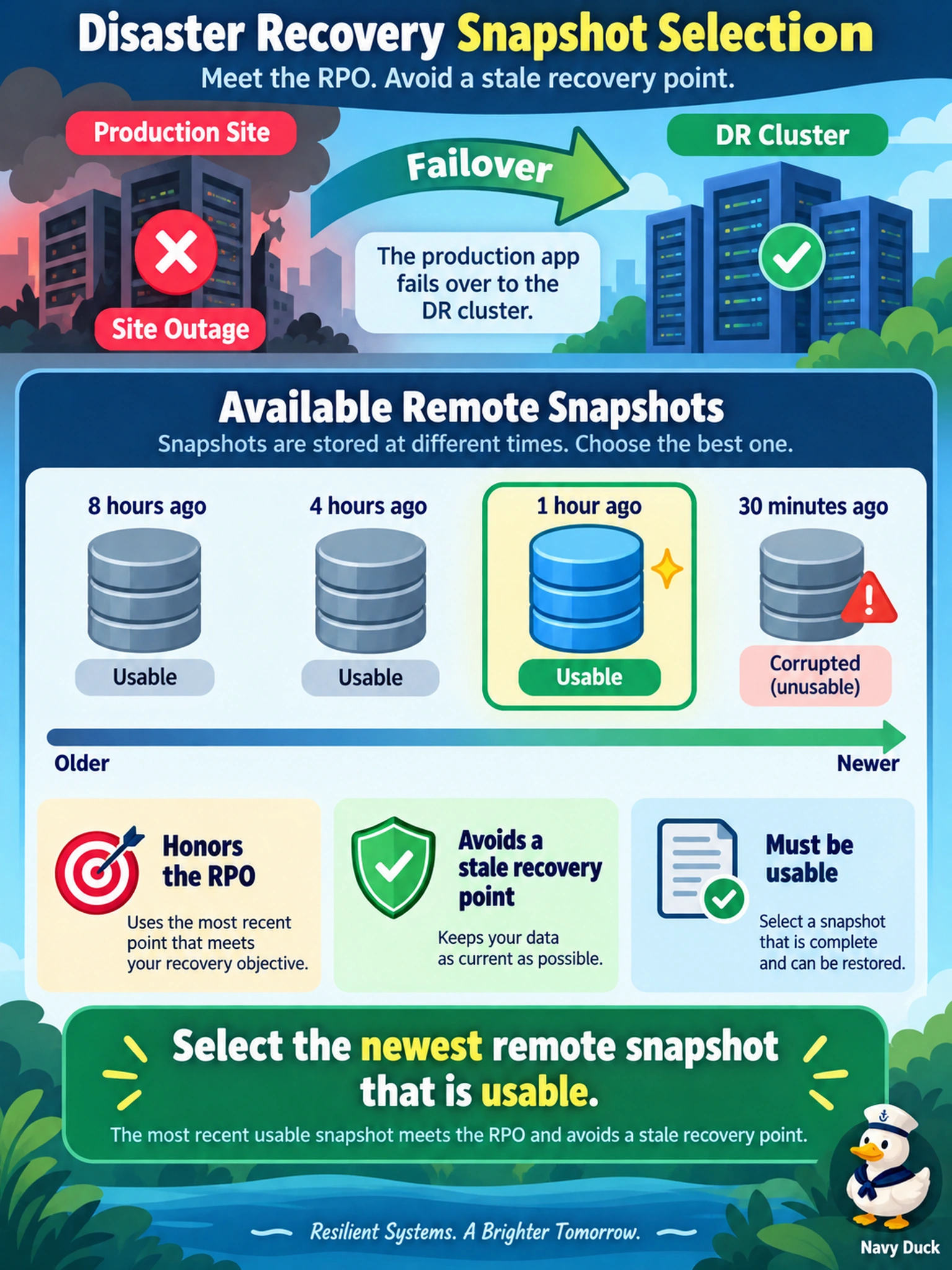
A production app fails over to the DR cluster after a site outage. The recovery plan lists several remote snapshots created at different times. The admin wants to honor the RPO while avoiding a stale recovery point. Which snapshot should be selected?
Select an answer to reveal the explanation.
Short Explanation
Think of a DR failover like grabbing the newest good photo from a cloud album, not the oldest one sitting on a dead phone. You want the latest remote snapshot that's usable, because that's the freshest recovery point you can actually mount. Picking a stale or merely scheduled snapshot can put you back hours.
Full Explanation
During failover, the administrator must select the recovery point that gives the smallest acceptable data loss while still being recoverable. Nutanix replication creates remote snapshots on the target cluster, and the appropriate choice is the newest remote snapshot that has completed transfer and is available and usable, because it represents the latest data that can actually be restored. A snapshot from the source cluster before the outage may be recent, but it is not the remote copy being recovered and may be inaccessible or stale once the primary site is down. A snapshot whose replication job merely finished without warnings is not enough if consistency checks, transfer completion, or usability status have not confirmed that it can be mounted. The oldest retained remote snapshot may satisfy a retention rule, but it deliberately increases RPO and can miss transactions captured by newer usable points. Exam caveat: RPO is not only about timestamp; the selected point must be a verified usable remote snapshot available to the recovery plan. Operational check: Review the recovery-point list for the protection domain, confirm the snapshot's remote location and usable status, then compare its timestamp with the application's RPO before executing failover.