
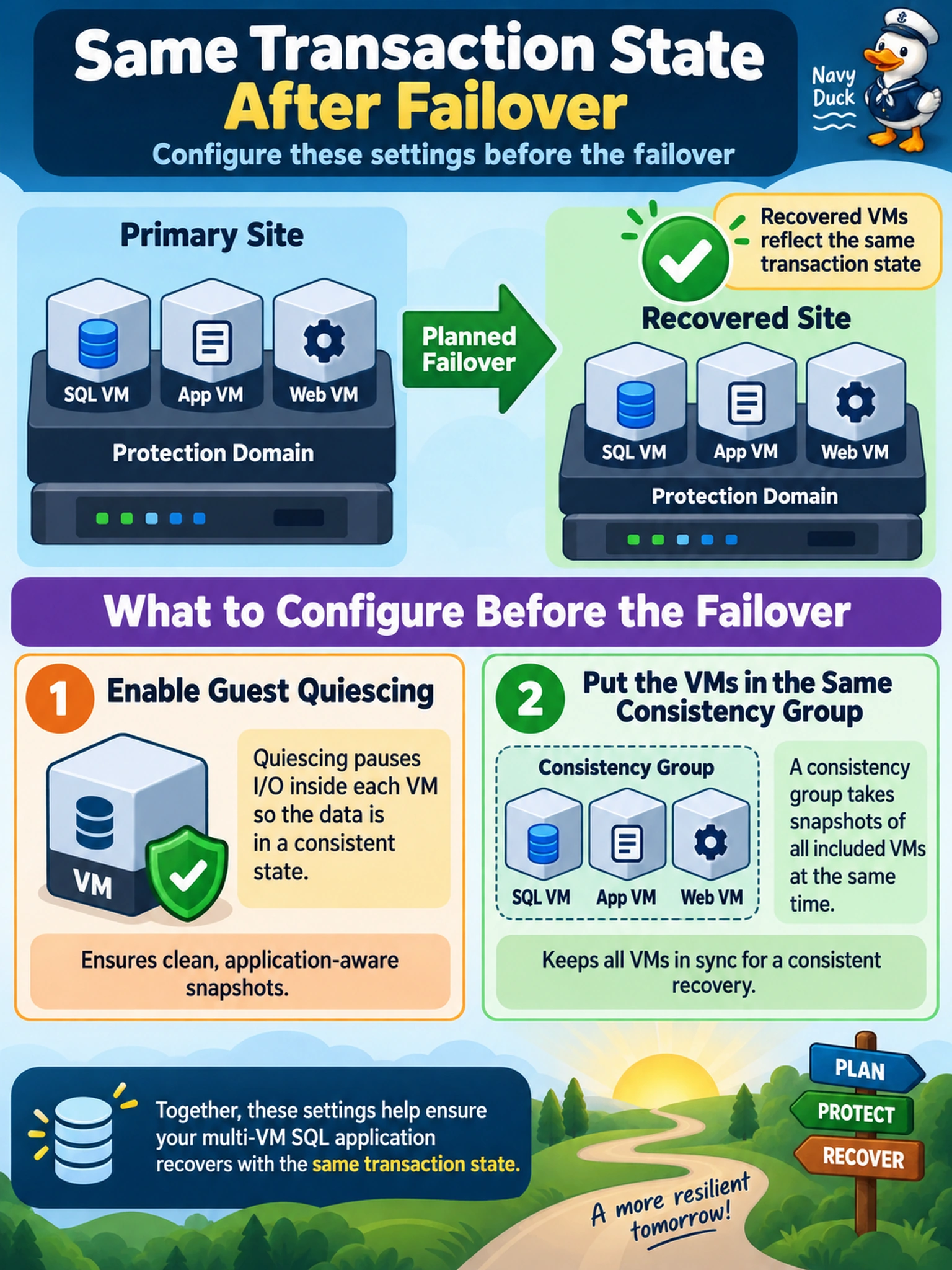
During a planned failover of a multi-VM SQL application in a Nutanix protection domain, the admin needs the recovered VMs to reflect the same transaction state. What should be configured before the failover?
Select an answer to reveal the explanation.
Short Explanation
Think of it like taking a group photo: if every VM doesn't freeze at the same instant, your app wakes up with mismatched pieces. You want a consistency group plus quiescing so the snapshot is one clean, app-consistent point in time. Don't chase faster replication; speed doesn't make the pieces line up.
Full Explanation
In Nutanix DR, a protection domain supplies replication and snapshots, but a recovery point is only as coherent as the snapshot set behind it. When several VMs form one application, a consistency group coordinates snapshot creation so member VMs share the same recovery point, while quiescing lets the guest flush caches and checkpoint application state. During failover, the runbook can resume from snapshots that represent the same transaction state rather than unrelated local points. Increasing asynchronous replication frequency reduces the distance between recovery points, but it does not make a group of VM snapshots internally coherent; the snapshots may still capture different guest states. Relying on independently created local snapshots before failover is unsafe because each snapshot reflects a different point in time, so databases, logs, and dependent services can disagree. Choosing the latest replica alone is also insufficient: without grouped snapshots and quiescing, it is not guaranteed to be application-consistent across all members. Exam caveat: do not confuse a low RPO with application consistency; replication cadence controls staleness, not coherence. Operational check: before failover, confirm every application VM is assigned to the same consistency group and that guest quiescing is enabled, then validate the latest snapshot set shows one consistent recovery point.