
A Nutanix administrator must validate that a DR recovery plan can restore a set of AHV VMs after a site outage. Production workloads must continue running while the test is performed. Which action should you take?
Select an answer to reveal the explanation.
Short Explanation
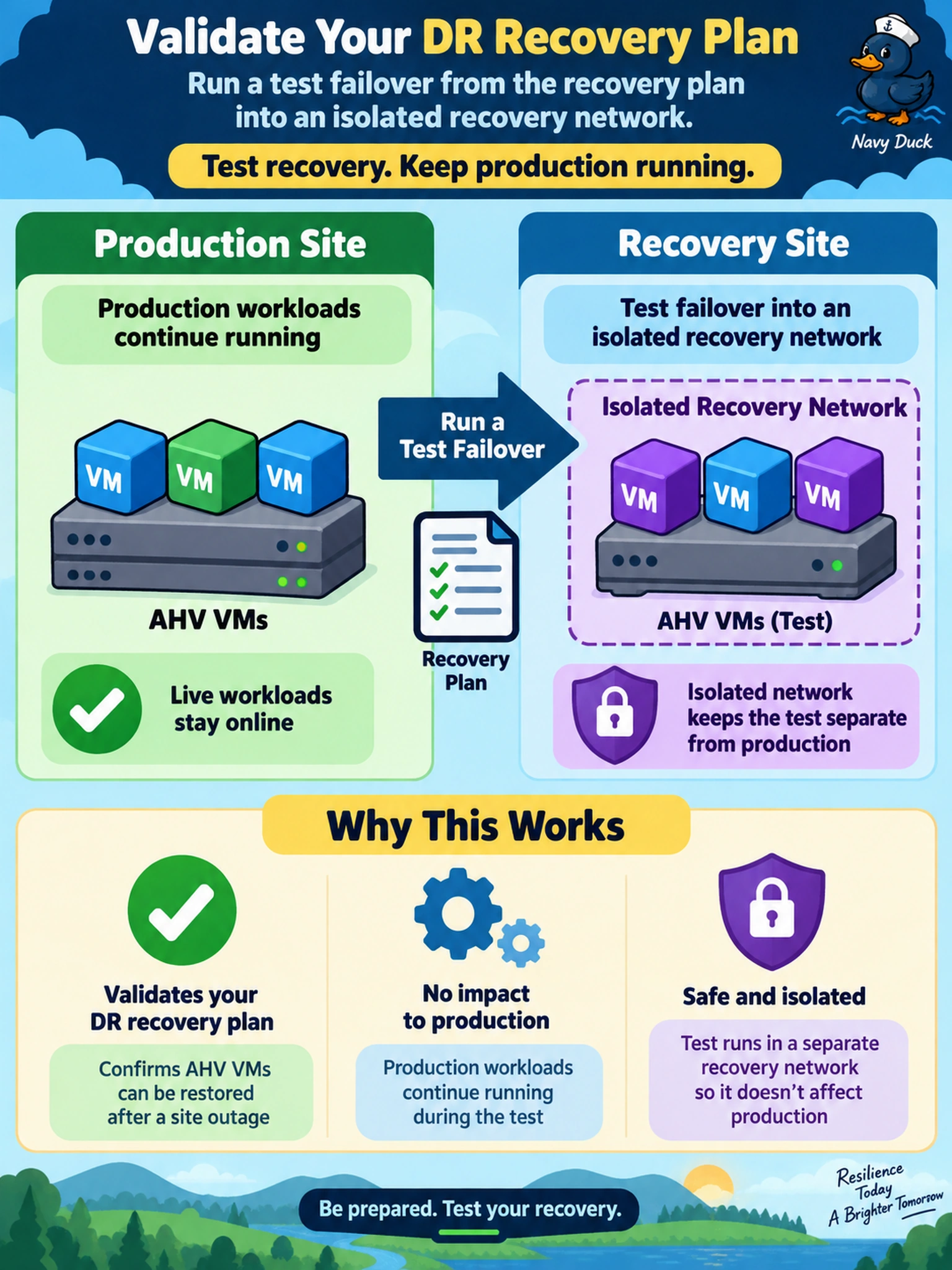
Think of it like a fire drill: you want to prove the exit route works without burning the building down. Run the recovery plan's test failover into an isolated recovery network so production keeps running. If you fail over the live production protection domain, you just turned a drill into an outage.
Full Explanation
Test failover is designed for recovery validation without interrupting the source environment. In a Nutanix DR workflow, the recovery plan can create disposable copies of replicated VMs on an isolated network, allowing you to verify power-on order, network mappings, application startup, and runbook accuracy while production replication and workloads remain unchanged. Promoting an asynchronous pair to Metro availability is a protection-mode change for synchronous or near-synchronous replication, not a safe validation method, and it does not prove the existing recovery plan works. Failing over the production protection domain or live-migrating production VMs to the DR cluster would disrupt or move live workloads, which violates the requirement that production continue running. Restoring from a remote snapshot into a production folder also interferes with the live estate and does not exercise the recovery plan's orchestrated network and dependency behavior. Exam caveat: do not confuse test failover with production failover or failback; only the test path is expected to be non-disruptive. Operational check: before the test, confirm the recovery network, IP pool, and isolation policy exist, then verify that source VMs remain powered on and replication status stays healthy during validation.