
An administrator is preparing to enable Metro availability between two Nutanix AHV clusters in separate data centers. Which requirement must be satisfied before the Metro relationship can be established?
Select an answer to reveal the explanation.
Short Explanation
Think of Metro availability as a tightrope between two data centers: both ends have to be built for the same kind of load. If one side is just a cheap single-node async setup, the rope snaps. You need compatible site resources and the right network conditions before it can work.
Full Explanation
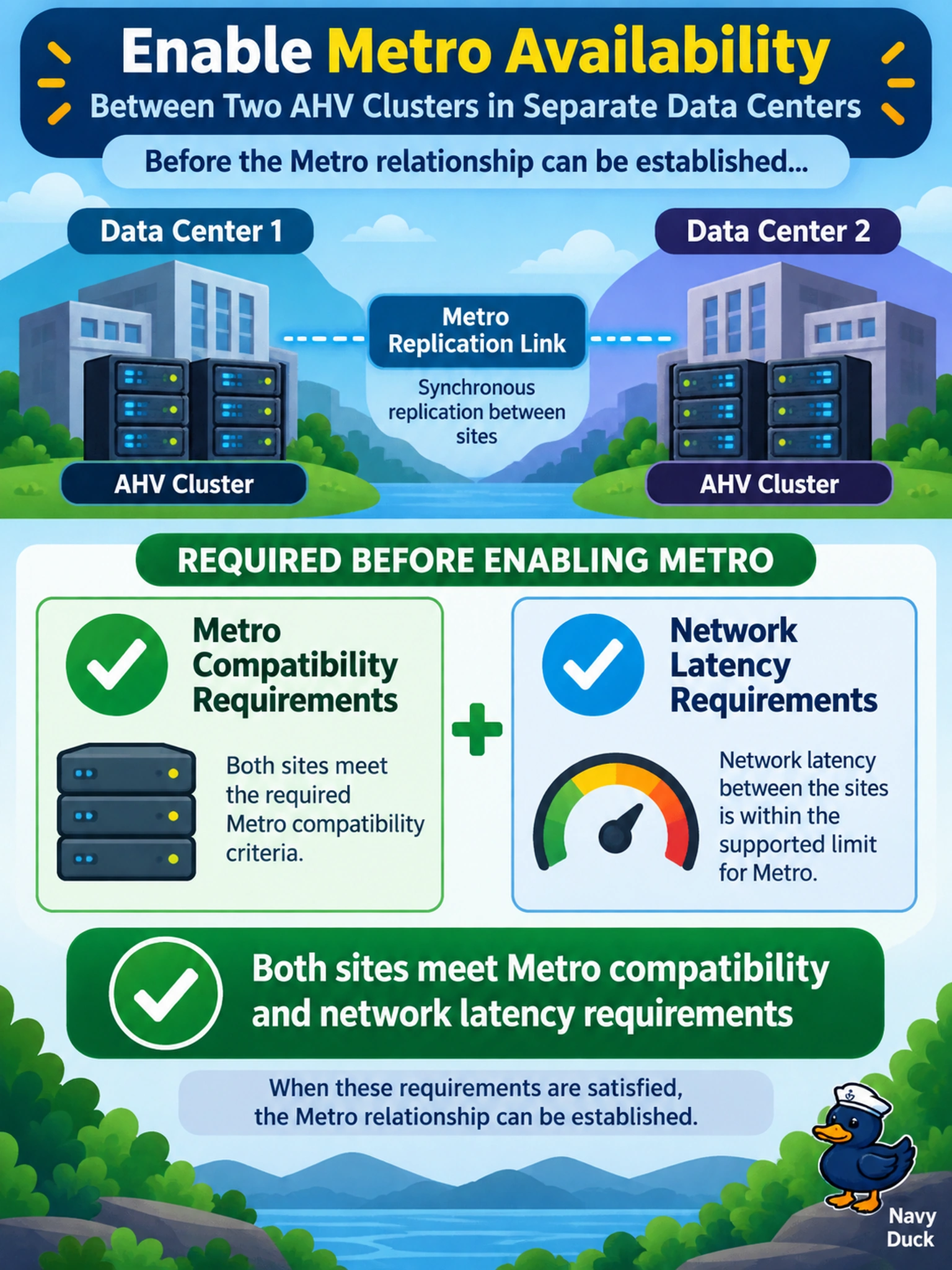
Mechanism: Metro availability provides continuous cross-site availability for protected VMs, so both sites must be compatible and meet network conditions. The relationship depends on paired cluster resources, storage configuration, and supported latency because data changes must remain consistently available across sites. A single-node site with local snapshots and asynchronous replication describes a basic or async protection design, not Metro availability, because it does not provide a continuously available stretched pair across two supported sites. Configuring NearSync replication and snapshot-based recovery plans describes an asynchronous or near-synchronous DR workflow, not Metro, since Metro relies on continuous replication between compatible sites rather than scheduled snapshot recovery. Requiring compatibility only at the primary site is incorrect because Metro availability depends on both sites being supported and appropriately matched; the secondary site cannot be an arbitrary hypervisor or unsupported resource pool. Exam caveat: The exam tests the requirement that both sites are compatible and network conditions are suitable, not a memorized latency number unless the question provides one. Operational check: Run the cluster health checks and network latency validation available for the Metro configuration, then confirm site compatibility before enabling the relationship.