
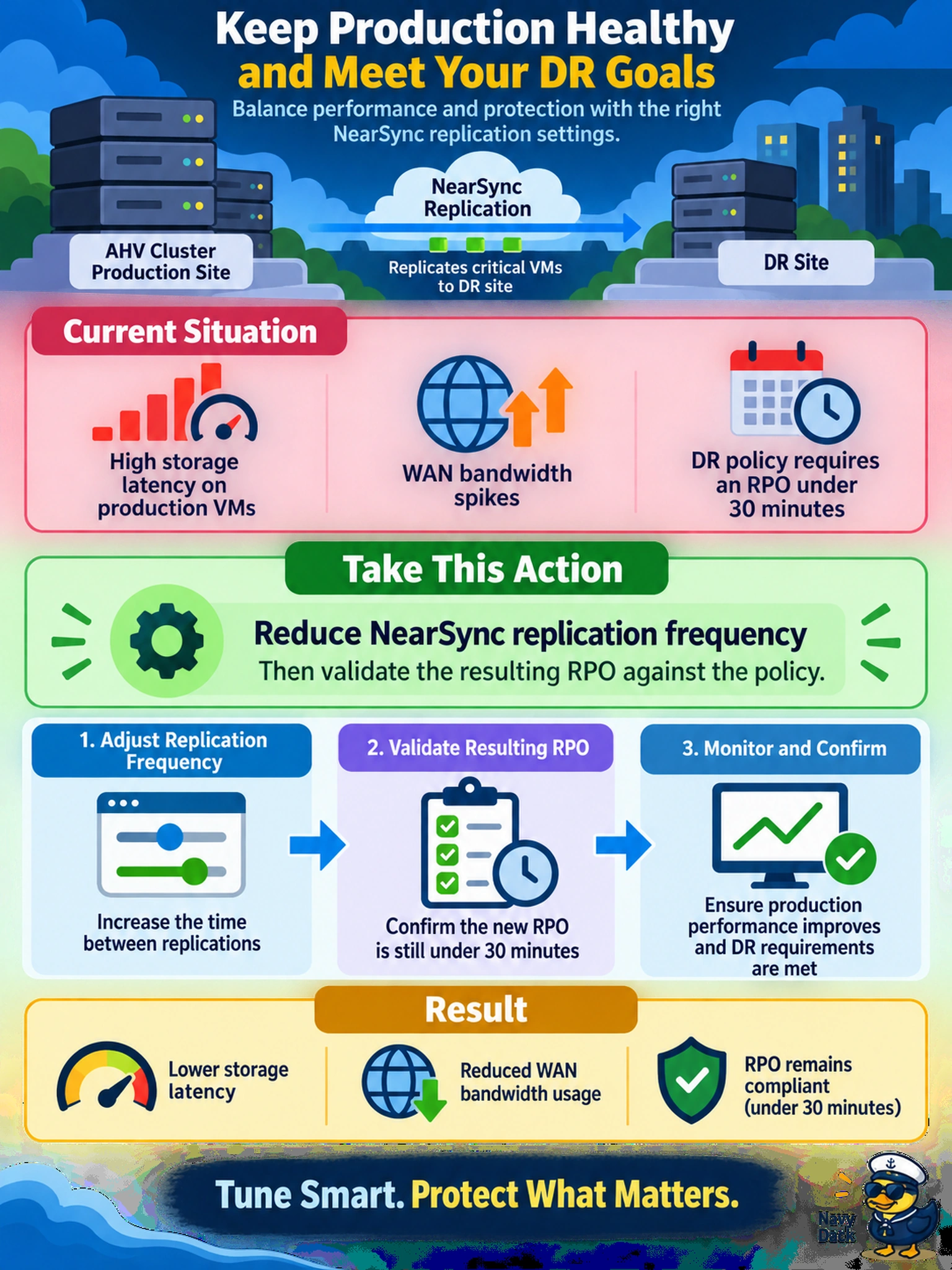
A Nutanix AHV cluster uses NearSync replication for critical VMs to a DR site. During business hours, production VMs show high storage latency and WAN bandwidth spikes, while the DR policy requires an RPO under 30 minutes. Which action best balances production performance with the DR requirement?
Select an answer to reveal the explanation.
Short Explanation
Think of NearSync like a fire hose: more frequent bursts drain more bandwidth and I/O. If you see production apps coughing, turn down the replication frequency and check the RPO before you decide async is the answer. Don't starve the workload to feed the DR policy.
Full Explanation
NearSync replication sends frequent change deltas to the DR site, so bandwidth and storage I/O demand rise with production write rate and replication frequency. When production VMs show latency and WAN saturation, compare the DR RPO/RTO with the performance impact. Lowering replication frequency reduces how often deltas are read and sent, easing contention while letting you validate whether the resulting RPO still meets the policy.
Keeping NearSync at its current frequency while adding WAN capacity may relieve network saturation, but it does not reduce production-side work generated by replication, so storage contention can persist. Throttling production VM I/O to protect replication inverts priority: DR replication should not deliberately starve running workloads unless an approved window allows it. Asynchronous replication with a longer RPO can be appropriate, but only after confirming the business policy permits weaker protection; it is a fallback, not the first balanced adjustment.
Exam caveat: questions often ask for the action that preserves the stated business requirement while reducing resource contention, not the most aggressive DR change. Operational check: after changing replication frequency, monitor replication lag, production latency, and WAN utilization during peak hours before accepting it.