
A Nutanix AHV production cluster replicates VMs to a remote site with async snapshot schedules. The app owner now needs recovery point objectives in seconds, but the network cannot support a stretched synchronous Metro deployment. Which replication capability should you use?
Select an answer to reveal the explanation.
Short Explanation
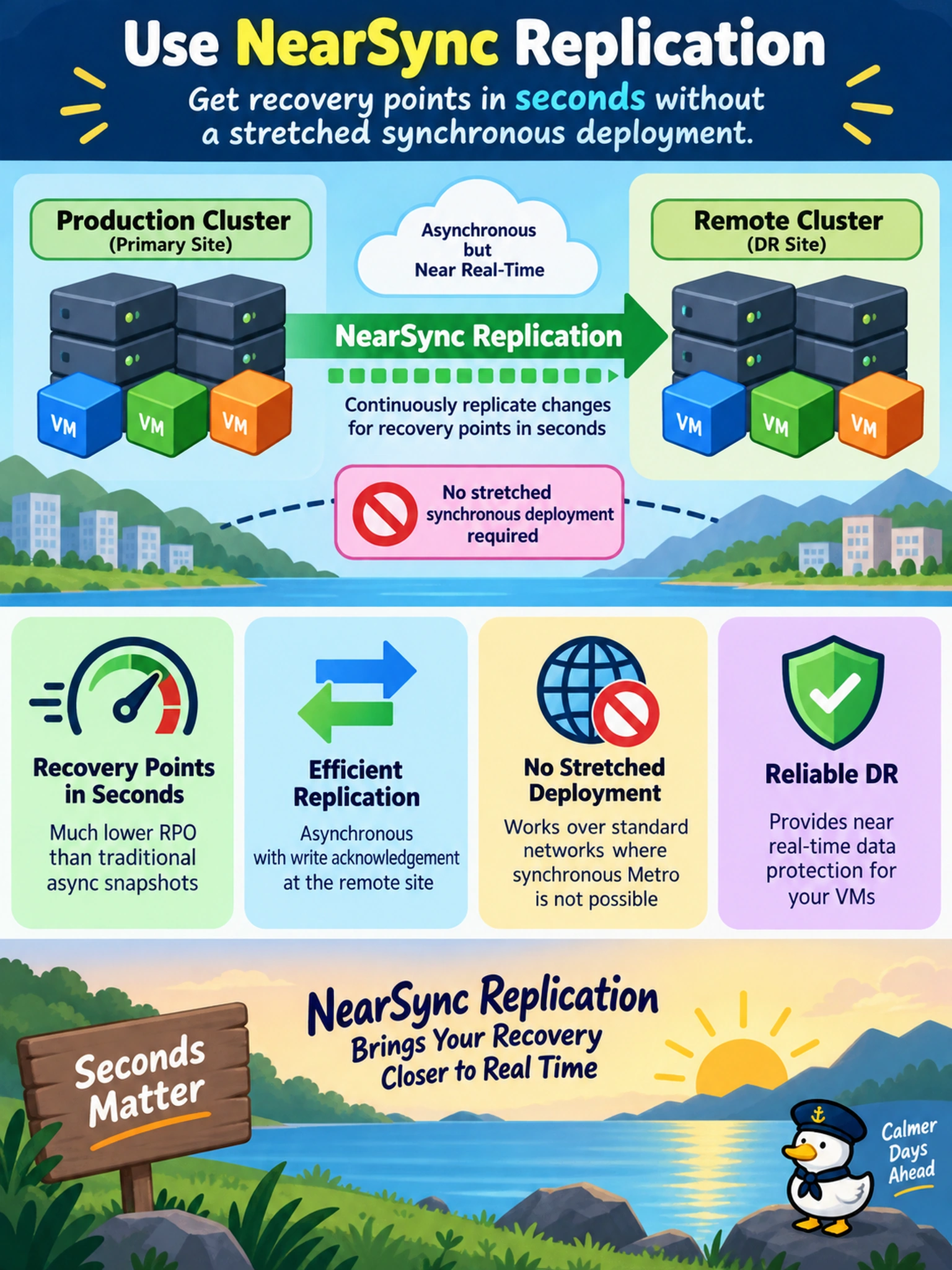
Think of scheduled async snapshots like mailing a copy of your files every few minutes: it's safe, but there's always a gap. NearSync tightens that gap by shipping changes almost continuously, so you get a seconds-level RPO. Don't jump to Metro just because it sounds stronger; Metro is a different synchronous design, not the default next step.
Full Explanation
NearSync replication sits between scheduled async snapshot replication and synchronous Metro availability. Instead of waiting for a snapshot interval, it continuously ships changed data to the remote protection domain entities, so the recovery point objective can be measured in seconds rather than minutes or hours. You apply it when the business wants a tighter RPO than async snapshots provide but cannot meet the latency, bandwidth, and stretched-cluster requirements of Metro. Async replication with 15-minute snapshot schedules remains a periodic copy method; the replica can lag by the schedule interval, so it does not meet a seconds-level objective. Metro availability with synchronous replication can meet a zero or near-zero RPO, but it is a distinct availability design that keeps writes synchronous across sites and requires a supported stretched Metro configuration, not merely a lower async interval. Local snapshots retained for 24 hours protect only against local corruption or deletion; they do not create a remote replica and cannot satisfy site-level DR. Exam caveat: do not choose Metro merely because it sounds stronger; match the RPO and constraints to the replication mode. Operational check: review the protection domain's replication mode, RPO, and last replication timestamp, then confirm the remote site receives near-continuous updates rather than only scheduled snapshot copies.