
A Nutanix administrator creates a Protection Domain on the primary AHV cluster and schedules snapshots, but no snapshots appear at the DR cluster. Which action makes the Protection Domain copy snapshots to the DR site?
Select an answer to reveal the explanation.
Short Explanation
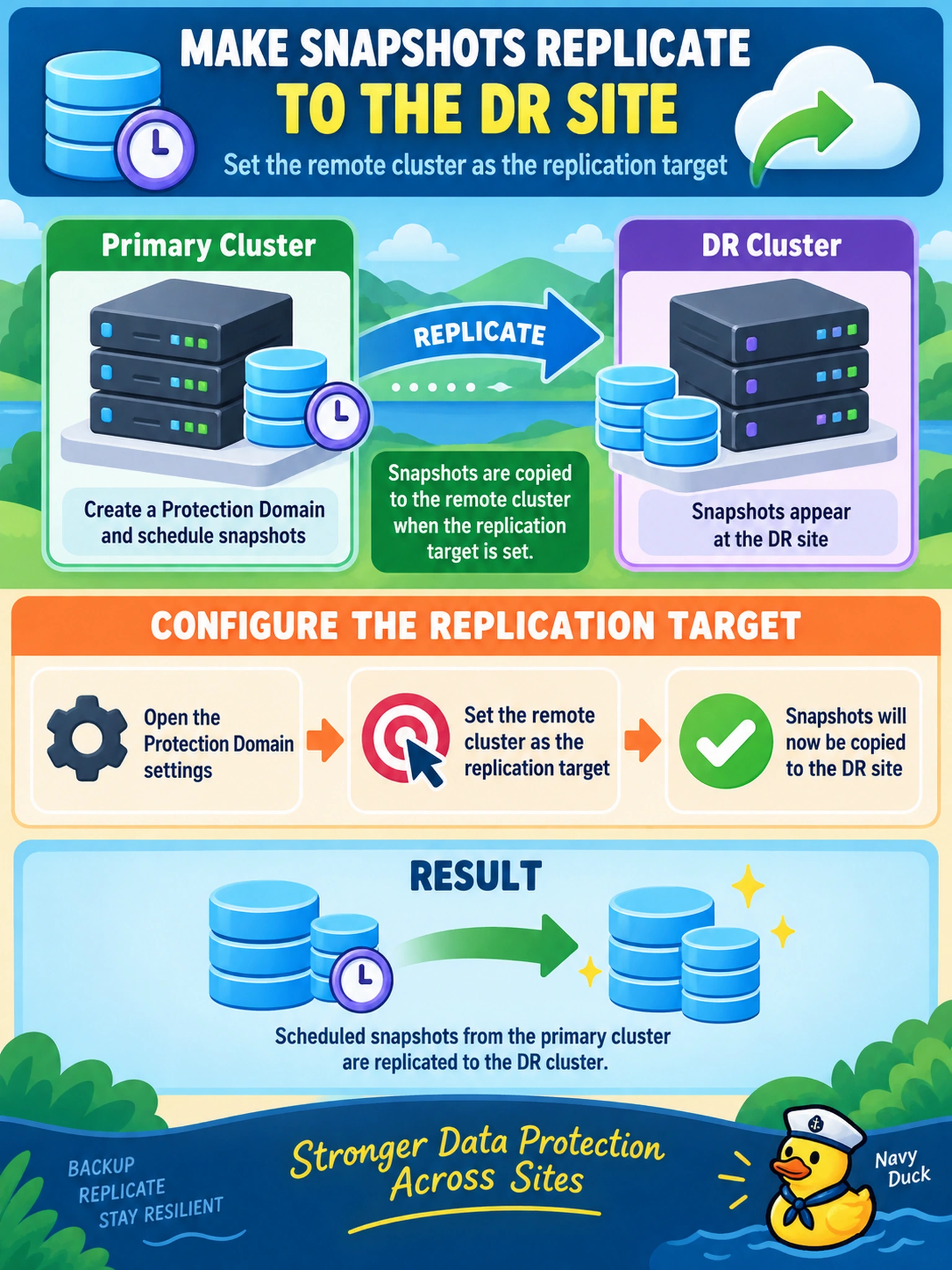
Think of a Protection Domain like a mail folder: if you don't tell it which remote site to send copies to, the snapshots just sit at home. You configure the remote cluster as the replication target, not a snapshot schedule or a fancy replication mode. That's the switch that actually moves the data.
Full Explanation
A Protection Domain groups VMs for consistent local snapshots, but local snapshots alone do not create DR copies. The Protection Domain must have a replication target defined, and that target identifies the remote Prism Element cluster that receives replicated snapshots. When the replication schedule runs, Stargate copies snapshot data from the source cluster to the target cluster, making the remote site the destination. Enabling NearSync on the local protection domain changes replication behavior toward near-synchronous continuous protection; it does not identify where asynchronous Protection Domain snapshots should be copied. Adding the local cluster to the remote site's Protection Domain reverses the relationship and does not configure the source PD to replicate outward, because the source Protection Domain still lacks its own target. Scheduling snapshots only on the remote Prism Element cluster is wrong, because remote snapshots are produced by replication from the source Protection Domain, not by independently scheduling snapshots on the target cluster. Exam caveat: Nutanix terminology distinguishes local Protection Domain snapshots from replicated snapshots, so the destination is controlled by the replication target setting rather than by snapshot frequency. Operational check: In Prism Central or Prism Element, open the Protection Domain configuration and confirm the remote cluster appears as the replication target before verifying remote snapshots after the next schedule.