
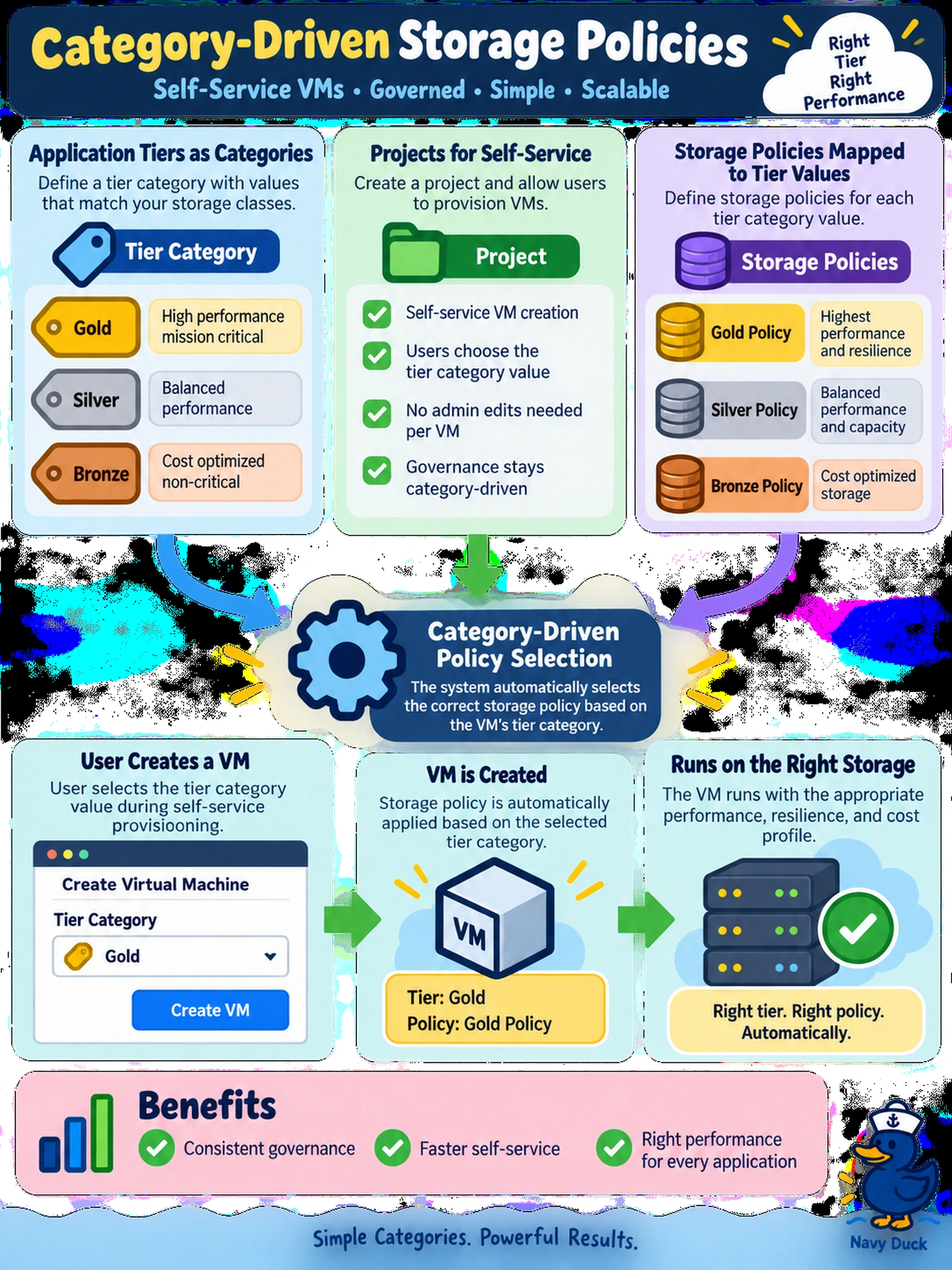
A team wants self-service VM creation to choose storage policy based on application tier (gold, silver, bronze) without admins editing each VM. In a Nutanix environment using categories and projects, what should you implement so governance stays category-driven?
Select an answer to reveal the explanation.
Short Explanation
Think of categories like labels on shipping crates: if the label says gold, the right handling policy follows. You don't want users guessing the crate's value or renaming it by hand. That's why tier categories should drive storage policy selection, not naming or manual container choices.
Full Explanation
Category-driven governance works by turning application tier into structured metadata. When a workload carries a standard category such as tier:gold, tier:silver, or tier:bronze, that value can be used to align the workload with the correct storage policy during self-service placement. This keeps policy decisions consistent, auditable, and independent of individual administrator preferences or VM names. Manual storage container selection is wrong because it shifts the decision to the user or operator and breaks automated governance. Project-wide storage policy edits are wrong because they apply a broad permission or default to all VMs in the project, ignoring the tier distinction the categories are meant to express. Naming-convention inference is wrong because names are mutable, unstructured, and easy to mistype, so they cannot provide reliable policy enforcement. Exam caveat: focus on the governance concept—categories classify workloads, while storage policies define performance and durability behavior—rather than on an exact menu path. Operational check: create a test VM with a known tier category, confirm the selected or enforced storage policy matches that tier, then verify a VM with an invalid or missing tier is blocked or flagged for remediation.