
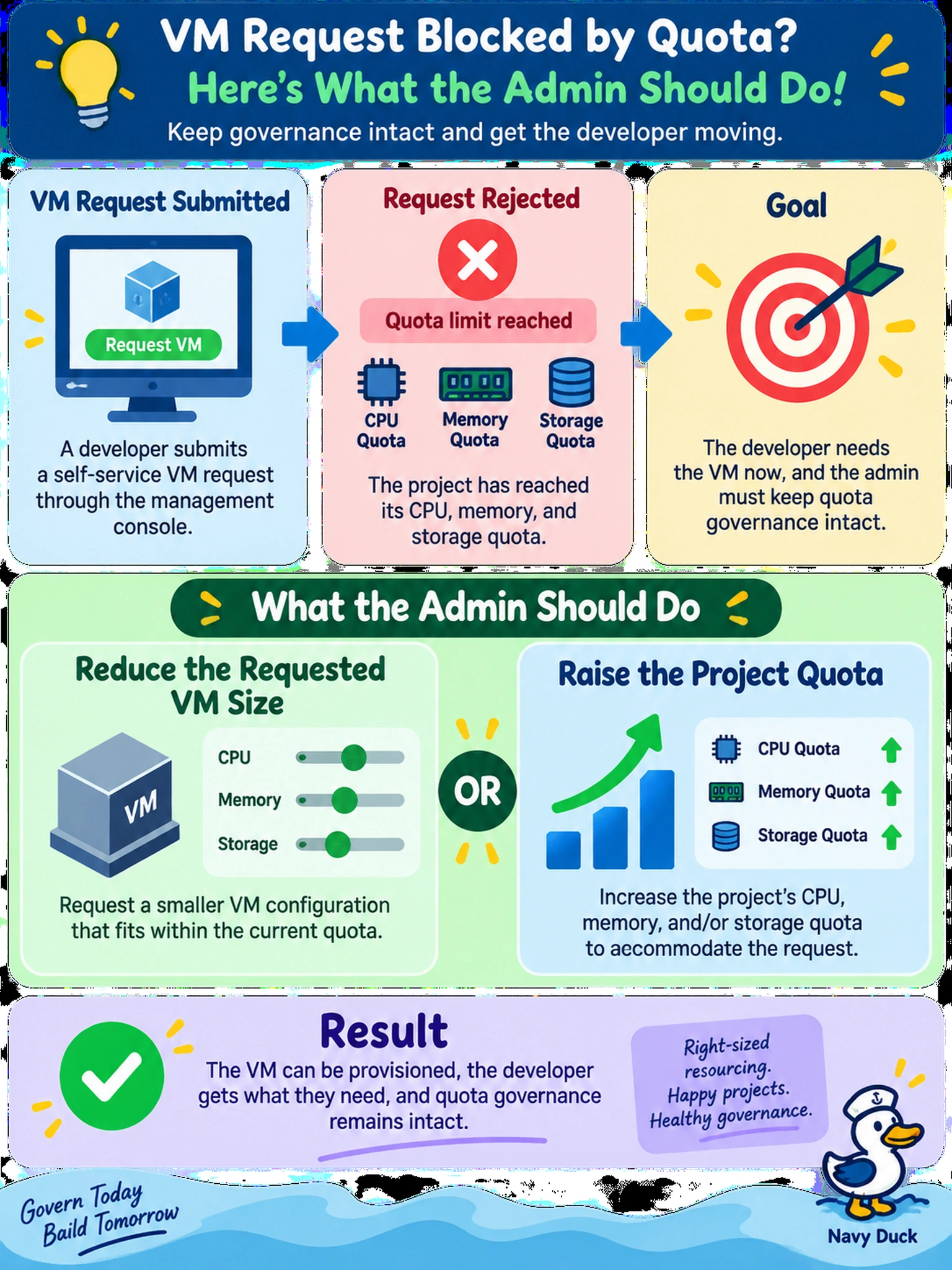
A developer submits a self-service VM request through Prism Central, but the request is rejected because the project has reached its CPU, memory, and storage quota. The developer needs the VM now, and the admin must keep quota governance intact. What should the admin do?
Select an answer to reveal the explanation.
Short Explanation
Think of a project quota like a prepaid card: when it's full, a bigger order won't go through. You can either shrink the order or load more credit, but don't turn off the card reader. That's why reducing the VM size or raising the project quota is the fix.
Full Explanation
Prism Central projects enforce quota limits as a governance boundary for self-service provisioning. When a request exceeds the configured CPU, memory, or storage allowance, the request is denied unless the requested resources are made smaller or the project allowance is increased. This preserves accountability while allowing legitimate capacity growth. A category assignment changes metadata and may influence placement or reporting, but it does not remove the project's quota enforcement. Moving the workload outside the project bypasses the intended self-service guardrail and leaves consumption untracked by the project owner. Turning off quota enforcement defeats the purpose of project governance and can permit uncontrolled resource consumption. Exam caveat: a quota rejection is a policy limit, not a hypervisor or storage failure, so troubleshooting should begin with quota and request sizing. Operational check: review the project quota summary, compare the requested vCPU, memory, and storage against remaining limits, then either resize the VM or submit a quota increase approval and document the change.