
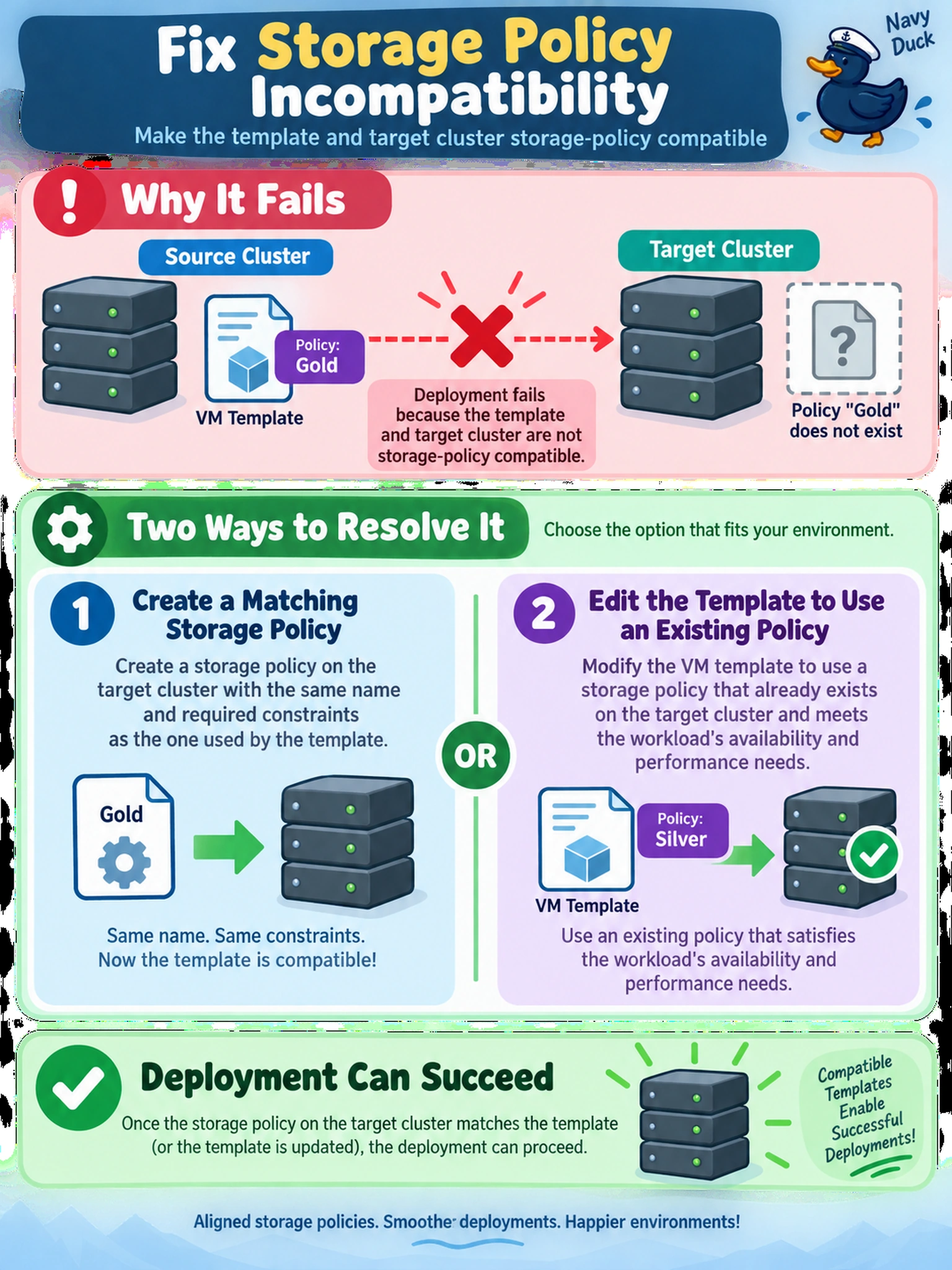
An administrator clones a VM template from a source cluster to a target cluster, but the template references a storage policy that does not exist there. The deployment fails because the template and target cluster are not storage-policy compatible. What should the administrator do?
Select an answer to reveal the explanation.
Short Explanation
Think of a storage policy like a parking permit: if the garage doesn't have that permit type, you can't park there. Either issue the same permit in that garage, or change the template to use a permit it already accepts. Don't start adding volume groups or Flow rules — you're fixing the wrong permission.
Full Explanation
A storage policy is a named object that packages storage requirements such as availability, performance, and placement constraints for virtual machines. When a template records a policy reference, deployment must find a compatible policy on the destination cluster; if the reference cannot be resolved, the workflow stops rather than silently applying different storage behavior. The correct remediation is therefore to make the referenced policy available on that cluster, with equivalent constraints, or to edit the template so it points to an existing policy that meets the workload requirements. Raising replication factor changes an availability setting, but it does not create the named policy object the template is trying to use, so the reference still fails. Creating a volume group supplies a block storage device, not a storage policy, and attaching it does not alter the template's policy metadata. Enabling a Flow network security policy affects network microsegmentation and traffic rules, not storage placement or storage policy resolution. Exam caveat: in multicloud or multi-cluster estates, storage policy definitions may not be automatically identical everywhere, so template portability depends on policy compatibility. Operational check: compare the policy name and constraints recorded in the template with the storage policies present on the target cluster, then create the missing policy or update the template before cloning.