
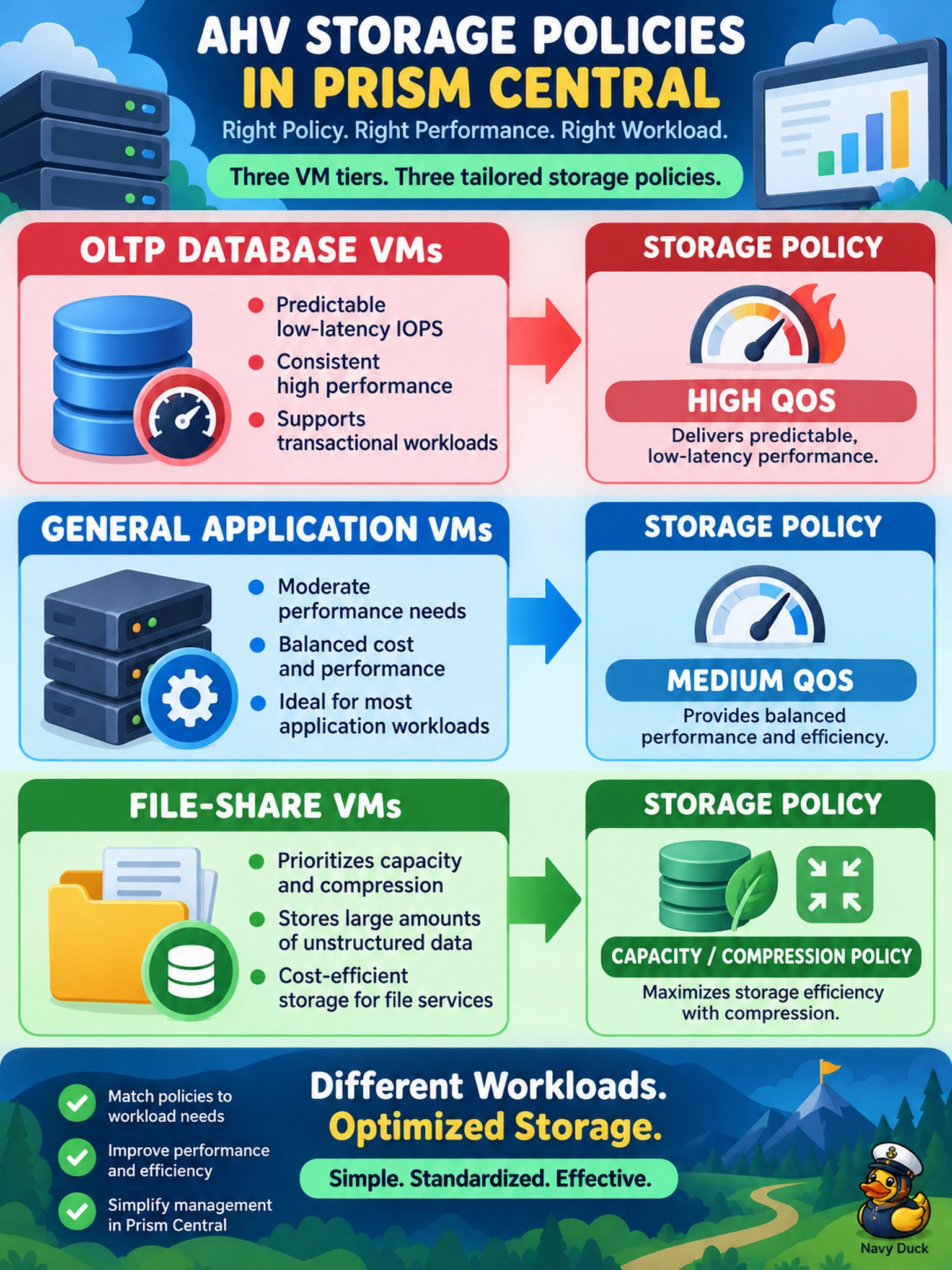
You are standardizing storage policies in Prism Central for three AHV tiers: OLTP database VMs need predictable low-latency IOPS, general application VMs need moderate performance, and file-share VMs prioritize capacity and compression. Which storage-policy mapping best reflects these requirements?
Select an answer to reveal the explanation.
Short Explanation
Think of storage policies like different lanes on a highway: your database needs the express lane, applications need the regular lane, and file shares can happily cruise in the capacity lane. If you put the OLTP database in a compression-heavy or medium-QoS lane, you're asking for latency spikes when the workload needs predictable IOPS.
Full Explanation
Storage policies translate application service levels into storage controls such as QoS, redundancy, and data reduction. An OLTP database tier needs predictable latency and sufficient IOPS, so a high-QoS or performance-oriented policy fits its bursty, latency-sensitive writes. General application VMs usually tolerate moderate throughput and benefit from medium-QoS settings that prevent them from monopolizing shared storage. File-share VMs often favor capacity efficiency, so compression or capacity-oriented policies are appropriate when peak IOPS are not primary. A policy that places database VMs under compression or capacity settings is wrong because data reduction and space-saving controls can add overhead and reduce predictability for latency-sensitive workloads. Assigning general applications to the highest QoS tier is wrong because it consumes performance headroom reserved for the most demanding tier. Using high QoS for file shares is wrong when the stated need is capacity and compression, because sequential transfers rarely justify reserving the most constrained IOPS budget. Exam caveat: policies may be described as performance, capacity, or tier categories rather than exact QoS values. Operational check: review VM or disk policy assignments and confirm database workloads use QoS controls, applications use balanced settings, and file workloads use capacity or data-reduction controls.