
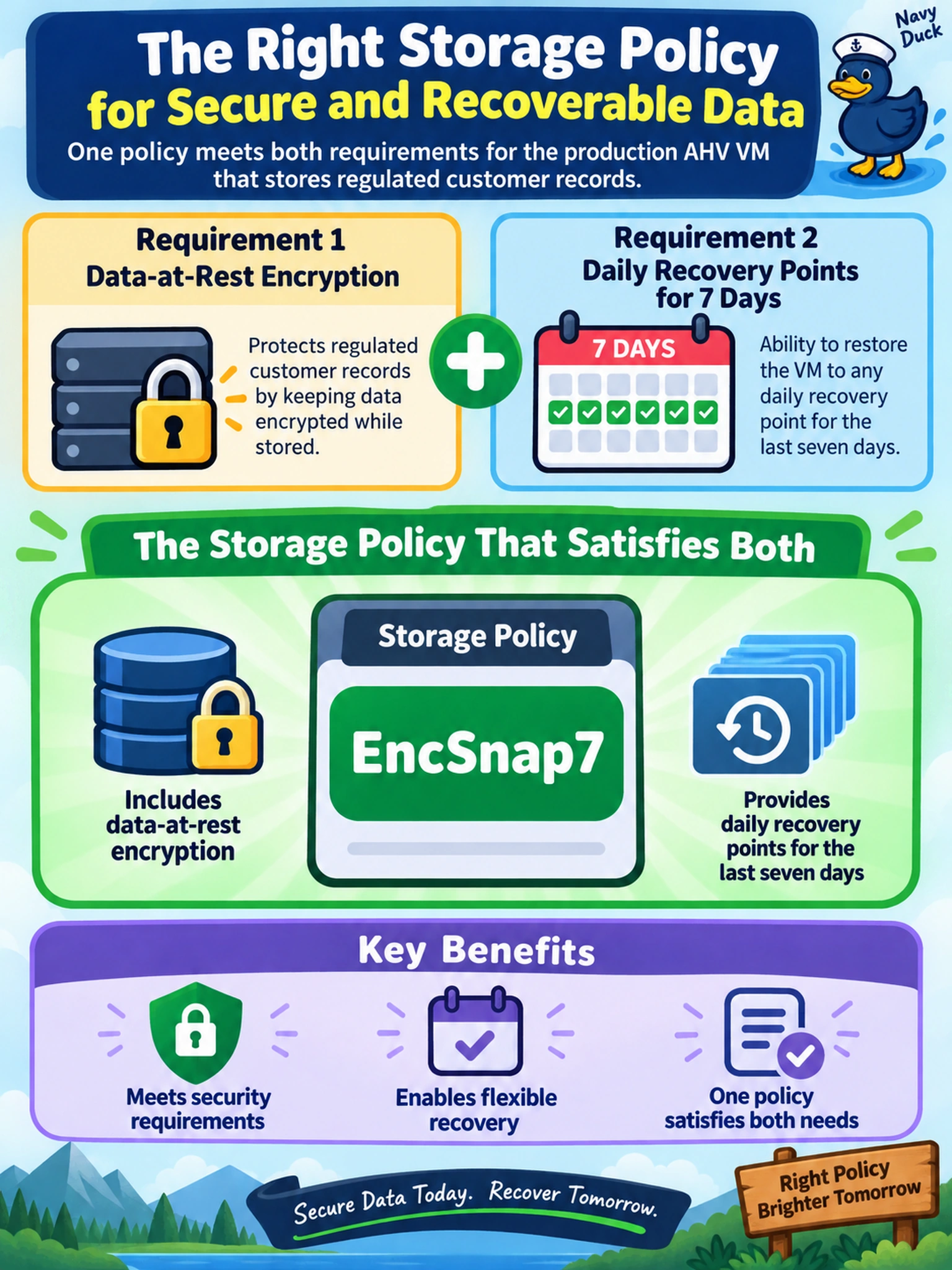
A production AHV VM stores regulated customer records. The security standard requires data-at-rest encryption and the ability to restore the VM to any daily recovery point for the last seven days. The administrator must assign one existing storage policy. Which storage policy satisfies both requirements?
Select an answer to reveal the explanation.
Short Explanation
Think of a storage policy as a compliance checklist you stick on the VM. If the rule says encrypt and keep seven days of snapshots, you pick the policy that does both, not the one that just dedupes or erasure-codes. Don't confuse capacity savings with data protection.
Full Explanation
A Nutanix storage policy can apply data-at-rest encryption and a snapshot schedule to a VM or VMDisk, so the correct policy must provide both controls. Encryption protects regulated records at rest, while a daily snapshot schedule with seven-day retention creates the required recovery points. The policy that combines encryption and seven-day snapshots is the only one that meets both compliance and data-protection controls.
A policy focused on compression and deduplication reduces capacity consumption, but it does not encrypt data or create snapshots. A policy using erasure coding or higher replication factor improves storage efficiency or fault tolerance, yet without encryption and snapshot retention it cannot satisfy either stated control. A policy that provides only snapshots gives recovery points but leaves data unprotected at rest, so it fails the security standard.
Exam caveat: match every stated requirement to a policy setting; do not select a policy because it is common, efficient, or highly available. Operational check: before assignment, open the storage policy and verify encryption is enabled and the snapshot schedule is daily with seven-day retention, then confirm the VM inherits the policy and test a snapshot restore.