
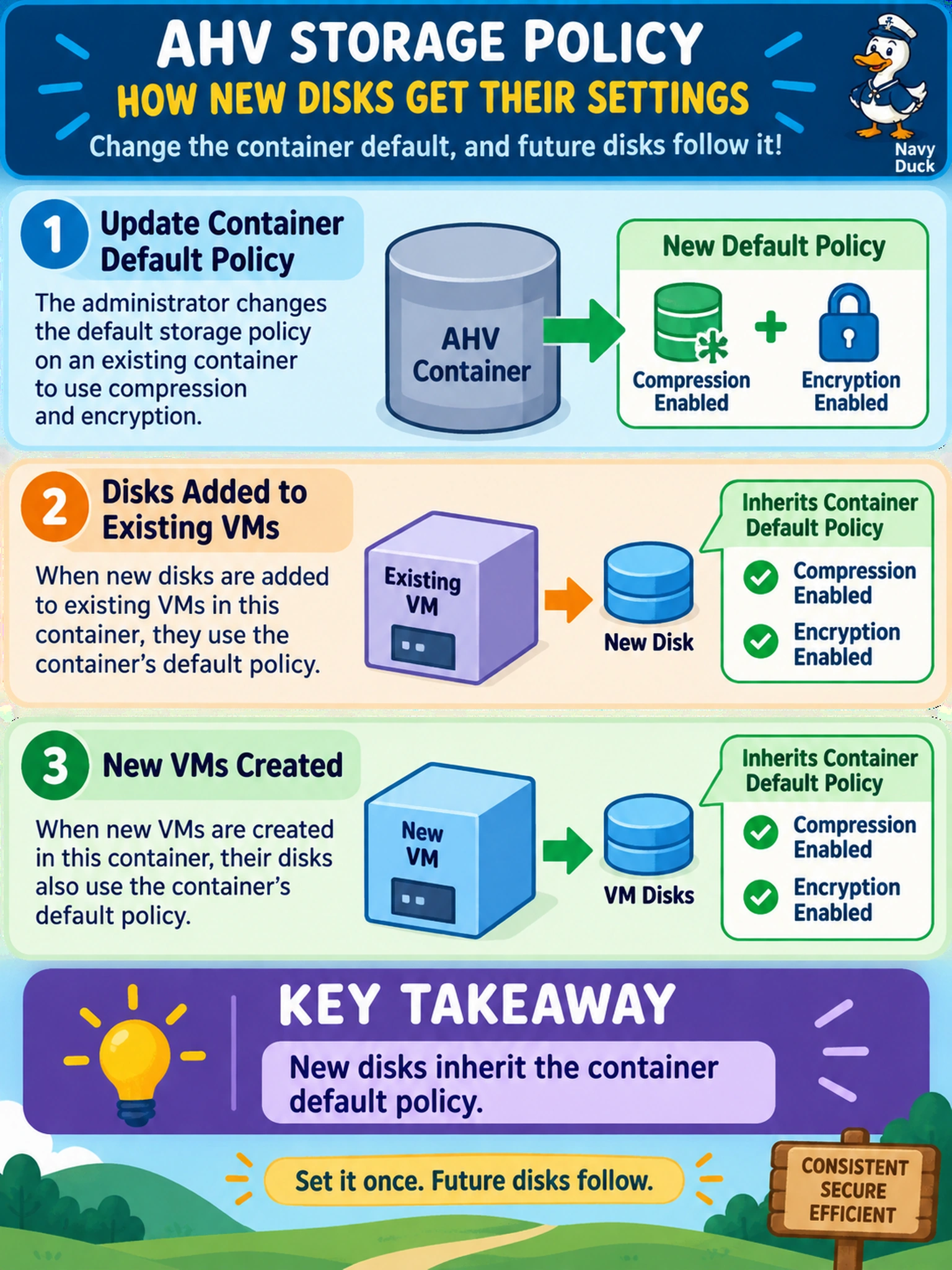
An administrator changes the default storage policy on an existing AHV container so future disks use compression and encryption. After the change, disks are added to existing VMs and new VMs are created. Which outcome should be expected?
Select an answer to reveal the explanation.
Short Explanation
Think of a container default policy like a house rule for new tenants: it applies when the disk is created, doesn't rewrite what's already there. If you set a policy on a container, you should expect it to cover newly created disks while existing disks keep their own settings.
Full Explanation
A container default storage policy acts as a creation-time template for storage objects placed on that container. When a new disk is provisioned, Nutanix applies the storage policy settings currently assigned as the container default, so features such as compression, encryption, or redundancy are selected for that disk as it is created. The assignment is bound to the disk at creation, which makes the default forward-looking rather than retroactive. Existing disks updating automatically is wrong because a default policy is not a bulk remediation action; disks already provisioned retain the storage policy state they had when they were created unless an administrator explicitly changes those disks. Limiting inheritance to volume group disks is wrong because the container default applies to disks created from the container, not only to disks presented through volume groups. Applying the policy only to the first disk of each VM is wrong because inheritance is evaluated per disk, not per virtual machine, so any eligible new disk created after the default changes can inherit it. Exam caveat: The key distinction is between newly created disks and pre-existing disks, because storage policy assignment is bound at creation. Operational check: After changing the container default, create a test disk from that container and verify the disk's storage policy shows the new settings.