
You are creating an AHV template for a Linux database VM. The guest kernel already has the virtio_scsi driver, and you want the best disk performance while keeping the template compatible with supported Linux guests. Which disk controller type should you configure?
Select an answer to reveal the explanation.
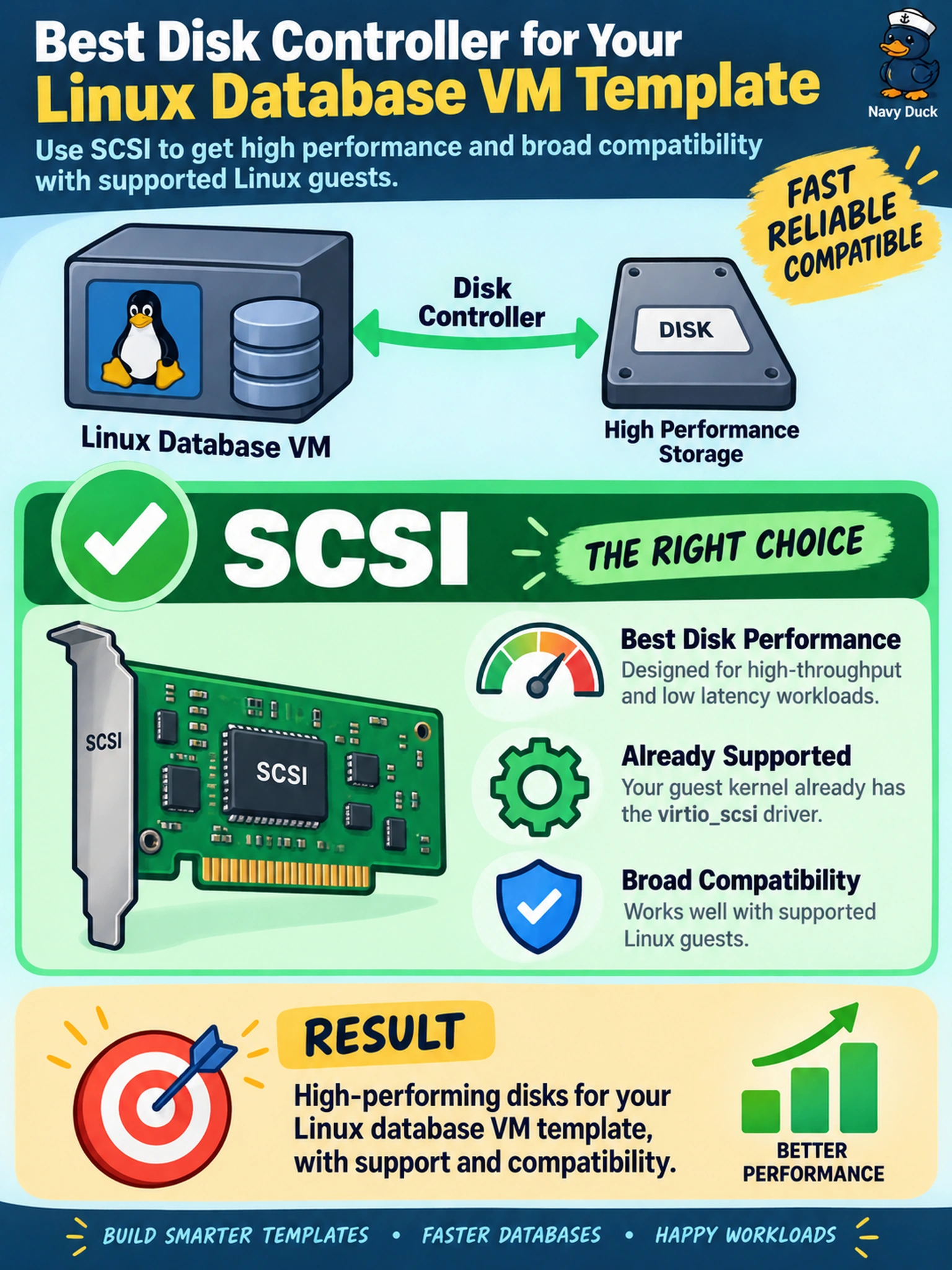
Short Explanation
Think of the controller like the cable you hand the guest OS. If Linux already has the VirtIO driver, you want the fast SCSI path, not a legacy compatibility cable. SATA and IDE are fallbacks for older guests, and SAS isn't a controller you pick in AHV.
Full Explanation
In AHV, the guest disk controller determines how the hypervisor presents block devices to the guest. When the guest already has the appropriate VirtIO driver, SCSI is the supported high-performance choice because it uses the VirtIO-SCSI path, giving efficient queueing and better throughput than emulated SATA or IDE. For a database workload, this matters: the guest sees a storage adapter designed for virtualized I/O rather than a compatibility shim. SATA is wrong here because it is primarily a compatibility controller for guests that lack VirtIO drivers; it does not provide the same performance characteristics for a supported Linux guest. IDE is wrong for the same reason: it is a legacy option useful only when an older guest cannot boot with modern drivers, and it is unsuitable for a new database template. SAS is wrong because it is not a selectable AHV guest disk controller type; physical SAS media may exist underneath, but the guest controller selection is SCSI, SATA, or IDE. Exam caveat: choose the controller that matches the guest driver and workload, not the physical disk technology. Operational check: confirm the Linux VM loads virtio_scsi before cloning the template, then validate disk performance after migration.