
You manage a running AHV VM in Prism Central that must receive additional vCPU and RAM without a reboot. Which prerequisite enables Prism to apply the new hardware values to the powered-on VM?
Select an answer to reveal the explanation.
Short Explanation
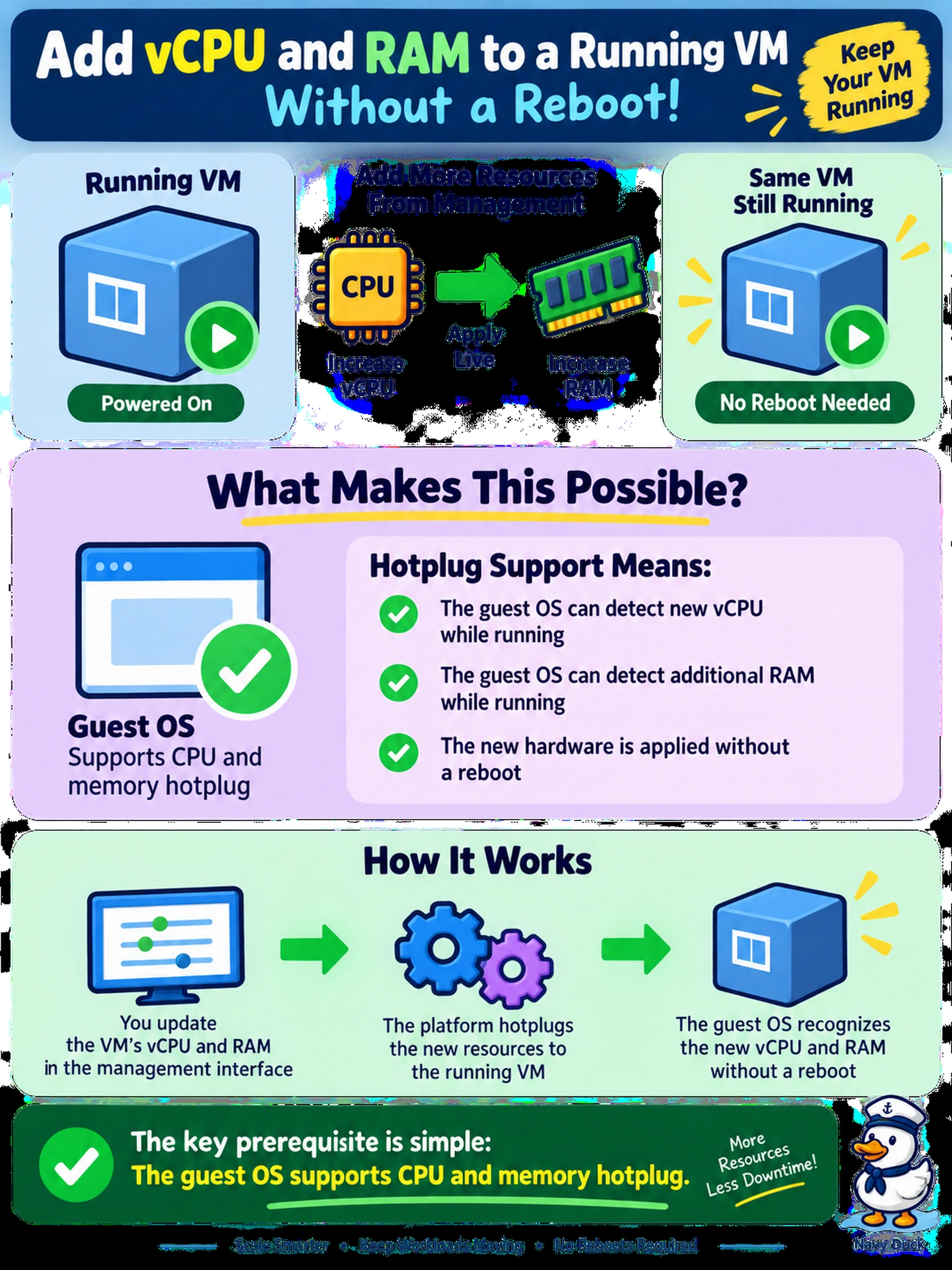
Think of hotplug like adding a memory module to a server that knows how to notice it. If the guest OS can accept CPU and memory changes, you can update a running AHV VM without rebooting. The trap is thinking Prism can force a guest that ignores hotplug to use the new resources immediately.
Full Explanation
AHV can change vCPU and memory on a powered-on VM through hardware hotplug when the platform and guest OS support it. Prism updates the VM's requested resources, then the hypervisor signals the guest to bring the new vCPU or memory online. Capacity must also be available on the host or cluster so the VM can be scheduled with the larger footprint. For AHV, this is a VM configuration operation, not a storage policy change. Powering the VM off is the conservative method, but it is not the prerequisite for live adjustment; if hotplug is supported, the change can be applied without an outage. Live migration relocates a running VM to another AHV host to balance load or prepare maintenance; it does not itself unlock CPU or memory hotplug. A protection domain defines replication and recovery relationships for VMs, so it governs DR operations rather than whether Prism can resize a running VM. Exam caveat: Nutanix live changes are supported only where the guest OS and hypervisor support them; verify behavior and resource availability before promising zero downtime. Operational check: edit the running VM's vCPU and memory in Prism, confirm the task completes, then validate the guest sees the new resources.