
An engineer manages several AHV clusters from Prism Central. During a planned power event, the host running the Prism Central VM may go offline. Before the event, which management-plane resilience consideration should be verified?
Select an answer to reveal the explanation.
Short Explanation
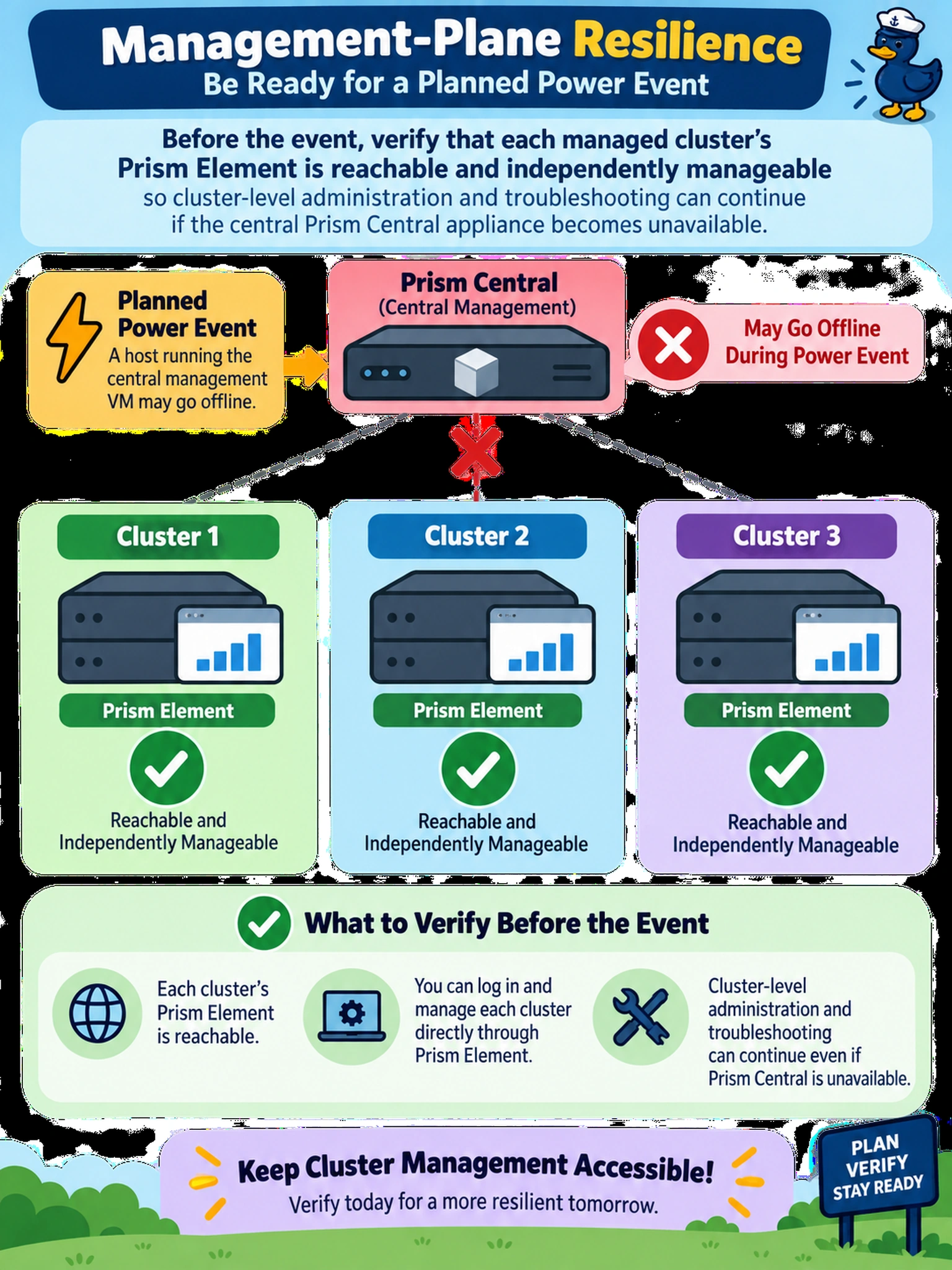
Think of Prism Central as your central dashboard, but it isn't the only door into each cluster. If that dashboard goes dark, your local Prism Element still lets you manage and troubleshoot the cluster, so you'd want that path proven before the outage. The trap is assuming central management doesn't equal cluster management.
Full Explanation
Prism Central aggregates inventory, alerts, and cross-cluster workflows, but it is not the only control path for cluster operations. Each cluster retains its own Prism Element management service, so verifying that Element is reachable from the admin network preserves local cluster administration, monitoring, and troubleshooting when the central appliance is down. In a resilience review, the right consideration is whether the management plane has a fallback path for the clusters themselves, not merely whether the central console is isolated or restorable. Isolating the management VM on a separate cluster reduces noisy-neighbor risk, but it does not remove the dependency on that cluster and can create a second management plane that still needs protection. Snapshots help recover a corrupted or misconfigured management VM, yet they are a point-in-time restoration method rather than continuous availability during a host or CVM outage. Flow controls application network policy and segmentation; it does not provide high availability or load balancing for the Prism management services. Exam caveat: Do not confuse centralized management with centralized control of every cluster operation. Operational check: From the administrator network, log in to Prism Element on each managed cluster and confirm cluster health and VM operations remain available while Prism Central is intentionally offline.