
Two AHV VMs in the same Prism Central cluster cannot communicate with each other. Each VM is connected to a different VLAN, and both VLANs have gateways. The engineer needs to identify why traffic fails. What should be verified first?
Select an answer to reveal the explanation.
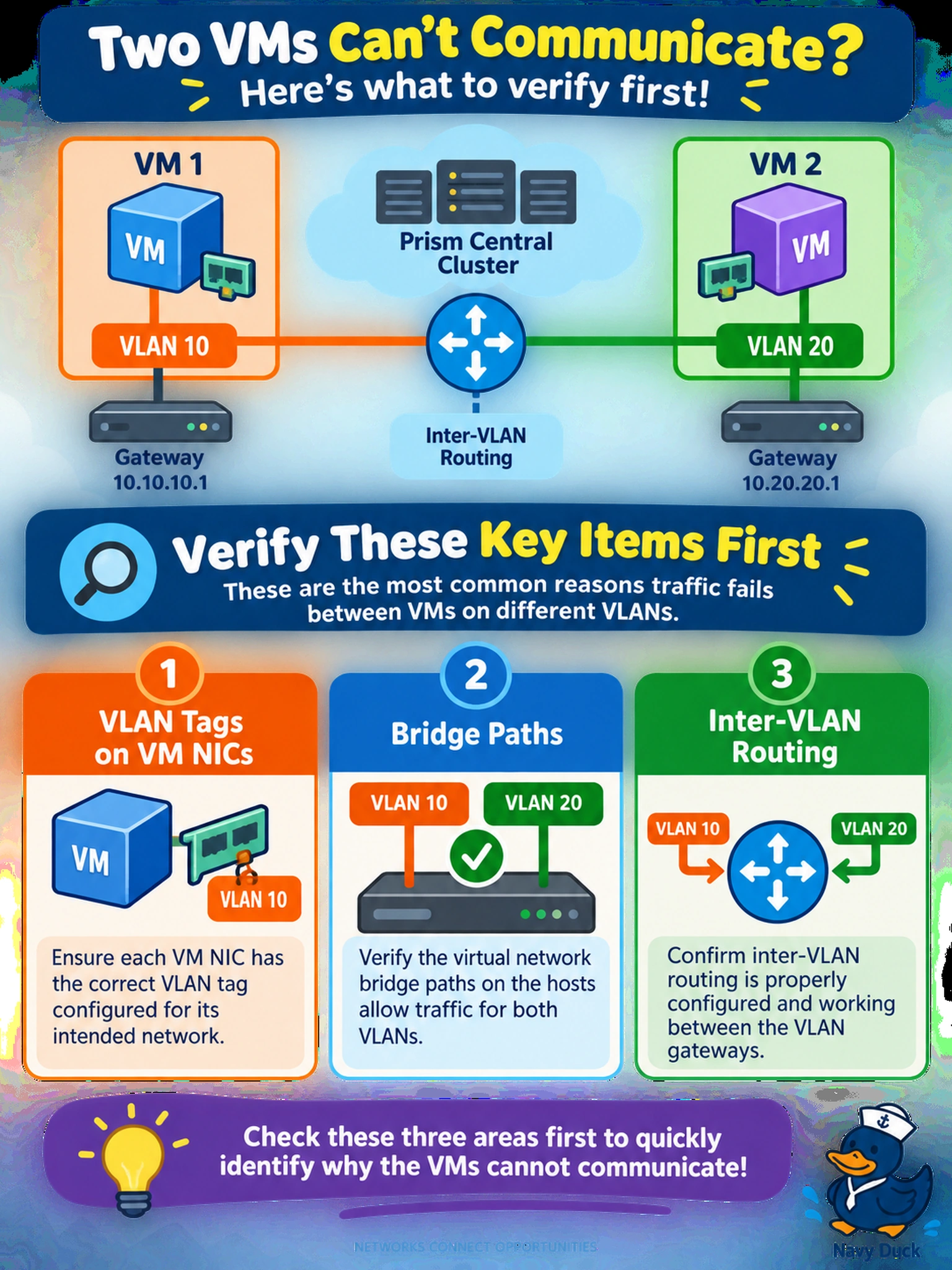
Short Explanation
Think of it like this: VLANs are separate hallways, and your VMs need the right door plus a route between hallways. If a VM can't reach another VLAN, first check the NIC VLAN tag, the bridge path, and inter-VLAN routing. Don't chase bond modes or mirroring until you've ruled out the basics.
Full Explanation
In Nutanix AHV, VM network traffic leaves the guest NIC through a virtual switch port that must be configured with the correct VLAN tag and be connected to the appropriate bridge or network path. For communication between different VLANs, the guest NICs must carry the expected tags, the host bridge must forward those tagged frames, and a routed interface or gateway must exist between the VLANs. When those three conditions align, traffic can traverse the logical networks. Checking Flow port mirroring does not solve reachability because mirroring duplicates traffic for inspection and does not create forwarding, routing, or VLAN membership. Verifying the storage bridge MTU against the CVM network MTU is unrelated to VM-to-VM VLAN communication because the storage bridge carries cluster and storage traffic rather than guest VLAN frames. Confirming that host bonds use active-backup mode addresses link redundancy or failover behavior, not whether the VM is attached to the correct VLAN or whether routed connectivity exists. Exam caveat: the exam expects you to separate guest network path validation from storage network tuning and from monitoring features such as mirroring. Operational check: from Prism Central or the AHV host, inspect the VM NIC VLAN settings and the bridge configuration, then confirm the gateway or routed interface for each VLAN is active.