
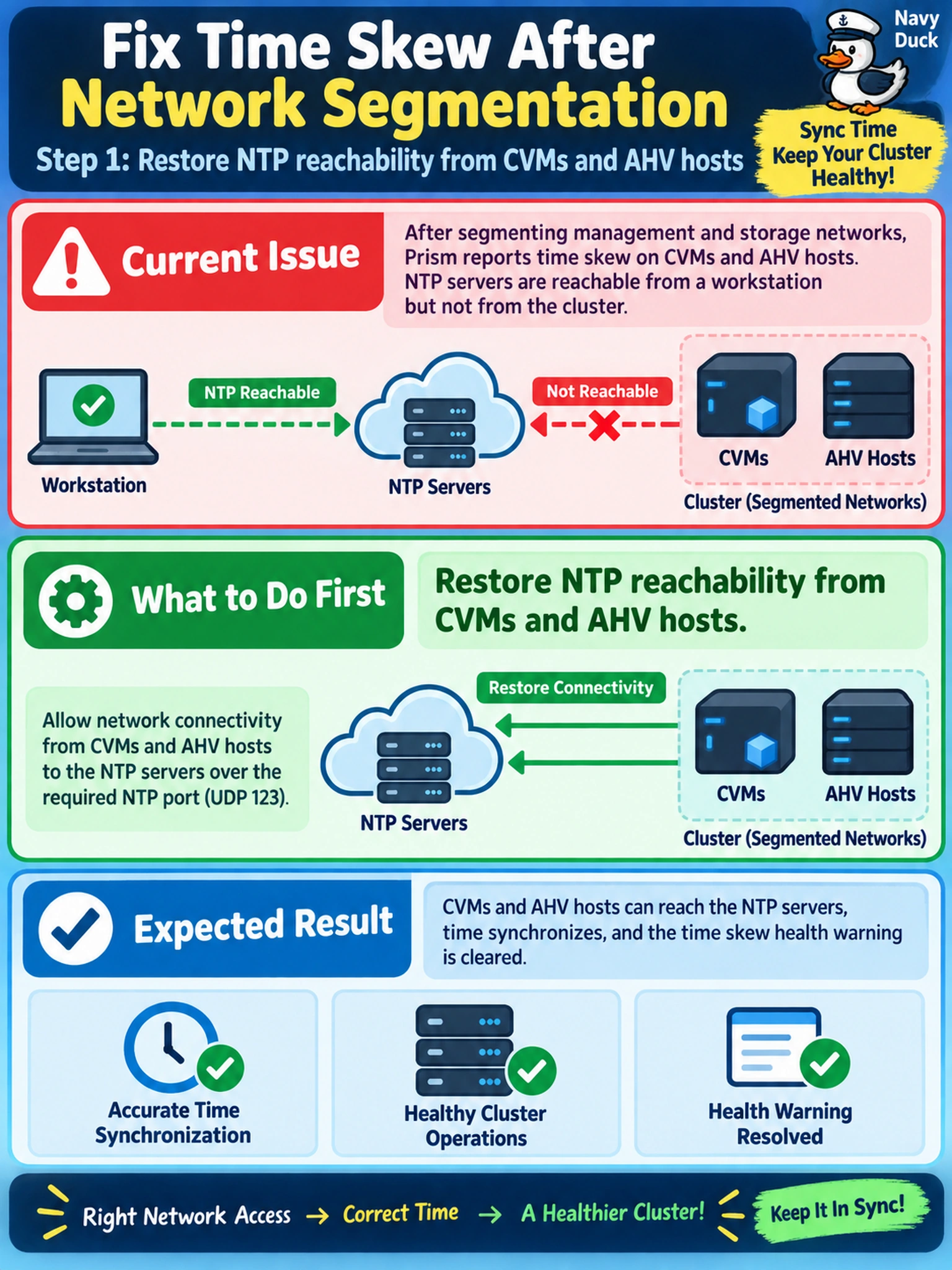
After segmenting management and storage networks on an AHV cluster, Prism reports time skew on CVMs and AHV hosts. NTP servers are reachable from a workstation but not from the cluster. What should the administrator do first to resolve the health warning?
Select an answer to reveal the explanation.
Short Explanation
Think of time sync like a heartbeat for the cluster: if the CVMs and AHV hosts can't reach NTP, health checks start screaming. After you slice networks, the first thing to ask is, 'Did the new path block the clocks?' Don't reboot or tweak time zones—restore NTP reachability from both CVMs and AHV hosts.
Full Explanation
NTP is a cluster health dependency because CVM and AHV host time must stay synchronized for distributed services, log correlation, and health checks. After a network segmentation change, the practical dependency is reachability: the CVMs and AHV hosts must be able to reach the configured NTP source through the new segment. If only a workstation can reach NTP, the cluster still fails the time check because the health warning is evaluated on cluster components, not on an outside client. Restoring firewall, VLAN, and routing paths for NTP from CVMs and AHV hosts is the correct remediation. A storage bond or bridge failure would show link, failover, or throughput symptoms, not primarily a time-skew warning, so recreating the network object is not the first step. Restarting CVMs may interrupt cluster services and does not create a missing NTP path; time drift returns if reachability remains blocked. Changing AHV host time zones affects local display, not coordinated time synchronization, and can create more confusion. Disabling checks would suppress the symptom and is not a supported way to resolve a real time-sync dependency. Exam caveat: treat time skew as an NTP dependency and a network reachability problem, not a clock-setting problem. Operational check: test NTP from a CVM and an AHV host, then verify the same source and firewall rules on the management and data network paths.