
During a Nutanix performance review, an AHV VM sees high storage latency, and you need to confirm which AOS service handles the primary data path for VM disk I/O. Which service should you examine?
Select an answer to reveal the explanation.
Short Explanation
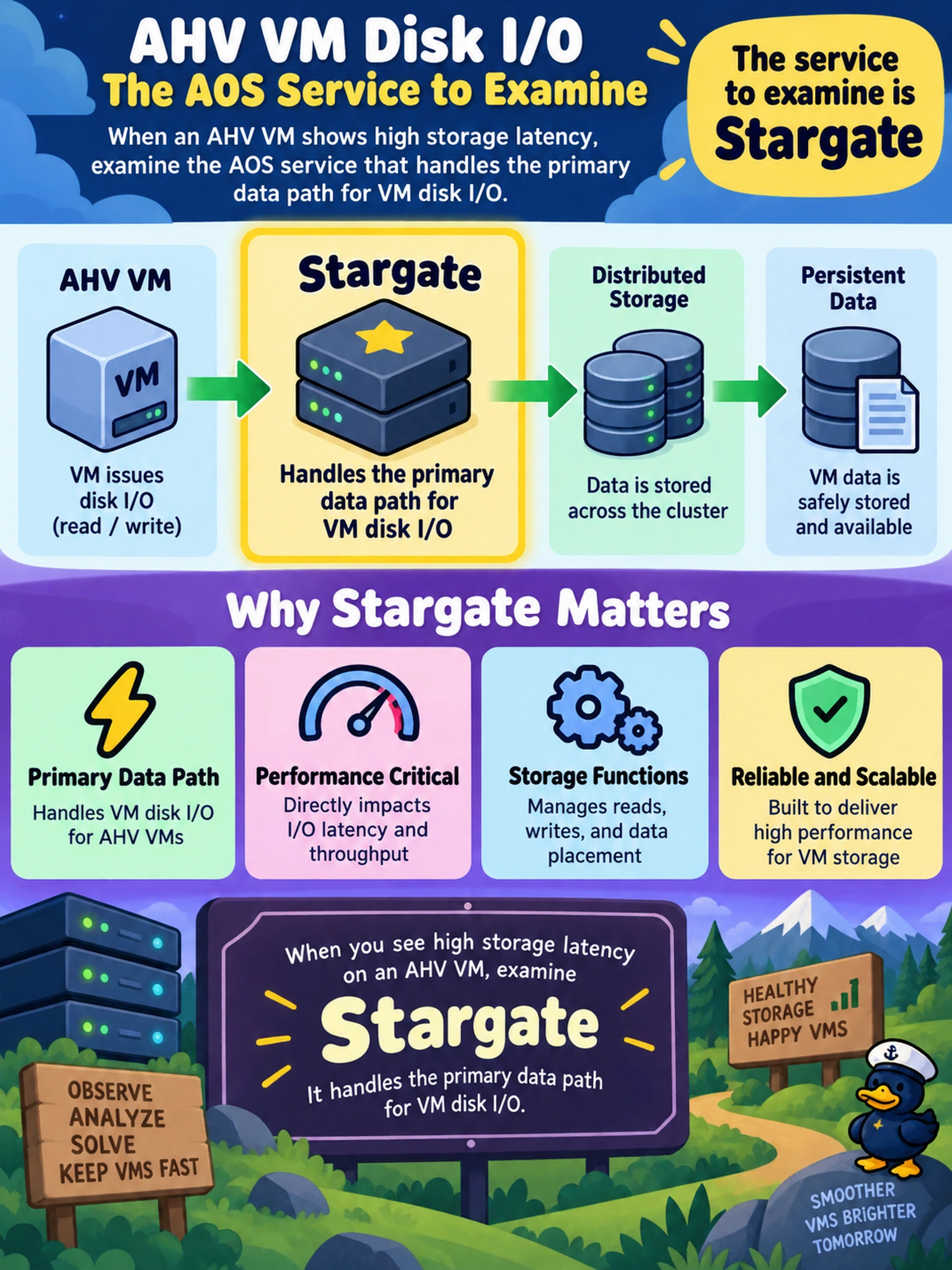
Think of it like this: when your VM sends a disk I/O, Stargate is the front door that receives and routes it. Curator, Cassandra, and Zookeeper are important, but they don't own the hot data path. If latency is on disk I/O, start with Stargate, not the background services.
Full Explanation
In Nutanix AOS, Stargate is the service that presents virtual disks to the hypervisor and handles the primary storage data path for VM disk I/O. It receives read and write requests from the guest, maps them into the distributed storage fabric, and coordinates movement of data across the cluster, so disk latency tied to VM I/O is analyzed through Stargate behavior and metrics. Curator performs background data services such as data reduction and related maintenance, which occur after primary I/O rather than serving the VM's request path. Cassandra stores distributed metadata and cluster state, so it supports metadata consistency and health but does not carry the VM's read/write data path. Zookeeper provides distributed coordination and leader election for cluster management functions, not the data plane for virtual disk operations. Exam caveat: Stargate is a data path service, while Curator, Cassandra, and Zookeeper are control-plane or background services. Operational check: Use the cluster performance monitoring tools to inspect storage I/O metrics for the affected CVM and correlate VM disk latency with Stargate queue depth, throughput, and error counters.