
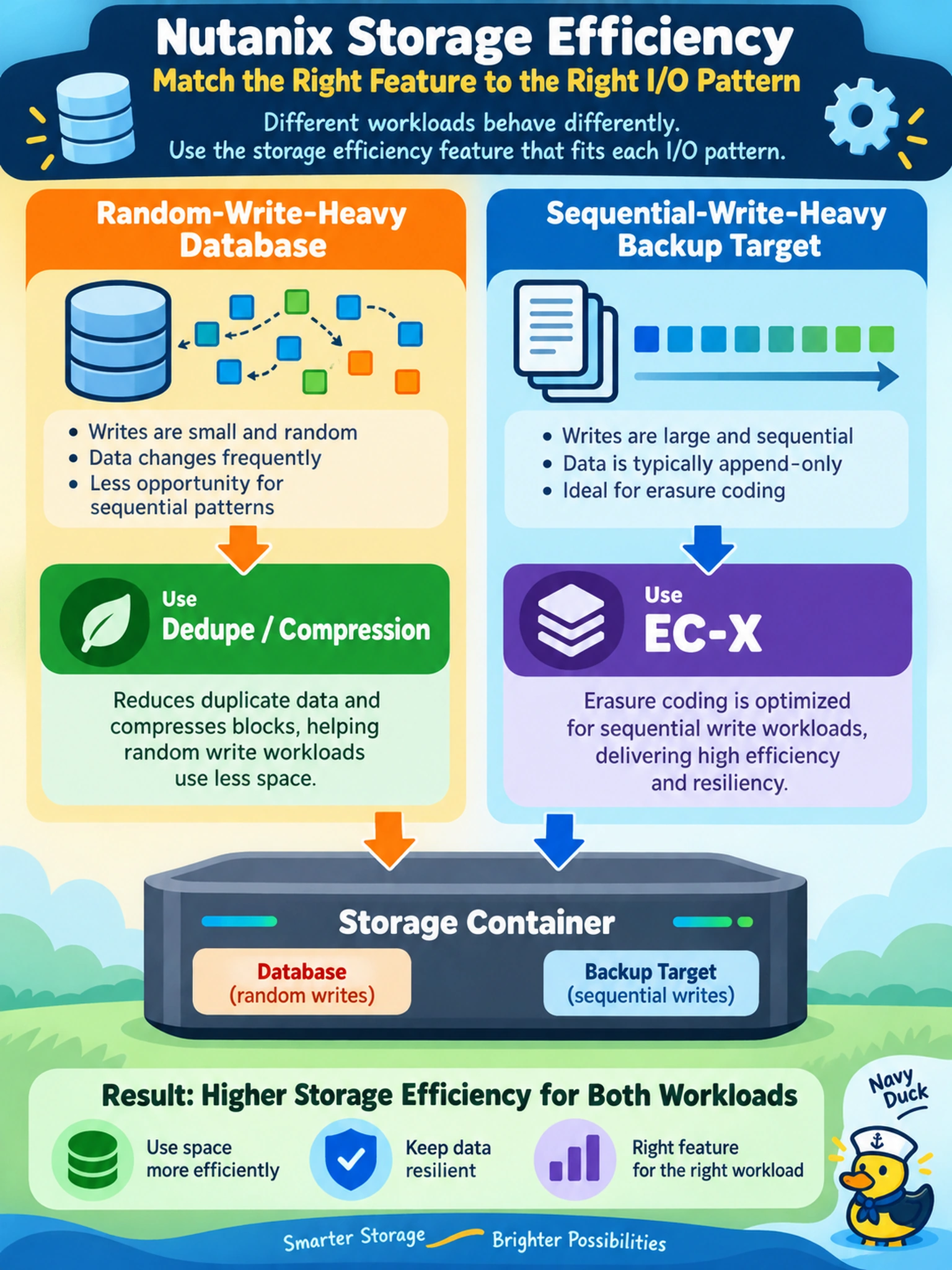
A Nutanix administrator is tuning storage efficiency on a container that hosts both a random-write-heavy database and a sequential-write-heavy backup target. Which placement best matches Nutanix storage efficiency behavior to these I/O patterns?
Select an answer to reveal the explanation.
Short Explanation
Think of EC-X like a bulk discount: it shines when you write large sequential blocks, while random writes punish it with extra rebuild work. You want dedupe/compression for the random-write container, because those features smooth small writes without the same EC-X overhead. Don't let capacity savings tempt you into erasure-coding a database that hammers random I/O.
Full Explanation
EC-X is a capacity-optimization feature that replaces RF2/RF3 mirror overhead with erasure coding once data is written. It is most efficient when writes arrive as large sequential extents because the cluster can write parity once and avoid frequent rebuilds. Random-write workloads, such as databases, update small scattered blocks; applying EC-X to them increases rebuild and read-modify-write pressure. Deduplication and compression are post-process efficiency layers that reduce stored data for patterns with repeated blocks and can be paired with mirrored containers for random-write workloads. EC-X for random writes is wrong because erasure coding assumes relatively stable extents and penalizes frequent small updates. Dedupe/compression for sequential writes is wrong because it misses the main capacity benefit of EC-X for large sequential data and can still leave mirrored overhead. EC-X for both is wrong because capacity reduction must be balanced against I/O pattern; it is not universally optimal. Exam caveat: the exam tests the workload-to-feature match, not exact menu paths. Operational check: review Prism performance metrics for write size and random/sequential behavior before enabling EC-X on a container.