
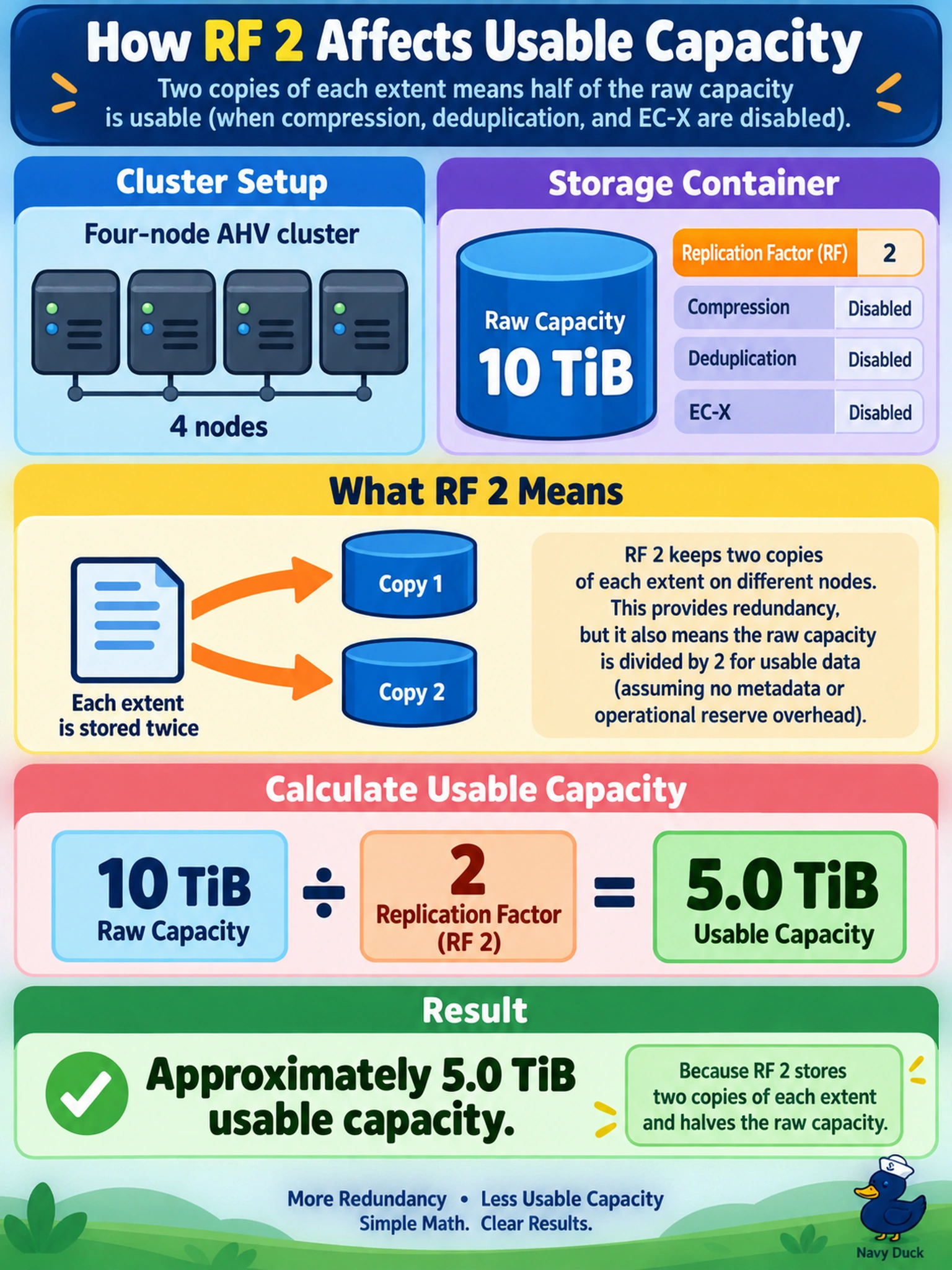
An administrator configures a storage container with 10 TiB of raw capacity on a four-node AHV cluster. The container uses RF 2, with compression, deduplication, and EC-X disabled. Assuming no metadata or operational reserve overhead, what is the approximate maximum usable capacity?
Select an answer to reveal the explanation.
Short Explanation
Think of replication factor like making photocopies: RF 2 means two copies, so your raw space gets split in half. Don't confuse that with EC-X or RF 3, because the math changes fast. If compression and dedupe are off, the usable capacity is just raw divided by RF.
Full Explanation
A storage container's usable capacity is governed first by the replication factor applied to data extents. With RF 2 and no data-reduction features enabled, each extent is written twice across fault domains, so the theoretical usable capacity is raw capacity divided by 2. The calculation assumes no metadata overhead, no free-space reserve, and no compression, deduplication, or EC-X, because those features alter the relationship between raw and usable capacity. A higher apparent usable value than raw/2 would require erasure coding or data reduction, not plain RF 2. A value equivalent to raw/3 reflects RF 3, which stores three copies and consumes more raw space. A value equal to raw capacity ignores the purpose of replication factor: it protects data extents by creating additional copies, not merely metadata. In practice, administrators should calculate expected usable capacity from RF, then verify it in Prism Element or Prism Central after container creation, because operational reserve and background processes can reduce the space available to VMs. Exam caveat: treat RF as a divisor unless the question explicitly enables EC-X or data reduction. Operational check: create a test container with the intended RF, then compare the reported usable capacity against the expected raw/RF result before placing production VMs.