
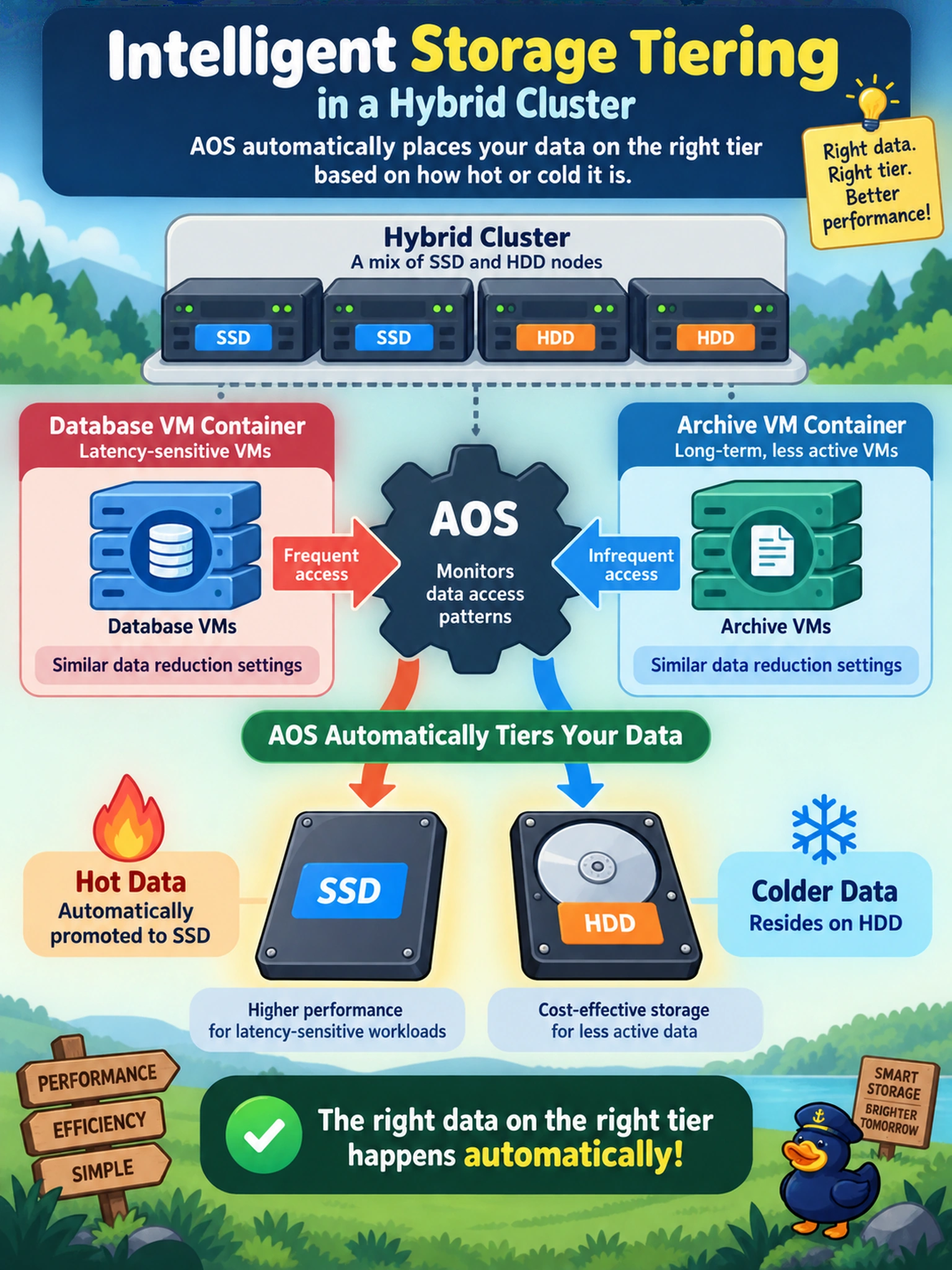
A hybrid Nutanix cluster contains both SSD and HDD nodes. An admin creates a container for latency-sensitive database VMs and another for archive VMs, both with similar data reduction settings. Which statement best describes how AOS handles storage tier behavior for these workloads?
Select an answer to reveal the explanation.
Short Explanation
Think of a hybrid cluster like a desk: hot files stay within reach on SSD, while older files get shelved on HDD. You don't manually pin a container to one disk type for normal tiering; AOS moves data by access patterns. Don't confuse that with data reduction or manual rebalancing.
Full Explanation
In a hybrid cluster, AOS storage tiering treats SSD and HDD as a single logical capacity pool. Frequently accessed blocks are kept on SSD, while less active blocks age onto HDD as background tiering and data services move data. Container settings such as redundancy, compression, and deduplication shape how data is stored and reduced, not which physical tier a block lands on. Workload placement is therefore based on access behavior and the cluster's tiering policy rather than on manually binding a container to SSD-only or HDD-only nodes.
Container pinning to a specific disk class is not required for normal hybrid tiering; binding containers that way fights automatic movement of hot and cold data. Compression and deduplication reduce capacity consumption and may affect CPU or latency, but they do not choose the SSD or HDD tier for a block. A design where writes land on HDD first and wait for operator rebalance is also wrong; hybrid clusters use the flash tier for active data and move colder data to capacity media automatically.
Exam caveat: focus on the concept of automatic storage tiering, not on guessing a Prism menu path. Operational check: inspect a VM's disk metrics for read/write latency and confirm hot blocks remain on SSD while colder blocks age to HDD.