
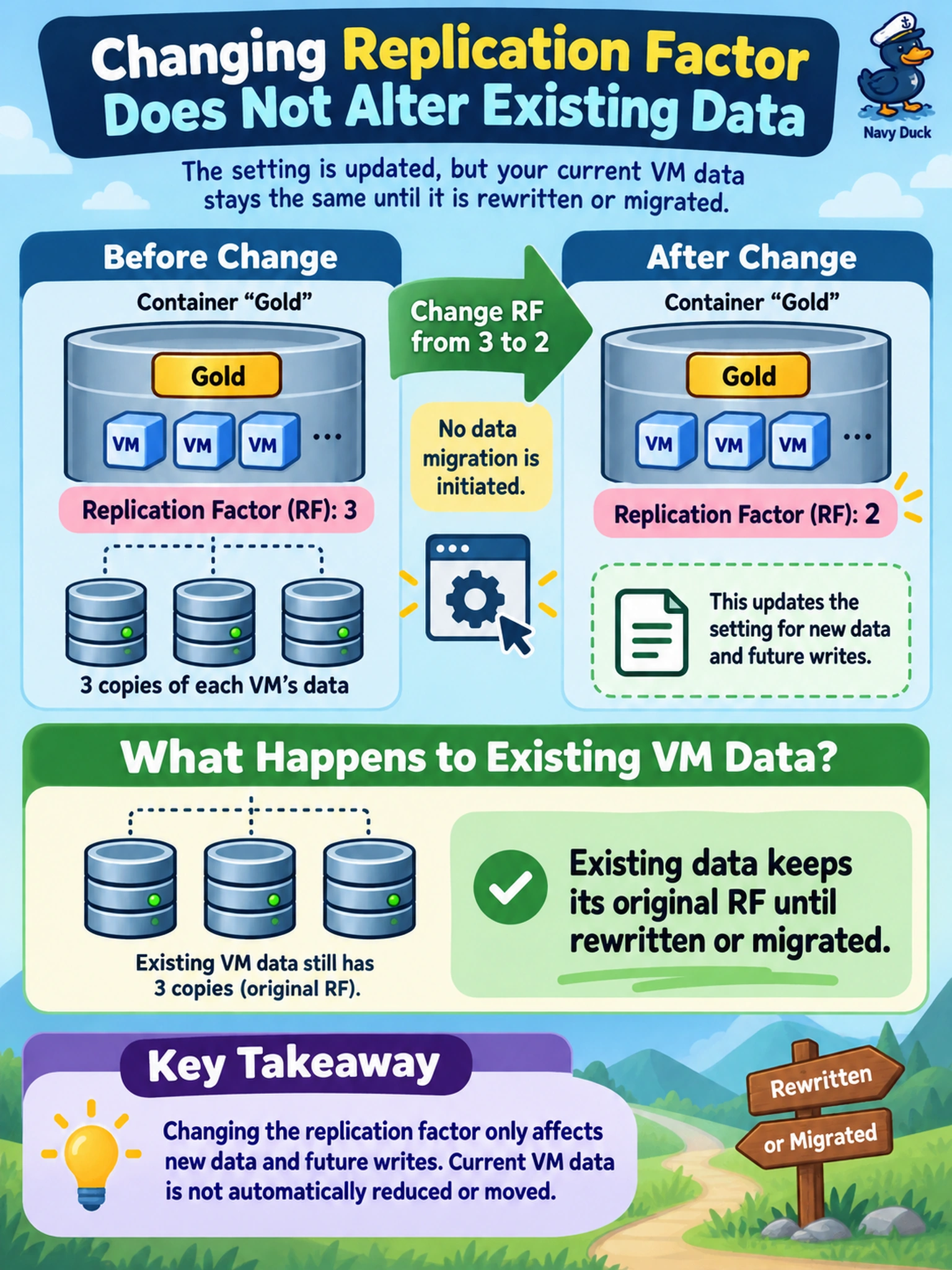
You change the Replication Factor (RF) from 3 to 2 on an existing storage container named 'Gold' that currently hosts several running VMs. No data migration is initiated. What is the immediate effect on the existing VM data stored on this container?
Select an answer to reveal the explanation.
Short Explanation
Think of changing RF like lowering an insurance limit after a claim; your old blocks don't suddenly get rewritten. You're changing the rules for future writes, not forcing existing data to move or re-protect itself.
Full Explanation
Nutanix applies container protection settings when blocks are written, so changing a container's RF changes the default protection for new writes. Existing blocks keep the RF they were created with, because AOS does not rewrite all data immediately when a policy changes. This avoids a cluster-wide rewrite storm and keeps running VMs stable while the new RF takes effect gradually as data is written or moved. The idea that all existing data is immediately rewritten is wrong because that would create excessive I/O and was never the behavior of container RF changes. The idea that the container becomes inaccessible is wrong because RF is a protection policy, not a mount or availability setting, and the data remains readable and writable. The idea that storage consumption drops instantly is wrong because old blocks remain allocated at their original redundancy until they are overwritten, deleted, or migrated. Exam caveat: Do not confuse a container RF change with a VM storage policy change; both affect future writes rather than forcing immediate rewrites. Operational check: To enforce the new RF on existing VMs, migrate the affected VMs to a container using the desired RF.