
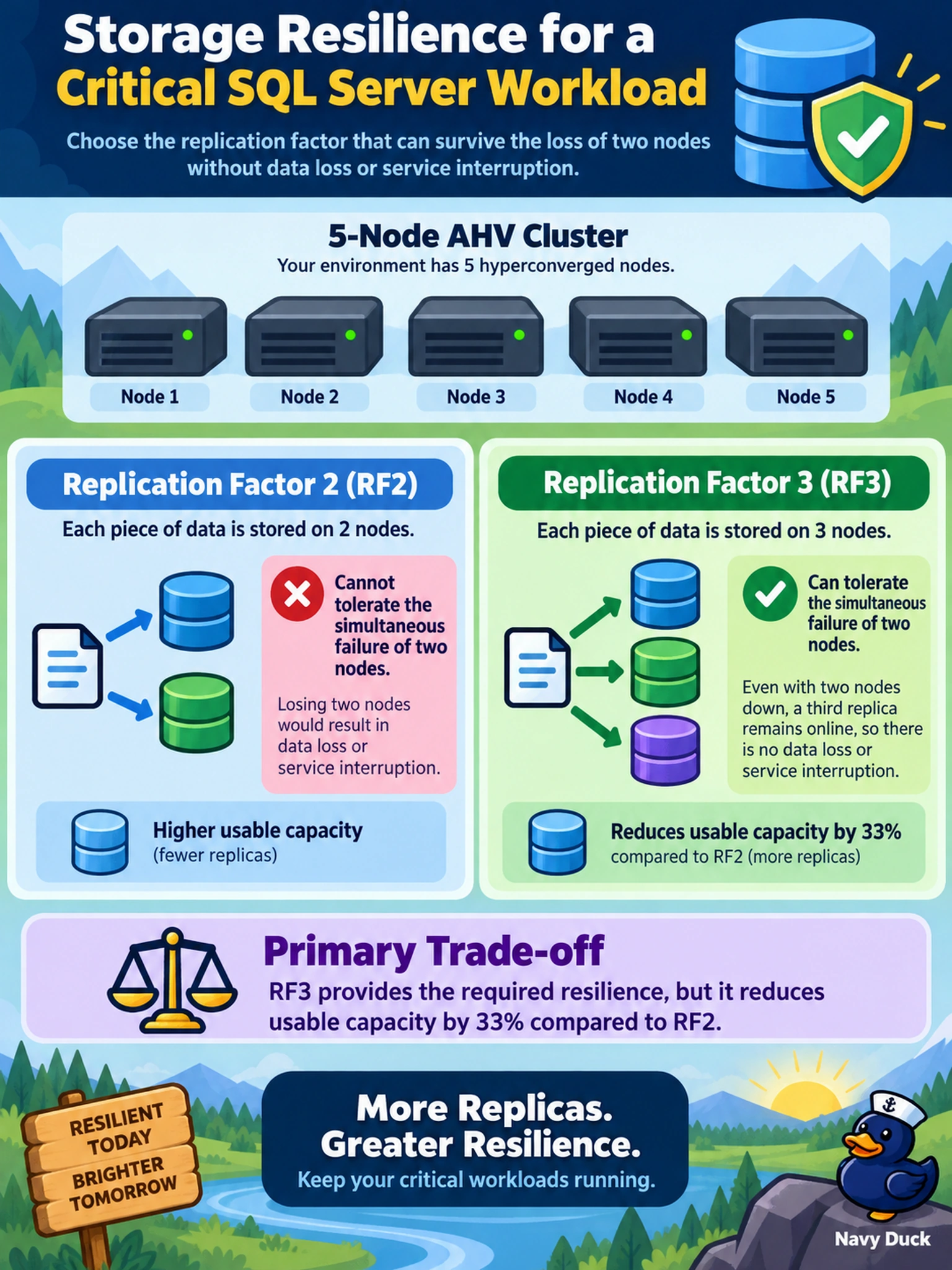
You are provisioning a new container for a critical SQL Server workload on a 5-node AHV cluster. The CISO mandates that the storage layer must tolerate the simultaneous failure of two nodes without data loss or service interruption. You must choose between configuring the container for Replication Factor 2 (RF2) or Replication Factor 3 (RF3). Which configuration meets the resilience requirement, and what is the primary trade-off?
Select an answer to reveal the explanation.
Short Explanation
Think of RF like copies of your data: RF2 keeps two copies, so one node can die; RF3 keeps three, so two can die. If the CISO wants double-node failure tolerance, RF3 is the only safe choice, and the trap is thinking you're getting it free—RF3 consumes more raw capacity than RF2.
Full Explanation
Replication Factor controls how many independent copies of each block AOS keeps across different nodes. RF2 protects against a single node failure; RF3 protects against two simultaneous node failures, which is why RF3 satisfies the stated resilience requirement. The cost is capacity efficiency: RF3 requires 1.5 times the raw capacity of RF2 for the same logical data, so usable capacity falls by about 33 percent relative to RF2. RF2 does not meet the requirement because two failed nodes could remove both replicas; Stargate rebuilds data after a failure, but it cannot recover data when both copies are gone. Erasure Coding is a different redundancy mechanism that can reduce capacity overhead, but it does not make an RF2 container equivalent to RF3 for this requirement without changing the protection model and accepting different performance and complexity trade-offs. RF3 does increase write fan-out, yet a 50 percent latency penalty is not a reliable general outcome on a healthy cluster with sufficient network and CPU headroom. Exam caveat: distinguish fault tolerance from capacity cost, and do not assume Erasure Coding automatically satisfies a stated RF requirement. Operational check: confirm the container RF in Prism Element, then calculate raw capacity demand at RF3 and verify spare capacity before provisioning the workload.