
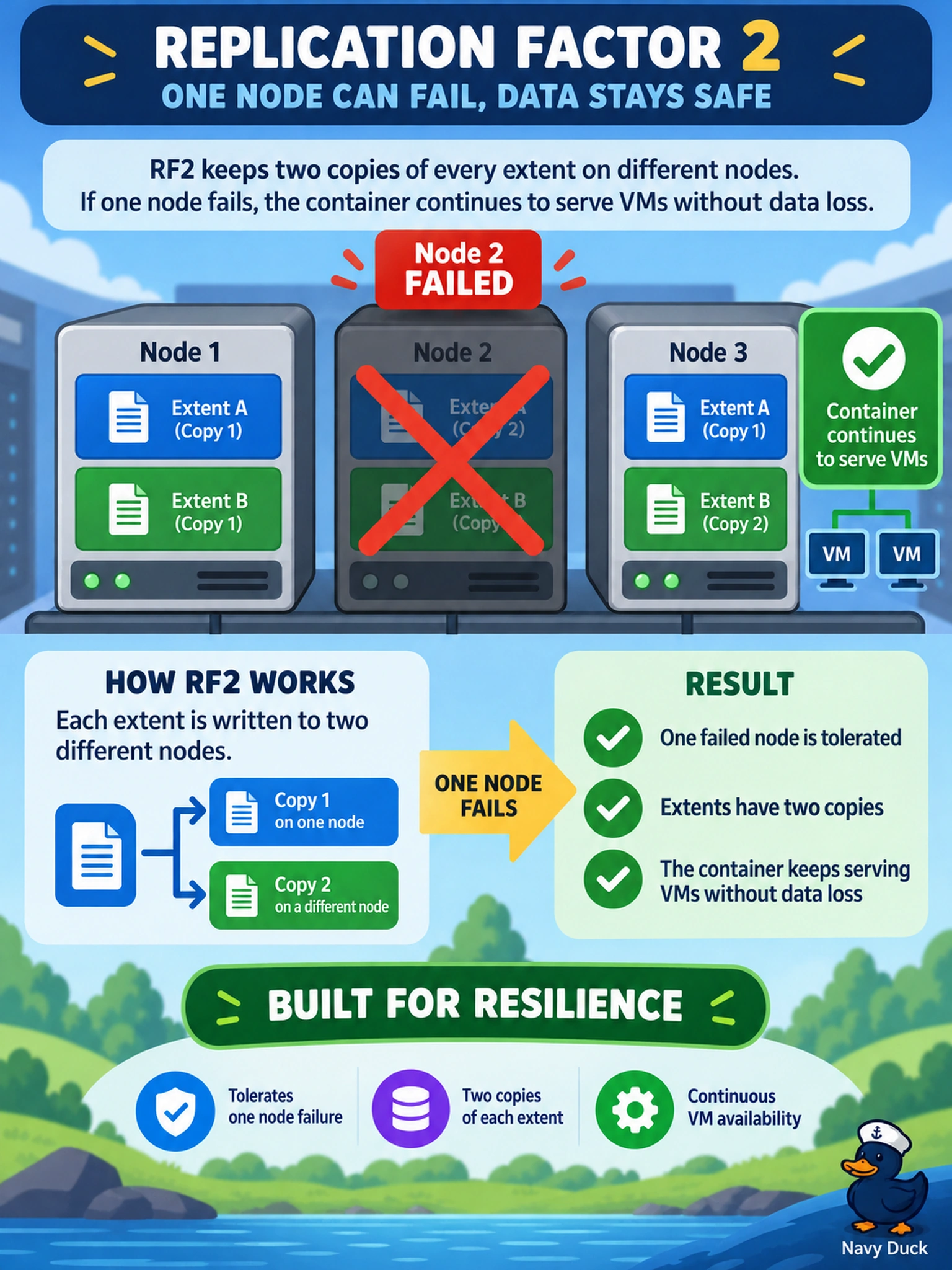
A production container is configured with Replication Factor 2. During maintenance, one AHV node fails and is powered off. The administrator must confirm the container can continue serving VMs without data loss. Which failure domain does RF2 provide?
Select an answer to reveal the explanation.
Short Explanation
Think of RF2 like keeping two copies of your house key: if one goes missing, you still get in. If both are gone, you're locked out, so RF2 only tolerates one failure. The trap is assuming more copies than actually exist.
Full Explanation
Replication Factor 2 is a storage policy applied to a container: each extent is written as two copies, normally placed on separate nodes to create a node-level failure domain. When one AHV node fails, the surviving copy can still be read and written, so the container continues serving VMs without data loss. The protection boundary is the copy count: two copies can lose one copy, but not two. A three-copy layout is a different failure domain because it can lose two copies, so claiming RF2 tolerates two failed nodes overstates its durability. Similarly, erasure coding is a distinct data layout that combines data and parity chunks; its resilience depends on the EC configuration, not on RF2, and it is not the mechanism implied by a simple two-copy container. A one-copy layout offers no redundancy, so any failed node holding that copy can cause data unavailability or loss. Exam caveat: Treat replication factor as the number of copies, not as an automatic rack, disk, or site guarantee unless the failure domain is explicitly defined. Operational check: Review the container RF and confirm data placement spans nodes, then validate with a controlled node outage.