
You are provisioning a new storage container for a production database on a Nutanix cluster. The application requires that data remains accessible and writable even if two nodes fail simultaneously. You have sufficient raw capacity available on the cluster. Which replication factor should you configure for this container to meet the availability requirement without over-provisioning?
Select an answer to reveal the explanation.
Short Explanation
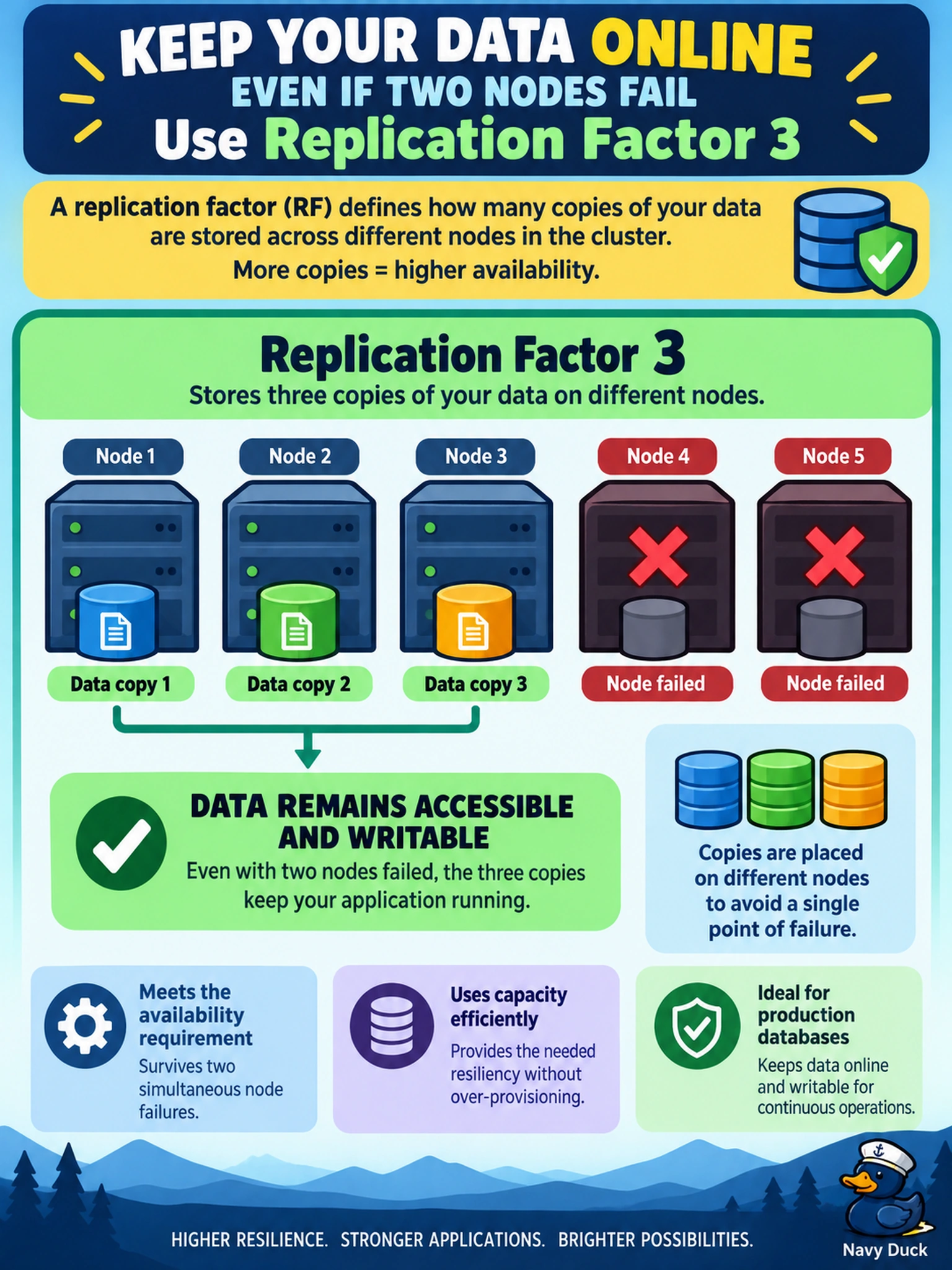
Think of replication factor like insurance coverage: RF 2 only covers one node failure, so if two nodes die you lose a copy. Pick RF 3 when you need to survive two failures, and don't pay for RF 4 just because capacity exists.
Full Explanation
Nutanix Acropolis Operating System (AOS) uses Replication Factor (RF) to determine how many copies of data are stored across the cluster. RF 2 stores two copies of every extent, allowing the cluster to survive a single node failure while maintaining data availability and integrity. RF 3 stores three copies, allowing the cluster to survive up to two simultaneous node failures. The scenario specifies the requirement to remain accessible and writable after two nodes fail. RF 2 is insufficient because the loss of two nodes would result in the loss of both copies of the affected data extents, leading to data unavailability. RF 4 would provide redundancy for three node failures, which exceeds the stated requirement and results in unnecessary capacity consumption and write amplification. Erasure Coding (EC-X) typically operates with a lower effective RF (often RF 2 equivalent for protection against single failures or specific stripe configurations), but standard EC-X implementations do not guarantee the same synchronous write path durability or availability guarantees during multiple simultaneous node failures as RF 3 does for this specific tolerance level without complex configuration that is not standard for this basic requirement. The correct choice aligns the redundancy level precisely with the fault tolerance requirement. Exam caveat: Do not confuse RF with Erasure Coding efficiency metrics; RF is a direct count of copies. Operational check: Verify the container's RF setting in Prism Element or Prism Central before applying the storage policy to the VMs.