
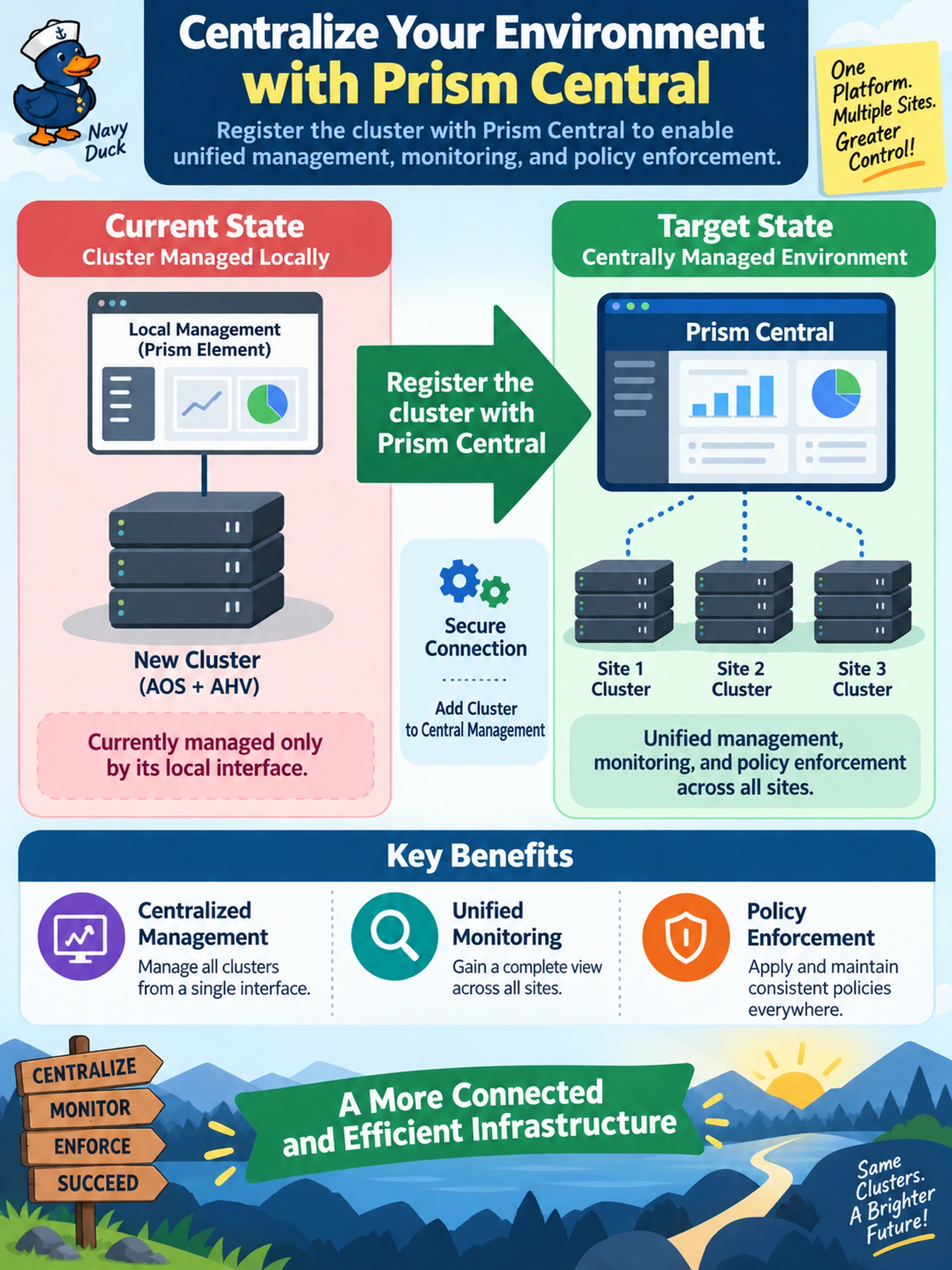
You have just completed the initial configuration of a new Nutanix cluster running AOS and AHV. The cluster is currently managed solely by its local Prism Element interface. Your organization requires centralized management, unified monitoring, and policy enforcement across this new cluster and several existing sites using Prism Central. Which action must you perform to achieve this centralized management?
Select an answer to reveal the explanation.
Short Explanation
Think of Prism Central as the conductor of an orchestra. If a new musician (your cluster) walks on stage but isn't introduced to the conductor, they just play their own sheet music in isolation. You have to register the cluster with Prism Central so it can see the big picture, apply global policies, and show up in your unified dashboards. Without that handshake, you're stuck managing each cluster separately, which defeats the whole point of a multicloud strategy.
Full Explanation
Prism Central serves as the centralized management plane for Nutanix environments, aggregating data from multiple Prism Element instances to provide a unified view of infrastructure health, capacity, and policy compliance. To bring a newly deployed cluster under this umbrella, the administrator must explicitly register the cluster with Prism Central. This registration process establishes the communication channel, allowing Prism Central to ingest telemetry, apply global RBAC, and manage resources centrally. Without this step, the cluster remains siloed, managed only via its local Prism Element interface. Upgrading the AOS version via Lifecycle Manager (LCM) is a maintenance task that ensures software currency and feature availability but does not establish the management relationship between Prism Element and Prism Central. Configuring a protection domain is a data protection activity related to disaster recovery and snapshots, unrelated to the administrative management plane. Creating a new storage container is a storage provisioning task that defines where data resides but has no bearing on the centralization of management functions. Exam caveat: Do not confuse the initial cluster configuration with Prism Central registration; they are distinct steps in the deployment lifecycle. Operational check: Verify the cluster appears in the Prism Central 'Clusters' list and that its health status is visible in the global dashboard.