
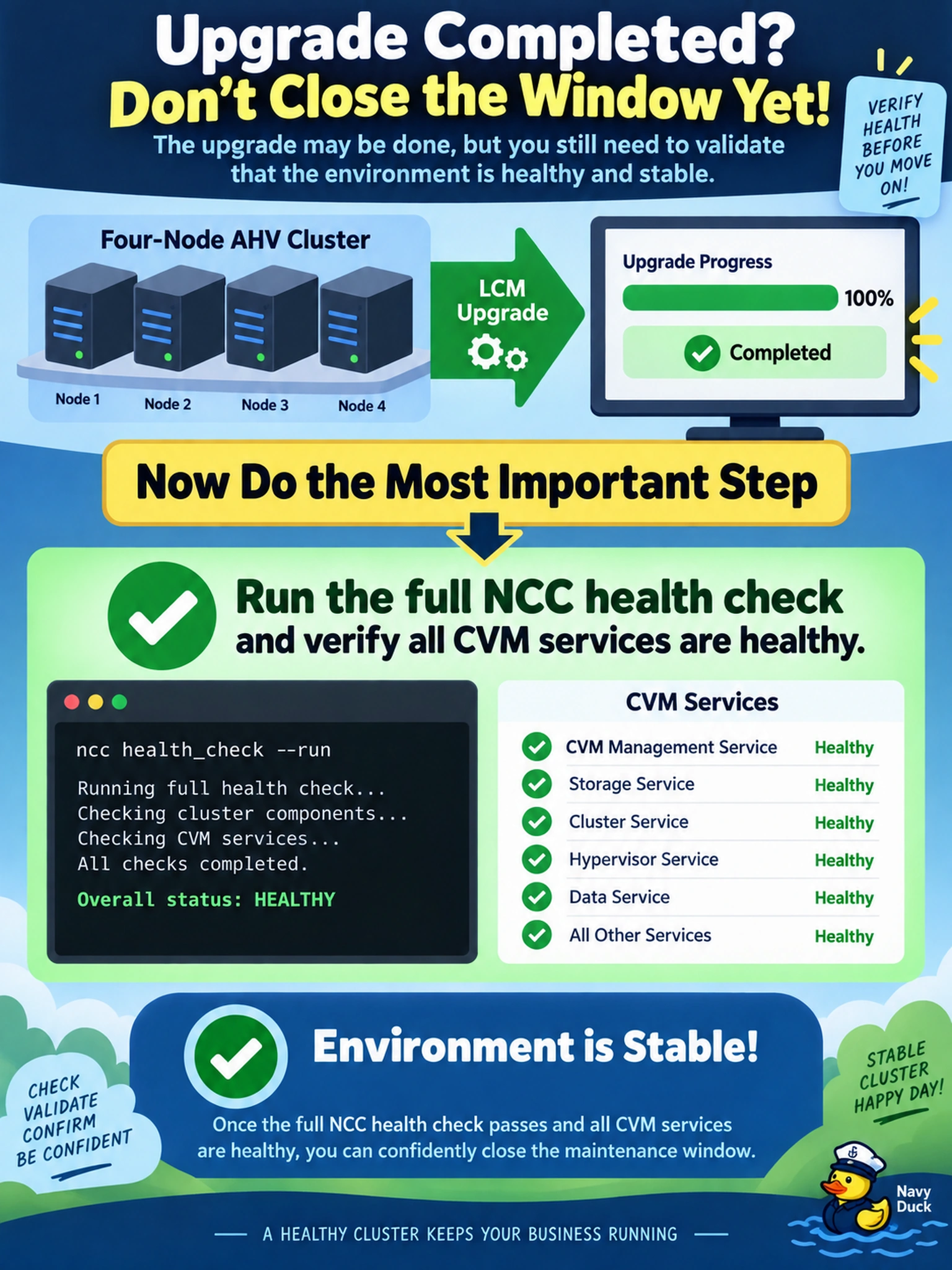
You have just completed a Prism-based LCM upgrade of a four-node AHV cluster. The LCM progress bar reaches 100% and the status shows 'Completed'. Before declaring the maintenance window closed, what is the single most critical validation step to ensure the environment is stable?
Select an answer to reveal the explanation.
Short Explanation
Think of an upgrade like a car repair: the mechanic saying 'done' is not the same as the engine being healthy. You need NCC to inspect core services and storage state before closing the window. Checking VMs or the UI alone can hide broken CVMs underneath.
Full Explanation
After an LCM upgrade completes, the change workflow has installed packages and restarted services, but the cluster’s distributed control plane may still be settling. Running NCC validates CVM process health, storage domain consistency, metadata integrity, and node-to-node communication, which are the services that keep AHV workloads safe after a version change. A passing NCC result is stronger evidence of readiness than the LCM status bar because it tests the operational state rather than the upgrade progress. Confirming VM accessibility only proves the guest OS is reachable; it does not reveal storage latency, metadata corruption, or a degraded CVM service that could later impact many VMs. Loading Prism Element UI proves the management interface is available, but the UI can remain responsive even when Curator, Stargate, or other backend services are unhealthy. Watching the Events pane for a short period is passive and can miss problems because alerts may be delayed, suppressed during maintenance, or only appear after the issue has already affected performance or redundancy. Exam caveat: Do not treat LCM completion as proof of cluster health; post-upgrade validation must include a health check. Operational check: Run the full NCC health check from Prism Element or CLI, review failed and warning items, and confirm all CVM services report normal before closing the maintenance window.