
An LCM-managed 4-node AHV cluster needs upgrades to LCM framework, AOS, and AHV. The admin wants minimal disruption and correct dependency handling. Which upgrade sequence should you use?
Select an answer to reveal the explanation.
Short Explanation
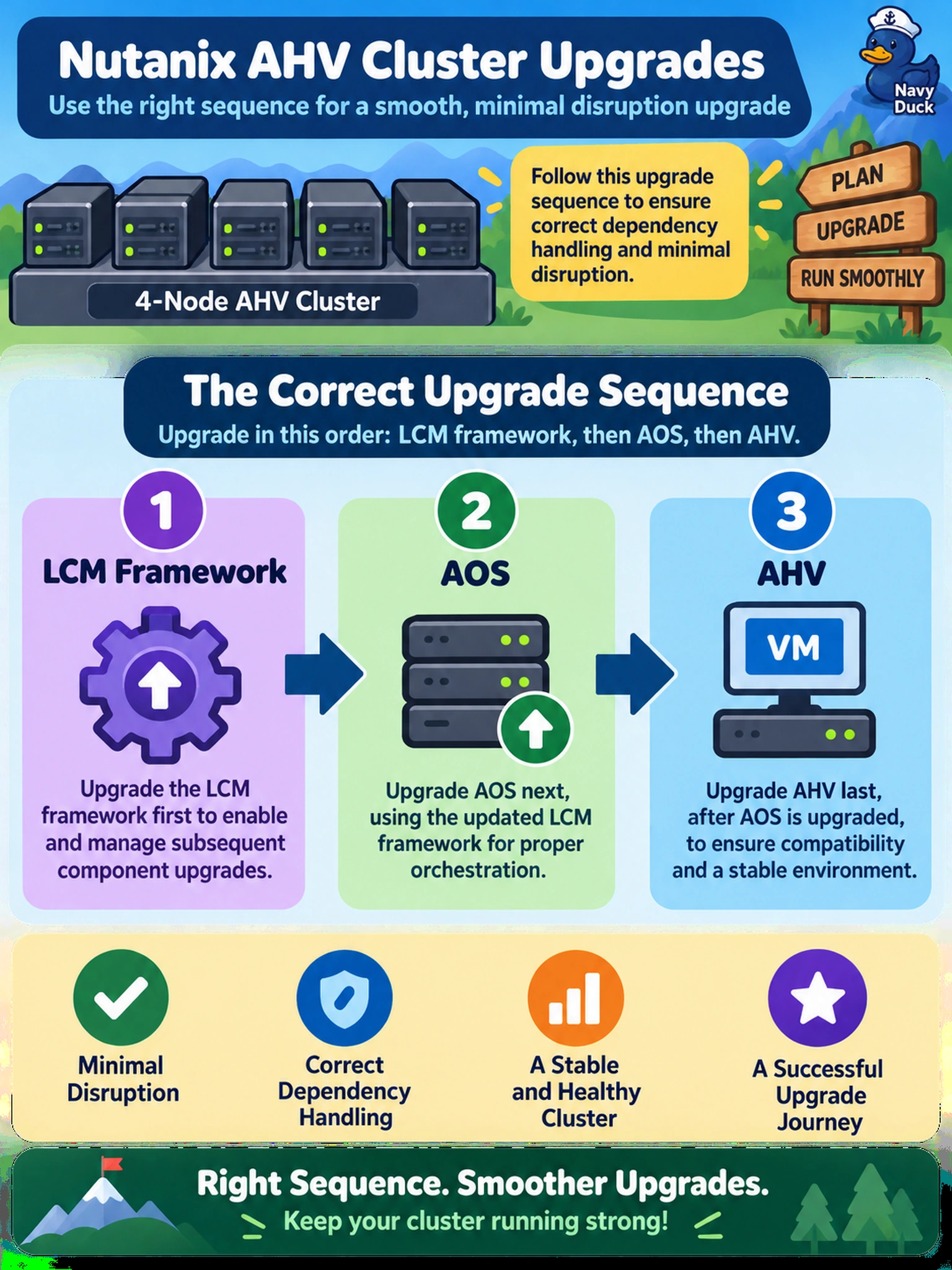
Think of LCM as the foreman before the crew starts work. Upgrade the framework first, then the storage layer, then the hypervisor. If you skip that order, you are asking old tools to manage new workloads.
Full Explanation
Lifecycle Manager uses a framework layer that understands component dependencies and orchestrates staged upgrades. The framework must be current before it can correctly validate, stage, and sequence AOS and AHV upgrades. AOS is upgraded before AHV because storage services and CVMs provide the cluster foundation; AHV upgrades then move hosts through rolling reboots while VMs remain available where supported. Upgrading AOS before LCM framework is wrong because the older framework may not recognize newer component versions or enforce the proper pre-checks. Upgrading AHV before AOS is wrong because hypervisor changes can assume a compatible storage stack and may interrupt CVM placement or VM mobility. Upgrading Prism Central before cluster components is not a substitute for node sequencing; Prism Central is a management plane and can be upgraded separately, but it does not establish dependency order for LCM-managed cluster nodes. Exam caveat: always run LCM pre-checks and review the release notes for the target AOS/AHV combination before starting. Operational check: run LCM inventory, confirm the framework upgrade is listed first, then verify AOS and AHV upgrade paths appear only after the framework update succeeds.