
A facility has an entryway to a posted High Radiation Area where dose rates reach 350 mrem/hr at 30 centimeters, and the door cannot be kept locked because operators enter frequently. Under NRC 10 CFR 20.1601, which control measure satisfies access control requirements when no interlock reduces the radiation level?
Select an answer to reveal the explanation.
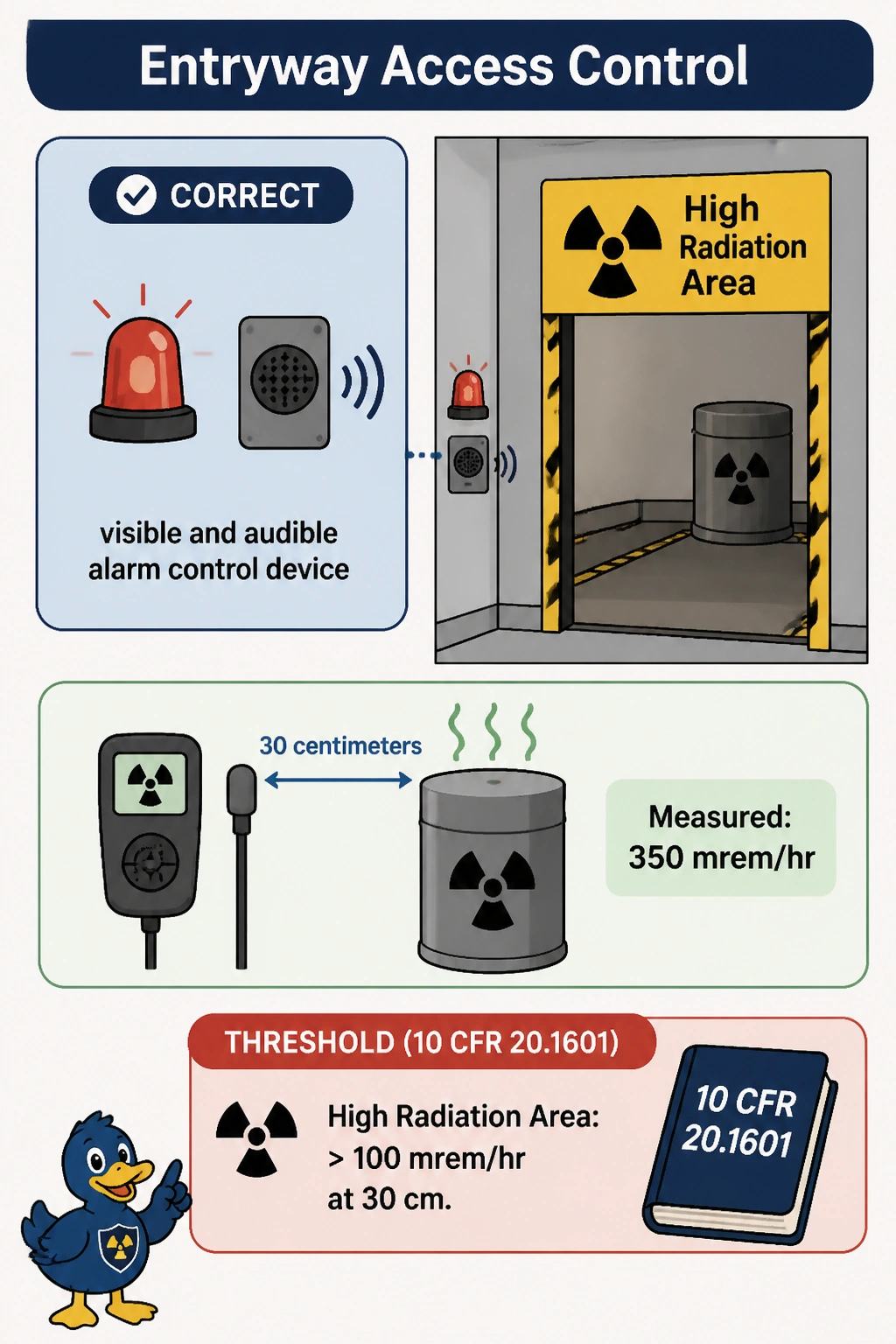
Short Explanation
You need an active alarm at an entryway that cannot stay locked, so people are alerted when someone enters the High Radiation Area. A caution sign and entry log or a passive TLD badge cannot provide that real-time access control, and protective clothing does not control external radiation.
Full Explanation
Under NRC 10 CFR 20.1601, a High Radiation Area is one where radiation levels exceed 100 mrem/hr at 30 centimeters; the stated 350 mrem/hr meets that threshold. When the door cannot remain locked and no interlock reduces the radiation level, equipping the entryway with a visible and audible alarm control device alerts the entering individual and a supervisor in real time, satisfying the access-control requirement. Posting a caution sign at the doorway and logging entry times supports warning and administrative tracking, but does not provide an active access-control alert. Providing each worker a passive TLD badge records cumulative dose after processing; it does not prevent or alert on entry. Requiring double protective coveralls and gloves addresses surface contamination, not penetrating external radiation fields. An exam caveat is that the stated dose rate must be assessed at 30 centimeters: the regulatory threshold is more than 100 mrem/hr, and the question specifies that neither a locked door nor a level-reducing interlock is available. As a practical check, test the visible and audible alarm regularly and confirm that the alert is clearly perceived at the continuously staffed control station.
Prefer to study offline? Printable PDF study book + test engine ($7.50, unofficial). These questions stay free here.