
Under 10 CFR 20.1003 and 20.1902, what dose rate threshold at 30 centimeters from a radiation source or penetrating surface requires an area to be posted as a High Radiation Area?
Select an answer to reveal the explanation.
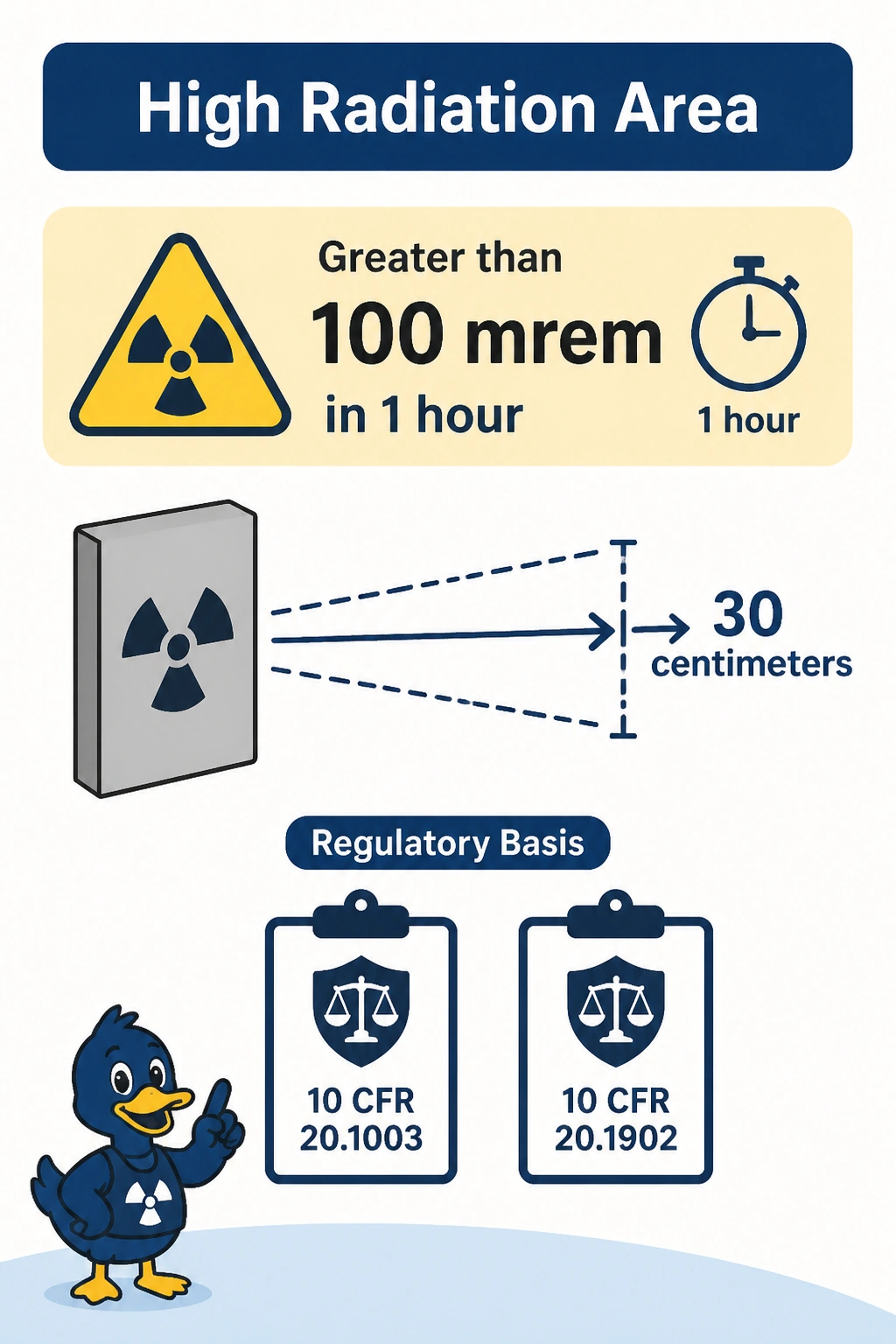
Short Explanation
You can use posting thresholds as early warnings before entering higher-risk radiological areas. Under 10 CFR 20, a dose rate greater than 100 mrem in 1 hour at 30 centimeters makes an area a High Radiation Area. Keep the 5 mrem threshold in mind as the trigger for a standard Radiation Area, not a High Radiation Area.
Full Explanation
Under 10 CFR 20.1003 and 20.1902, a licensee must post each High Radiation Area with a conspicuous sign bearing the radiation symbol and the words Caution, High Radiation Area or Danger, High Radiation Area. The defining threshold is greater than 100 mrem in 1 hour at 30 centimeters from the source or surface; this triggers posting and additional access controls under 10 CFR 20.1601. Greater than 5 mrem in 1 hour at 30 centimeters from the source or surface is the lower threshold for a standard Radiation Area under 10 CFR 20.1902, so it does not define a High Radiation Area. Greater than 50 mrem in 1 hour at 30 centimeters from the source or surface is not an NRC posting boundary. Greater than 1,000 mrem in 1 hour at 30 centimeters from the source or surface sets the trigger ten times too high, although facilities often apply extra administrative controls to areas above 1,000 mrem/hr. A regulatory caveat is that the High Radiation Area threshold is measured at 30 cm from the source or any surface the radiation penetrates, while a Very High Radiation Area is defined at 1 meter as greater than 500 rads in 1 hour. As a practical check, survey at 30 cm from accessible surfaces and verify that High Radiation Area postings and lockable or alarmed access controls are in place.
Prefer to study offline? Printable PDF study book + test engine ($7.50, unofficial). These questions stay free here.