
A calibrated ionization chamber measures an integrated photon exposure of 2.0 roentgens (R) in dry air. What is this exposure expressed in SI units of coulombs per kilogram (C/kg)?
Select an answer to reveal the explanation.
Short Explanation
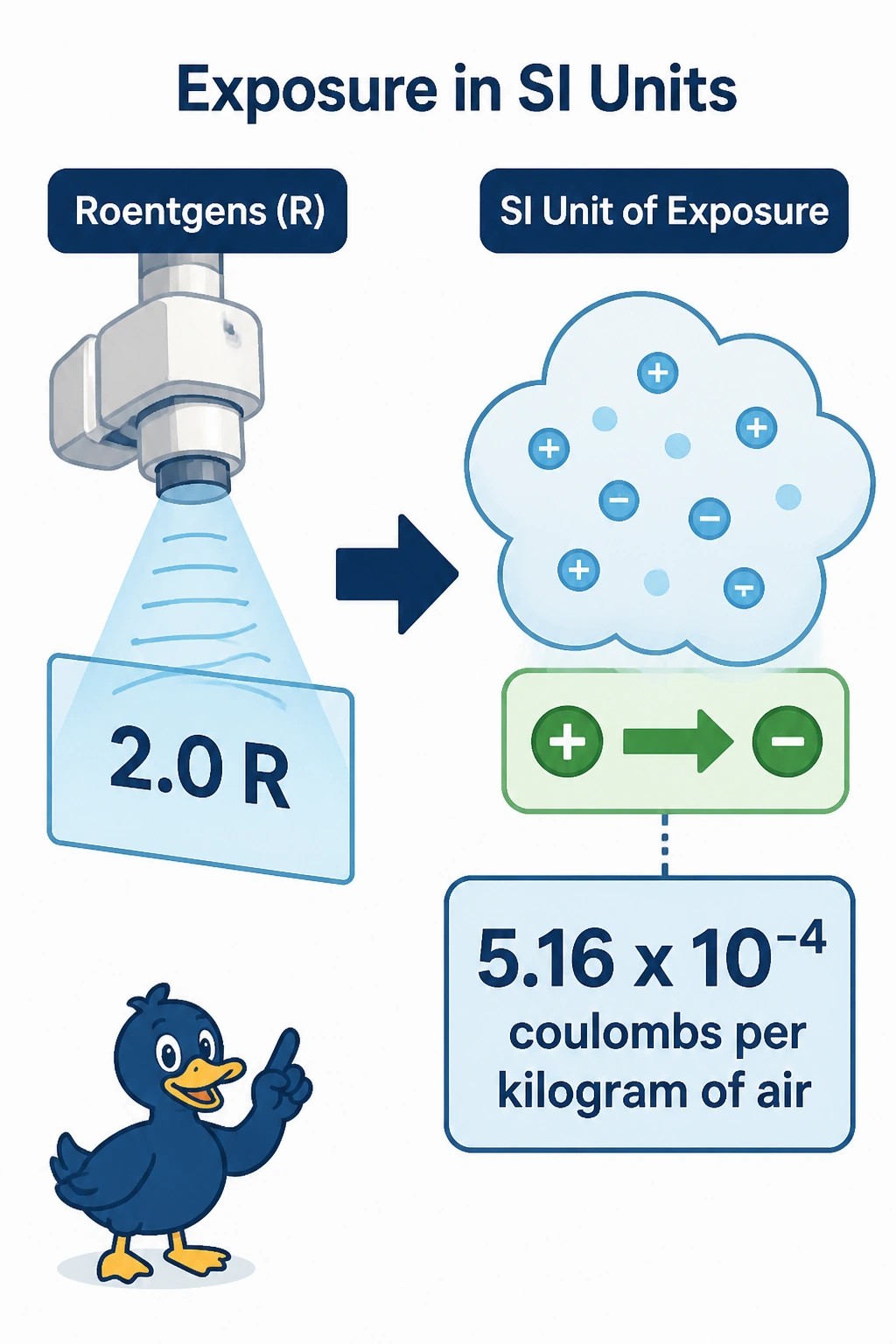
Converting roentgens to SI exposure units is straightforward once you anchor one conversion constant: 1 R equals 2.58 x 10^-4 coulombs per kilogram of dry air. You simply double that constant for 2.0 R to get 5.16 x 10^-4 C/kg. The classic exam trap is dividing by two instead of multiplying, or forgetting to scale the 1 R constant at all.
Full Explanation
Exposure quantifies the total electrical charge of one sign produced in dry air per unit mass of air by X-ray or gamma ionization. Selecting 5.16 x 10^-4 coulombs per kilogram of air is correct because 1 roentgen (R) is defined as exactly 2.58 x 10^-4 C/kg in dry air, so multiplying 2.0 R by 2.58 x 10^-4 C/(kg*R) yields 5.16 x 10^-4 C/kg. Selecting 1.29 x 10^-4 coulombs per kilogram results from dividing 2.58 x 10^-4 by 2.0 instead of multiplying, which halves the exposure rather than doubling it. Selecting 2.58 x 10^-4 coulombs per kilogram states the conversion factor for 1.0 R and forgets to multiply by the measured 2.0 R value. Selecting 7.75 x 10^-3 coulombs per kilogram inverts the conversion direction or misapplies the reciprocal factor (3,876 R per C/kg) by dividing 2.0 by 258. As an exam caveat, the roentgen and C/kg apply strictly to photon radiation (X-rays and gamma rays) in air and cannot be used for particulate radiation or directly equated to tissue absorbed dose without an f-factor conversion. As an operational check, confirm that any vented ionization chamber reading is corrected to standard temperature and pressure before converting roentgens to C/kg.
Prefer to study offline? Printable PDF study book + test engine ($7.50, unofficial). These questions stay free here.