
A radiation protection report lists a worker's annual effective dose as 0.025 sieverts (Sv). What is this dose expressed in conventional units of millirem (mrem)?
Select an answer to reveal the explanation.
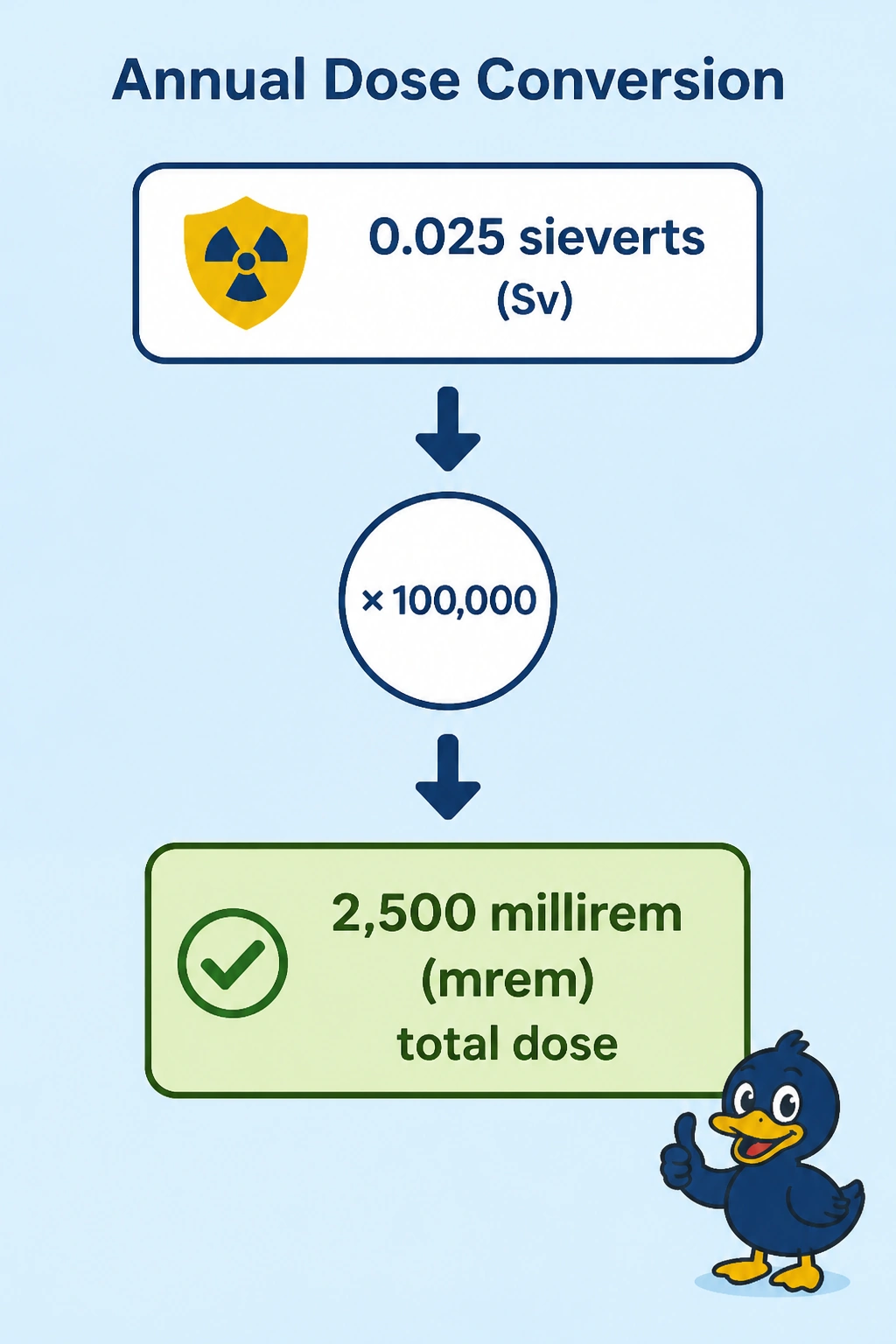
Short Explanation
Converting between SI sieverts and conventional millirem is a two-step decimal shift: first multiply sieverts by 100 to get rem, then multiply rem by 1,000 to get millirem. When you multiply 0.025 Sv by 100,000, you land on 2,500 mrem. The trap is stopping at 250 mrem or jumping to 25,000 mrem by misplacing a zero during the rem-to-millirem step.
Full Explanation
To convert an effective dose from sieverts (Sv) to millirem (mrem), apply the exact SI-to-conventional equivalence of 1 Sv equals 100 rem, combined with 1 rem equals 1,000 mrem, meaning 1 Sv equals 100,000 mrem. Multiplying 0.025 Sv by 100 rem per Sv gives 2.5 rem, and multiplying 2.5 rem by 1,000 mrem per rem yields "2,500 millirem (mrem) total dose". Selecting "250 millirem (mrem) total dose" is off by a factor of ten, usually from multiplying 0.025 by 10,000 instead of 100,000. Choosing "25 millirem (mrem) total dose" underestimates the dose by a factor of 100, which happens if you treat 1 Sv as 1,000 mrem rather than 100 rem. Picking "25,000 millirem (mrem) in all" overstates the dose by a factor of ten from adding an extra zero during conversion. As a caveat, dose conversion factors apply equally to equivalent dose and effective dose, whereas absorbed dose uses grays and rads. As an operational check, compare the converted value against the NRC annual occupational whole-body limit of 5,000 mrem (5 rem) to confirm the magnitude makes sense—2,500 mrem is half the annual limit.
Prefer to study offline? Printable PDF study book + test engine ($7.50, unofficial). These questions stay free here.